Bar with certificate
A bar with certificate is an investment bullion bar made of a precious metal accompanied by an authentication document confirming its authenticity, weight and fineness. The certificate (together with the markings on the bar) makes trading easier, helps verify origin and increases confidence in both buy-back and resale.
Trade in precious metals has a long tradition, but the way their quality has been verified has changed significantly over time. In the past, the value of metal was often demonstrated by weighing, fineness tests and trust in the mark of the processor or in the authority guaranteeing the metal. With coins this role was filled by the ruler or the state through the mintage system; with bars, trust was tied to the reputation of the refinery, to hallmarks and to the trading practice of the day.
With the development of the modern investment market, bars became a standardised product with clearly defined parameters intended for a broad range of investors. It is precisely here that documentation began to play an increasingly important role. Whereas with large "good delivery" bars in banking practice the emphasis is placed on market standards and the reputation of the refinery, with smaller investment bars for private individuals the idea of an accompanying certificate gradually took hold. This was meant to simplify verification and reduce uncertainty during resale, especially for bars that often change owners outside the institutional environment.
The certificate also became important because of the globalisation of the market. Investment gold and silver began to be routinely purchased through specialised dealers, abroad and online, and customers expected a uniform and easily comprehensible confirmation of parameters. The authentication document therefore complemented the traditional markings on the bar (hallmark, fineness, weight, manufacturer, sometimes a serial number) with a "paper" document that can be archived and presented at buy-back.
History
In recent decades the concept of certification has shifted even further. A number of refineries offer bars in sealed packaging in which the certificate forms part of the packaging (often in the form of a card). This combines two things: a declaration of parameters together with protection against tampering. It can thus be easier to demonstrate that the bar has not been altered after manufacture, which is essential in the precious-metals market, since even a minor disturbance of the surface or weight can raise doubts.
A bar with certificate can usually be recognised by the fact that in addition to the bar itself you also receive a document (or card) with the product details. The certificate as standard states the weight, fineness, type of metal and manufacturer identification; a serial number is often added, which tends to be struck on the bar as well. With some products the certificate is directly linked to a protective packaging: the bar is sealed and any opening leaves visible traces. This can be practical for resale, because the dealer can more quickly assess that it is a commonly traded investment product.
It is important to distinguish between the certificate and the "hallmark". The hallmark (on items where it is used) is the official or manufacturer's marking directly on the metal, whereas the certificate is an accompanying document. With investment bars the key is typically the combination of both: clear markings on the bar and trustworthy documentation. The certificate alone, however, is not an absolute guarantee — what is decisive is the reputation of the manufacturer, the verification of parameters and the possibility of cross-checking, for instance by matching the serial number or by the buyer's testing methods.
Certificate, markings and practical use
In practice the certificate helps with the recording of assets (for instance for one's own overview), with resale and sometimes with insurance or inheritance matters, as it makes the description and identification of a specific piece easier. At the same time, a bar tends to retain the highest value when the original packaging is preserved, the markings are legible and proof of origin is available. With some types of bars it is moreover important that the packaging remains undamaged — not because of any "magic" of the plastic, but because the market accepts such pieces more readily and without unnecessary doubts.
In our auction and shop
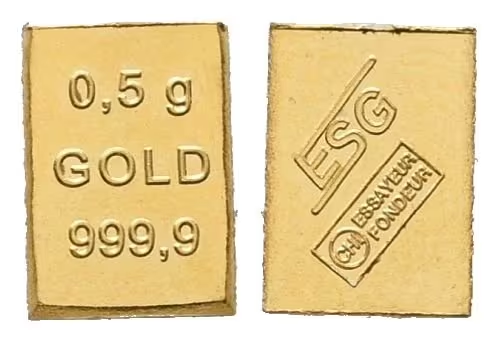
- Code: Z2-0005
Investiční slitek, 999.9/1000 (0,5 g)
Investiční slitek, 999.9/1000, 8 mm x 5 mm (0,5 g), švýcarský výrobce ESSAYEUR FONDEUR
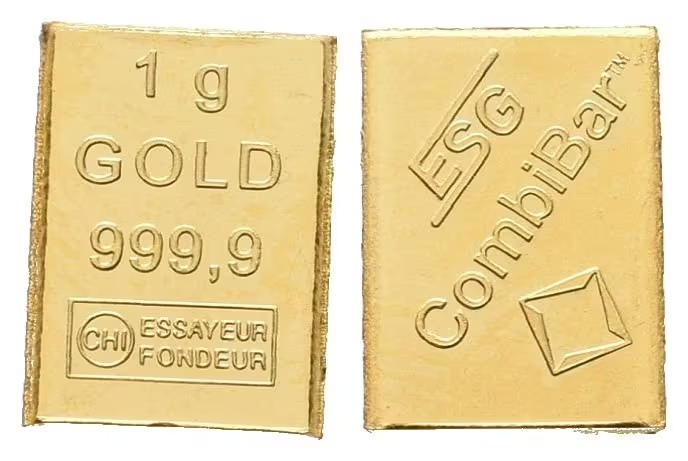
- Code: Z2-001
Investiční slitek, 999.9/1000 (1 g)
Investiční slitek, 999.9/1000, 11 mm x 8 mm (1 g), švýcarský výrobce ESSAYEUR FONDEUR