Stockholm
Stockholm is the capital of Sweden, spread across a system of islands and peninsulas at the outflow of Lake Mälaren into the Baltic Sea. Thanks to its position on the waterways, it became the centre of trade and administration of the country, and today it is also an important cultural and scientific centre of northern Europe.
Stockholm is indeed a modern metropolis, but its roots reach into the high Middle Ages. The city is traditionally associated with the name of Birger Jarl and appears in the sources from the mid-13th century; the year 1252 is often given as its founding. The location was crucial: the place controlled access from the Baltic Sea to Lake Mälaren, that is, to an important inland waterway. This gave Stockholm an advantage in both trade and defence - whoever controlled the straits and bridges also controlled the flow of goods, customs duties and the movement of people.
In the Middle Ages, Stockholm gradually developed into the administrative and commercial hub of Sweden. The core of today's Gamla Stan emerged, where power and crafts were concentrated. The city grew rich on the exchange of raw materials and products within the Baltic area and at the same time became the scene of political clashes typical of the European north. Swedish history was long determined by tensions between the domestic nobility, royal power and the ambitions of neighbouring states, especially in the era of the Kalmar Union. Stockholm was therefore not only a market place but also a strategic fortress and a symbol of statehood.
The modern period brought Stockholm further growth and transformations. The city became a stable administrative centre and gradually also a cultural centre that concentrated the institutions of the kingdom. Fires and rebuilding changed the form of the urban fabric, while the development of maritime and inland trade strengthened the economic significance of the port. In the 19th century industrialisation reached Stockholm: infrastructure expanded, new districts were added and the city began to be more connected with its surroundings. During the 20th century the metropolis grew outwards and a modern conurbation emerged with transport systems that had to cope with rugged terrain and water surfaces.
History
One of the long-defining features of Stockholm is precisely its water geography. The city spreads across a number of islands connected by bridges and embankments, and to this day combines the historical centre with modern administrative and residential zones. Alongside its political function (seat of the government, parliament and key institutions), Stockholm also became a symbol of the Swedish emphasis on public space, culture and education. This is reflected in the dense network of museums, galleries and universities and also in the long-standing ability of the city to attract residents and businesses from various parts of the world.
Stockholm is easily readable for the visitor thanks to the contrast between the medieval Gamla Stan and the younger districts that emerged from the 19th century onwards. Orientation is determined by water: embankments, straits and bridges naturally guide movement through the city and create typical views of the islands and historical landmarks. In practice, this means that Stockholm is walked along the edge of water - and many places still function as hubs where transport, administration and tourist traffic meet.
From the perspective of coinage and the history of money, it is interesting that Stockholm was long one of the key points of Swedish minting. In the historical centre, this tradition is also recalled by topography, for example by names associated with the mint and mint administration. The minting of Swedish coins was for centuries part of the state infrastructure in Stockholm, and in the modern period mint operations were gradually relocated and modernised to meet the technical demands of the time. The city's institutional memory builds on this layer: in Stockholm there are numismatic collections and museums devoted to the history of money, medals and the economy, helping to understand coins as a historical source, not just as a piece of metal.
The city, institutions and numismatic connections
In practice, Stockholm is also a good example of how the significance of a capital city is imprinted in the visual culture of a state. Motifs associated with the metropolis appear on medals, commemorative strikes and in the symbolism of institutions, because the capital naturally represents statehood and continuity. Whether one perceives Stockholm as a port, a political centre or a cultural city, one will always find traces of economic history in it - from trading houses and stock exchange institutions to museum and archival work with old coins and hoards.
In our auction and shop
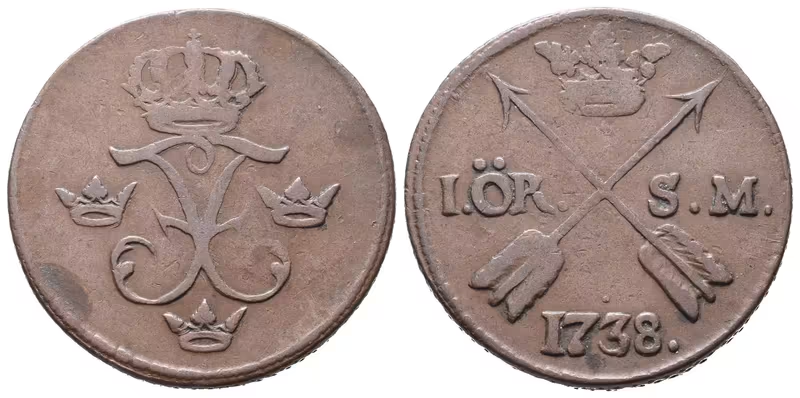
- Code: SSVED87-G1738
Švédsko, 1 Öre SM 1738
Švédsko, Frederik I., 1720 - 1751 1 Öre Silvermynt 1738, Stockholm, KM.416, patina, oběh
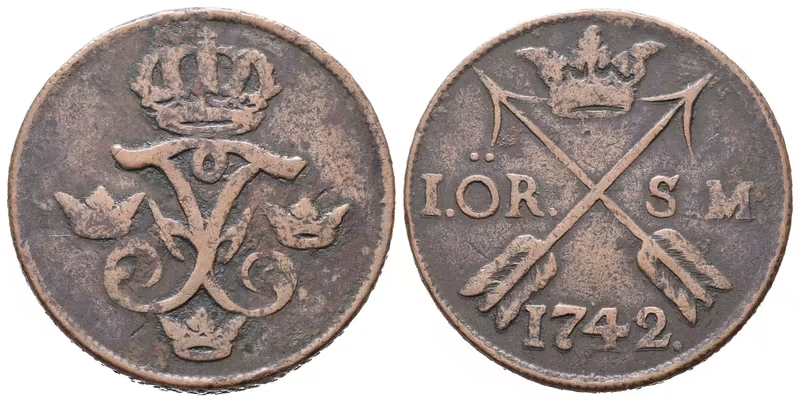
Skladem 1 ks - Code: SSVED87-G1742
Švédsko, 1 Öre SM 1742
Švédsko, Frederik I., 1720 - 1751 1 Öre Silvermynt 1742, Stockholm, KM.416, patina, oběh
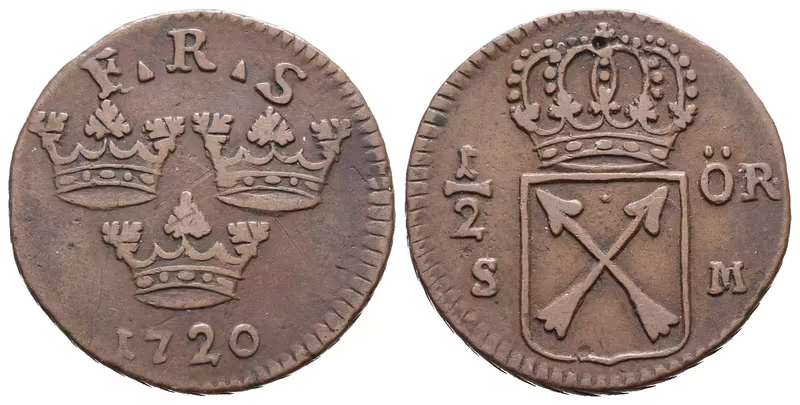
Skladem 1 ks - Code: SSVED87-H1720
Švédsko, 1/2 Öre SM 1720
Švédsko, Frederik I., 1720 - 1751 1/2 Öre Silvermynt 1720, Stockholm, KM.380, patina
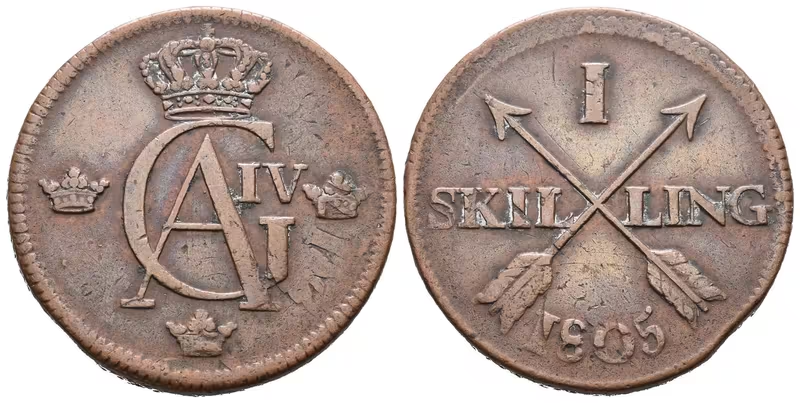
Skladem 1 ks - Code: SSVED90-C1805
Švédsko, 1 Šilink 1805
Švédsko, Gustav IV. Adolf, 1792 - 1809 1 Skilling 1805, Stockholm, KM.566, pěkná zach. a patina, zbytky lesku, přeražba na starším skillingu, viditelné pozůstatky na Av, i Rv._R!
Skladem 1 ks