Taras
Taras was an ancient Greek city in southern Italy, founded by Spartan colonists in the 8th century BC on the site of today's Taranto. It belonged among the most important cities of so-called Magna Graecia and became famous for its artistically refined coins with motifs of Taras, the mythical founder of the city.
The city of Taras was founded around 706 BC by Spartan colonists led by the legendary Phalanthus. According to ancient sources these colonists were descendants of Spartan women and helots, born during the long wars of the 8th century. The city quickly prospered thanks to its strategic position on the coast of the Gulf of Taranto and became one of the richest and most powerful centres of Greek colonisation in southern Italy.
In the 6th and 5th centuries BC, Taras reached the peak of its power and became the hegemon of the Italiote League, the union of Greek cities in southern Italy. The city was famed for its culture, philosophical schools and especially the Pythagorean tradition. Significant thinkers worked here, such as Archytas, mathematician and philosopher, who was also an important politician and a friend of Plato.
Taras long maintained its independence and even became a rival of Rome itself. Between 280 and 275 BC the city engaged in wars against Roman expansion and called for help from the Epirote king Pyrrhus. Despite initial successes, which entered history as "Pyrrhic victories", the city was ultimately defeated, and Taras came under Roman rule in 272 BC.
History
After its conquest by Rome the city continued to preserve its Greek culture and traditions, became an important Roman port and remained a significant centre of Greek learning in southern Italy until late antiquity.
Taras ranks among the most valued ancient mints from the perspective of both collectors and historians. The city began striking its own coins as early as the 6th century BC and created some of the most beautiful ancient coins of all. The most characteristic motif of the Tarentine coins was Taras on the dolphin — the mythical hero and founder of the city riding a dolphin that had saved him from the sea.
On the obverse of the coins, the head or full figure of a horseman most often appeared, frequently interpreted as Taras or various deities. The reverse usually depicted a dolphin, sometimes with a rider, or other maritime motifs. These motifs referred to the city's maritime tradition and to the legend of its foundation.
Coinage and numismatic features
The Tarentine coins were notable for their exceptional artistic quality and technical perfection. They were struck mainly in silver in various denominations, from obols to staters. The pinnacle of Tarentine coinage are the staters of the 4th century BC with the signatures of famous engravers such as Aristoxenos or Heraklidas, which today fetch astronomical sums at numismatic auctions.
In our auction and shop
- Code: SUKRA91-F2017
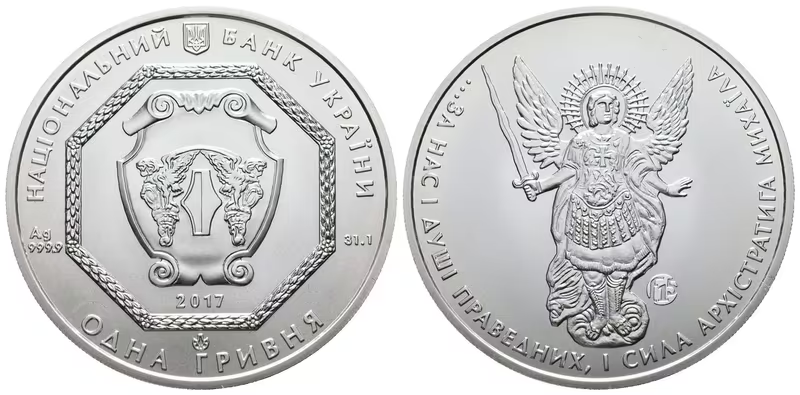
Ukrajina, 1 Grivna 2017 - Archanděl Michael
1 Grivna 2017 - Archanděl Michael, značka "f15 - Fabulous 15 ", raženo 4860 ks! Ag 0,999, 38,6 mm (31,1 g), 1 Oz Design emise byl navržen ukrajinskými výtvarníky Volodymyrem Taranem, Oleksandrem Charukem a Serhijem Charukem. Vyryt byl Romanem Čajkovským…
- Code: SUKRA91-F2014
Ukrajina, 1 Grivna 2014 - Archanděl Michael
1 Grivna 2018 - Archanděl Michael, značka "f15" Ag 0,999, 38,6 mm (31,1 g), 1 Oz Design emise z roku 2018 byl navržen ukrajinskými výtvarníky Volodymyrem Taranem, Oleksandrem Charukem a Serhijem Charukem. Vyryt byl Romanem Čajkovským a Svjatoslavem…
- Code: SUKRA91-F2018
Ukrajina, 1 Grivna 2014 - Archanděl Michael
1 Grivna 2018 - Archanděl Michael, značka "f15" Ag 0,999, 38,6 mm (31,1 g), 1 Oz, hranatá kapsle Design emise z roku 2018 byl navržen ukrajinskými výtvarníky Volodymyrem Taranem, Oleksandrem Charukem a Serhijem Charukem. Vyryt byl Romanem Čajkovským a…