Thomas Jefferson
Thomas Jefferson (1743–1826) was an American politician and thinker, the principal author of the Declaration of Independence and the third President of the United States. He was renowned for his emphasis on civil liberties, education and the agrarian republic; under his administration the United States considerably expanded its territory through the Louis…
Thomas Jefferson was born in Virginia into the family of a planter and through his education soon ranked among the most prominent intellectuals of the British colonies in North America. He studied law and began to be active in public life precisely at the time when the conflict between the colonies and the British Crown was intensifying. Jefferson was among those who understood the dispute not merely as a political one, but also as a question of natural rights and the legitimacy of government. In 1776 he was entrusted with drafting the text of the Declaration of Independence, which became the programmatic document of the American Revolution. Its language — emphasising equality, the right to liberty and the consent of the governed — significantly influenced modern political thought, although the practice of the young state often found itself in tension with these ideals.
After the War of Independence, Jefferson held a number of significant offices. In Virginia he devoted himself to reforms intended to weaken the privileges of the traditional elites and to strengthen freedom of religion and education. In the 1780s he served as a diplomat in France, where he observed European politics and the epoch-making events before the French Revolution. After his return to the USA he became the first Secretary of State in the administration of George Washington, but he soon found himself in sharp dispute over the form of the federal state. On one side stood the conception of a strong central government associated with the name of Alexander Hamilton; on the other, Jefferson's vision of a republic resting on the rights of the individual states and on a broader stratum of independent citizens. These divisions contributed to the emergence of the first political parties and shaped American political culture in the long term.
History
In 1797 Jefferson became Vice-President during the presidency of John Adams, and in 1801 he won the presidential election. His accession to office is usually described as a significant, largely peaceful political turnabout, which showed that the new state could transfer power without violence. Jefferson sought a more frugal administration, the reduction of debt and the lessening of the role of the federal government, but at the same time he had to deal with concrete international and domestic political problems. The best-known act of his presidency was the Louisiana Purchase (1803), the acquisition of an extensive territory from France, which effectively doubled the United States and opened the way to westward expansion. In foreign policy he had to contend with pressure from the European powers during the Napoleonic Wars and with the question of maritime trade; his efforts to protect American interests led, among other things, to an unpopular embargo intended to limit trade with warring Europe, but which struck the economy at home.
After leaving the presidency, Jefferson withdrew to Monticello and devoted himself to projects he considered key to the future of the republic. Education had a special significance for him: he was one of the founders of the University of Virginia and championed the idea that a free state needs informed citizens. At the same time, his legacy remains contradictory. Jefferson wrote of liberty and natural rights, yet he himself was a slave-owner, and his life and politics are today examined within the wider context of the history of slavery and inequality. This very contrast belongs among the most discussed themes in the modern interpretation of the "founding fathers".
Legacy, symbolism and numismatic context
Thomas Jefferson has been significantly reflected in the visual symbolism of the United States, including coins and medals. The best-known example is the American five-cent piece, the "Jefferson nickel", which from the 1930s has borne Jefferson's portrait, with his residence Monticello on the reverse. Over time the appearance of the coin has been adjusted several times, but the association of Jefferson with this ordinary denomination has made him one of the most recognisable faces of American circulating coinage. In addition, Jefferson has appeared on commemorative issues and memorial strikes, where the motif is usually tied to the history of the early republic, to the anniversaries of independence, or to themes of education and statehood.
From the numismatic standpoint, it is interesting to observe in "Jeffersonian" strikes how portrait and symbol are balanced on the coin: Jefferson tends to be depicted as a statesman and author of ideas, while Monticello functions as an easily legible reference to his personal and political world. In practice, with coins bearing his motifs, what is assessed in particular is the quality of the strike, the preservation of the details of the portrait, and the condition of the surface, since fine areas of relief can quickly fade on circulated pieces. For collector series it is moreover typical that differences arise also through changes of design, mint marks and year of issue, so that a single historical figure creates a "map" of the development of modern American coinage.
In our auction and shop
- Code: RX-USA-004New
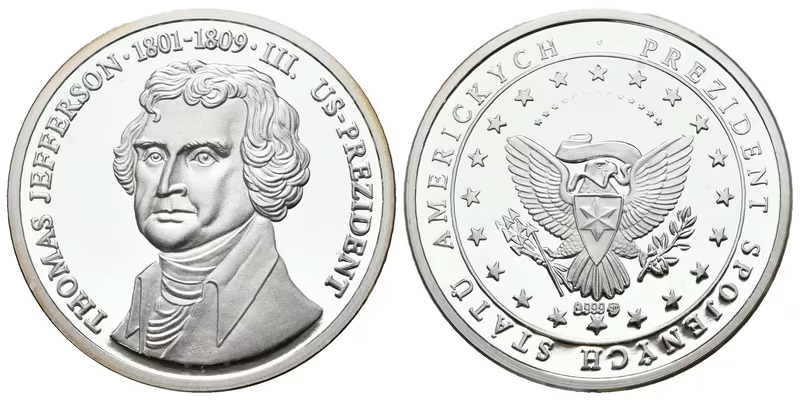
USA, medaile - Thomas Jefferson, III. prezident USA (1801-1809), portrét + státní znak USA
Soukromá ražba - série Prezidenti USA Medaile - Thomas Jefferson, III. prezident USA (1801-1809), portrét + státní znak USA Ag (.999), 30 mm (8,6 g), v kapsli. Stav mince odpovídá fotografii. Jedná se o druhotný prodej. (Možná oxidace, atd.. ! - VIZ…
Skladem 1 ks - Code: RX-USA-005New
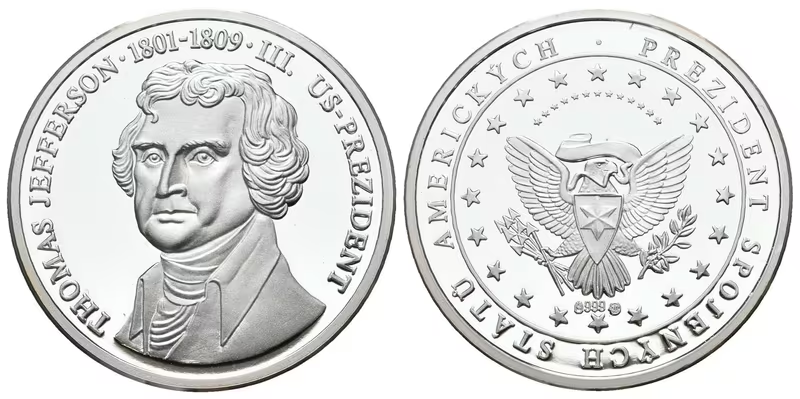
USA, medaile - Thomas Jefferson, III. prezident USA, prezidentský znak
Soukromá ražba - série Prezidenti USA Medaile - Thomas Jefferson, III. prezident USA, prezidentský znak Ag (.999), 30 mm (8,6 g), v kapsli. Stav mince odpovídá fotografii. Jedná se o druhotný prodej. (Možná oxidace, atd.. ! - VIZ FOTOGRAFIE !)
Skladem 1 ks - Code: SUSA-SP1993CP
USA, 1 Dollar 1993 - Thomas Jefferson
1 Dollar 1993 P - 250. výročí narození Thomase Jeffersona (Thomas Jefferson - 250th Birth Anniversary), KM. 249 Ag 0,900, 38,1 mm (26,73 g)
- Code: SUSA-SP1993CS
USA, 1 Dollar 1993 - Thomas Jefferson, PROOF
1 Dollar 1993 S - 250. výročí narození Thomase Jeffersona (Thomas Jefferson - 250th Birth Anniversary), KM. 249 Ag 0,900, 38,1 mm (26,73 g), PROOF