Woodrow Wilson
Woodrow Wilson was the 28th president of the United States (1913-1921), who pushed through significant economic reforms and led the USA into the First World War. He became renowned for his programme of post-war settlement and his support for the League of Nations, for which he received the Nobel Peace Prize.
Woodrow Wilson (1856-1924), real name Thomas Woodrow Wilson, was born in Virginia and originally made his name as an academic and later as president of Princeton University. He entered top-level politics relatively late: in the years 1911-1913 he was governor of New Jersey and in 1912 won the presidential election. He took office on 4 March 1913 and over two terms (until 4 March 1921) became one of the most influential figures of the American "Progressive Era".
In domestic policy Wilson's administration focused on the modernisation of the economic management of the state and the limitation of monopolies. The most significant steps included the creation of the Federal Reserve System as the foundation of modern monetary policy and banking supervision. At the same time, regulation of business was strengthened and the state became more involved in the functioning of the market in order to mitigate the most glaring imbalances of the industrialisation of the time. Alongside the reformist image, however, Wilson's period also has its shadow side: during his administration racial segregation expanded within the federal administration, and on the question of women's suffrage he was initially reserved, which provoked protests.
History
A fundamental part of Wilson's legacy is tied to foreign policy. When the First World War broke out in Europe, the United States initially remained neutral, but the situation gradually changed and in 1917 the USA entered the conflict. Wilson then formulated a programme of post-war settlement known as the Fourteen Points and became the chief face of the effort to create an international system that would in future reduce the risk of another world war. The peak of this was his participation in the Paris Peace Conference and his support for the establishment of the League of Nations. For this initiative he received the Nobel Peace Prize for the year 1919.
Wilson's post-war project, however, ran into domestic opposition. In the USA sharp disputes were waged over the ratification of the peace treaty and the entry into the League of Nations. Wilson sought to persuade the public through an extensive campaign, but in October 1919 he suffered a severe stroke that significantly limited him. At the close of his presidency a greater role was therefore played by his wife Edith Wilson, who controlled access to the president and the flow of information. Wilson formally remained in office until March 1921, but his real ability to direct policy was limited after the stroke. He died in 1924 in Washington, D.C.
Legacy and connections with banknotes and coins
Wilson's legacy is also reflected in notaphily and numismatics. The best-known is his portrait on the American banking "colossus" - the 100,000 dollar gold certificate (Series 1934). This extreme denomination was intended only for official transfers between Federal Reserve Banks and was never intended for ordinary circulation. Precisely for this reason it belongs more to the history of financial institutions and to collector specimens in museums than to standard monetary circulation.
Wilson also appears on commemorative coinage and medals commemorating the period of the First World War and post-war diplomacy. In a broader sense, for collectors he is also interesting in that his era is connected with the establishment of institutions that fundamentally influenced the modern currency and banking system of the United States, and thereby also the form of American banknotes and coins in the 20th century.
In our auction and shop
- Code: ZD-2018STO2
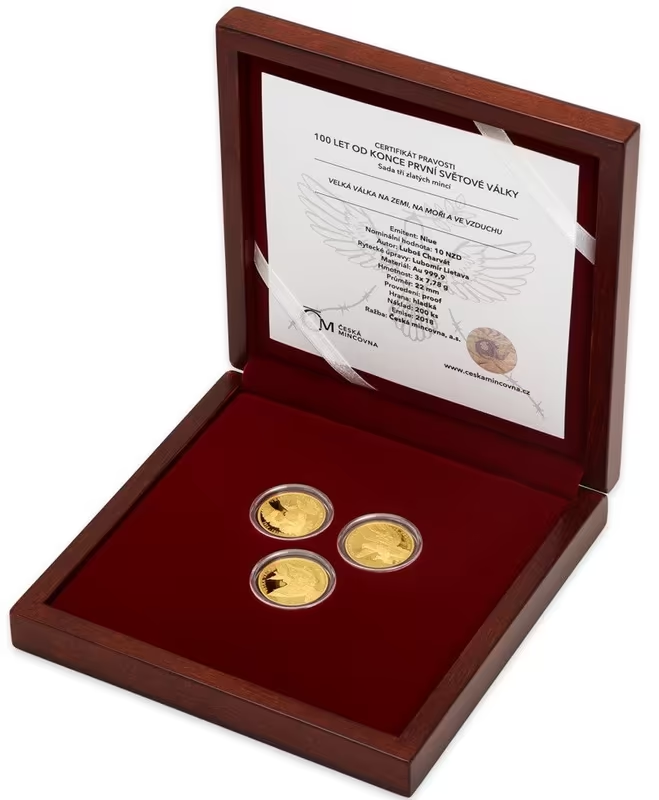
Sada mincí 2018 - 100 let od konce I. světové války
Česká republika (1993 - ) Sada tří mincí 2018 (Luboš Charvát) - 100 let od konce první světové války 3x Au 0,9999, 22 mm (7,78 g), náklad 200 ks, certifikát, etue, papírový přebal, PROOF První světová válka byla konfliktem, jaký lidstvo do té doby…
Skladem 1 ks