Gold Certificate
A gold certificate is a document confirming ownership of a certain quantity of gold, typically held at the issuer or a depositary. It can serve as an investment instrument, where the investor holds a 'paper' document instead of the physical metal, and its value is derived from the quantity and quality of gold stated in the certificate.
The gold certificate builds on a long tradition in which precious metal was placed in secure custody and a written document was used in circulation in its place. As early as the early modern period, deposit receipts and bills of exchange spread in commercial centres, allowing value to be transferred without the need to carry heavy and risky gold or silver coins. The principle was simple: the metal remained in the vault and the merchant or investor used a document which confirmed that he had a claim to the metal. The idea thus gradually arose that 'paper' could represent gold, if people trusted it and if an enforceable obligation to exchange existed.
In the 19th century and at the beginning of the 20th century the concept of the gold certificate also acquired a state dimension. In some countries banknotes or documents directly tied to gold appeared, which could be exchanged (under certain conditions) for the metal. These forms of money were connected with the operation of the gold standard, when the value of a currency was derived from a firmly defined quantity of gold. Gold certificates in this broader sense represented an effort to combine the convenience of paper money with confidence in the physical metal, because gold was perceived as a stable store of value.
In the 20th century, however, the role of gold in monetary systems was transformed. The direct convertibility of banknotes into gold was gradually limited and states moved to fiat currencies, whose value rests on confidence in the state and its institutional framework. The gold certificate was thereby transferred from the sphere of public currency rather to the sphere of investments. Instead of 'money backed by gold' it more frequently functioned as an investment product: confirmation that somewhere a specific quantity of gold exists to which the holder has a claim.
History
In modern practice gold certificates appear in various forms. They may be tied to specific bars with a serial number, or to a certain weight of gold held in a depositary. An important distinction is whether it is a certificate backed by a specific physical metal and whether the holder has a clearly defined right to delivery of the gold, or whether it is rather a financial obligation of the issuer that is settled in money. Both historically and today 'paper gold' may have various legal and practical properties – and that is precisely what is crucial for understanding the meaning of a certificate.
A gold certificate usually states the quantity of gold (for example in grams or troy ounces), the fineness and the identification of the issuer or depositary. With well-structured products it is also important to have information on where the gold is stored, whether it is separated (allocated) for a specific owner, or whether it is held jointly within a pool (unallocated). For the investor this is a fundamental difference: with allocated gold it is easier to demonstrate that the certificate corresponds to specific physical metal, whereas with unallocated gold it is more a matter of a claim against the service provider.
A practical advantage of the certificate is convenience. The holder does not have to deal with the physical storage, insurance and transport of gold, and at the same time can more easily transfer ownership if the product is set up as transferable. The disadvantage, on the other hand, is dependence on the credibility of the issuer and on the contractual terms: whether and under what circumstances it is possible actually to deliver the gold, what the fees are for custody and delivery, and how the situation is dealt with should the provider run into financial difficulties. Therefore, when assessing a certificate it is important to read the terms and to distinguish whether the buyer obtains a direct claim to specific metal or rather a financial product linked to the price of gold.
How a gold certificate works and what to watch out for
In the context of numismatics and collecting, the term gold certificate is sometimes confused with a certificate of authenticity for a coin or bar. These are two different things: a certificate of authenticity confirms the parameters of a specific piece (metal, fineness, weight, origin), whereas a gold certificate is primarily a document of an ownership claim to a certain quantity of gold, often stored outside the holder. In practice the two documents can of course meet – for example when a certificate is issued for a particular bar held in deposit – but their purpose is different.
In our auction and shop
- Code: ZD-2019MAJ
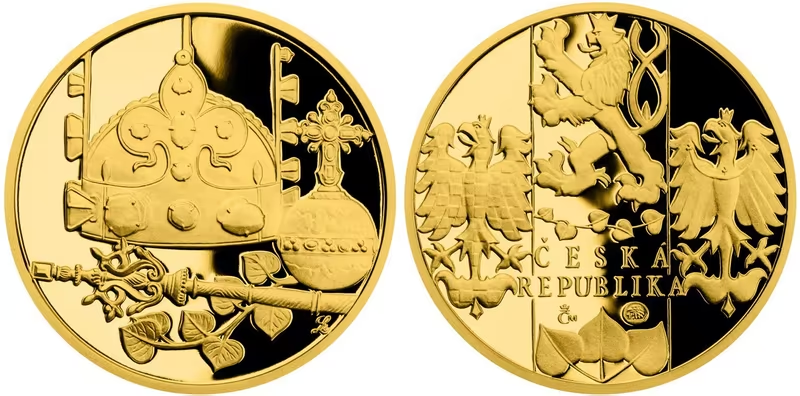
Medaile 2019 - Majestátní dukát České republiky
Česká republika (1993 - ) Medaile 2019 (Ludmila Kodytková) - Majestátní dukát České republiky se zlatým certifikátem Au 0,986, 20 mm (3,49 g), etue, zlatý certifikát Majestát může být vyjádřen vznešeností, mocí státu a jeho představitelů, tituly,…
- Code: ZD-2020VAC
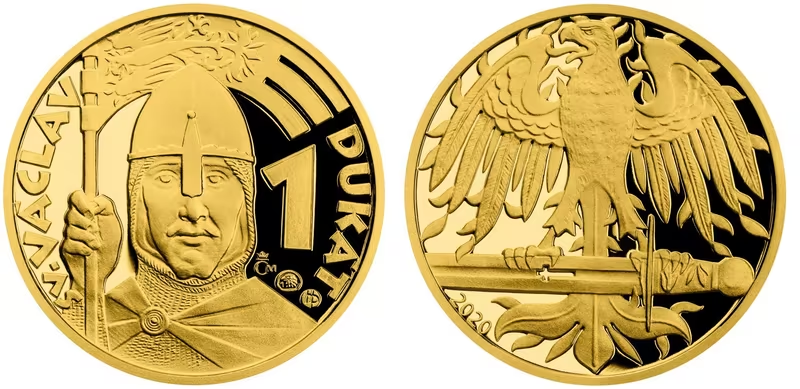
Medaile 2020 - Dukát sv. Václava
Česká republika (1993 - ) Medaile 2020 (Petr Horák) - Dukát sv. Václava se zlatým certifikátem Au 0,986, 20 mm (3,49 g), etue, zlatý a papírový certifikát Postava Svatého Václava - legendárního přemyslovského knížete a patrona českých zemí byla na…
- Code: ZD-2023VAC
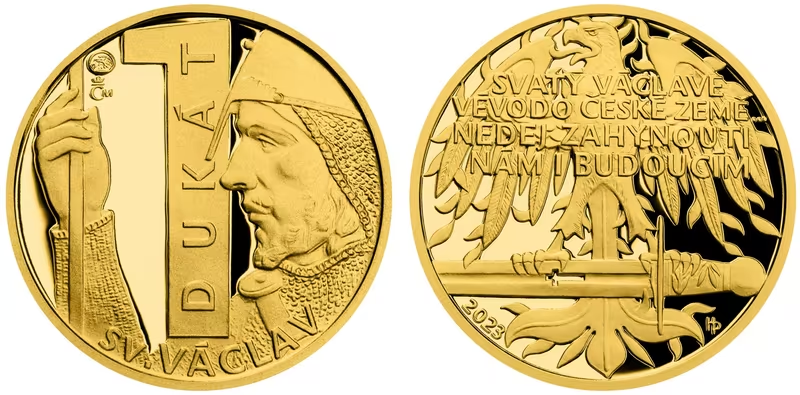
Medaile 2023 - Dukát sv. Václava
Česká republika (1993 - ) Medaile 2023 (Petr Horák) - Dukát sv. Václava se zlatým certifikátem Au 0,986, 20 mm (3,49 g), etue, zlatý a papírový certifikát Averzní strana zlatého dukátu, který je dílem medailéra Mgr. Petra Horáka, předkládá svatého…
- Code: ZD-2014SAM
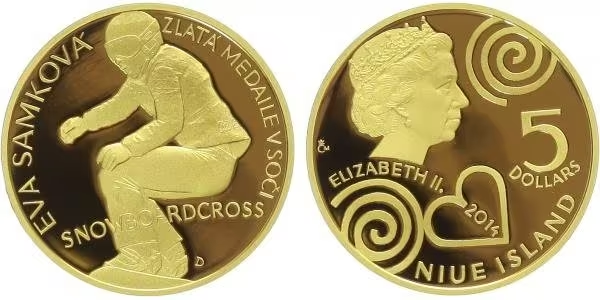
5 Dollars 2014 - Eva Samková - olympijská vítězka
Česká republika (1993 - ) 5 Dollars 2014 (Jiří Dostál) - Eva Samková - olympijská vítězka, Au 0,9999, 22 mm (7,78 g), 1/4 Oz, etue a certifikát, PROOF Zlatá mince připomíná zlatý úspěch nejrychlejší sportovkyně na ZOH v Soči