24 Kreuzer
The 24 kreuzer (twenty-four-kreuzer piece) is a silver coin introduced in the Czech lands by the estates monetary reform of 1619 as a higher kreuzer denomination for circulation in a time of political and economic uncertainty. Thanks to its distinctive motifs and clearly indicated value it belongs among the most easily recognisable coins from the period o…
The 24 kreuzer was introduced in Bohemia by the monetary reform of the estates directorate, specifically by the coinage instruction of 15 June 1619. This was a denomination intended to help stabilise and clarify circulation at a time when the state was rapidly changing and at the same time the need for well-usable silver coins for higher payments was growing. The twenty-four-kreuzer piece was struck as a relatively large coin (a diameter of around 31 mm is given) and on the obverse bore the Czech lion with the motto IN DEO FORTITVDO and with the value 24 marked. On the reverse there was usually a crown and below it the year; into the legend MONETA REGNI BOHEMIAE the mintmaster's mark was also inserted, thanks to which a number of issues can today be more precisely attributed.
In the Czech mints the 24 kreuzer was struck by the Bohemian estates in Prague in 1619 (mintmaster B. Hübmer) and in 1620 (mintmaster P. Škréta), in Kutná Hora the years 1619 and 1620 (mintmaster Š. Hölzl) and in Jáchymov the years 1619 and 1620 (mintmaster C. Lengefelder). The very range of mint locations shows that this was a denomination intended for real circulation, not merely for a one-off representative striking.
In Moravia the twenty-four-kreuzer piece had a different form and was struck only in Olomouc. Here the obverse shows the Moravian crowned eagle with the legend MONETA NOVA MARCHIO MORAVIAE (year 1619 or 1620). The reverse then bears a quadrangle entwined with grapevine with the legend VNIO TE STANTE VIREBO and the numeral 24. On the sides of the column is the mark of mintmaster K. Cantor. This Moravian variant is exceptionally rewarding for collectors, because even at the same value it offers a markedly different iconography and a clear identification of the land.
History
The short period of the reign of Frederick of the Palatinate also brought portrait twenty-four-kreuzer pieces: the ruler continued the striking of 24 kreuzer pieces with his portrait on the obverse. Strikings are cited in the mints of Prague 1620 (mintmaster P. Škréta), Kutná Hora 1620 (Š. Hölzl), Jáchymov 1620 (C. Lengefelder), further Opava 1620–1621 (K. Cantor) and Oleśnica 1620–1621 (J. Tuchmann). This group of strikings is prized also for the fact that it connects the denomination with a very specific political episode and gives the coin the 'face' of a short reign which entered history exceptionally dramatically.
At the beginning of the reign of Ferdinand II the 24 kreuzer was also struck in the period of the so-called kipper coinage, when poor-quality strikings from inferior metal entered circulation (associated with the de Witte consortium). In these issues the coins already bear the portrait of the emperor and arise in a whole range of mints: for example Prague 1623 (B. Hübmer), Kutná Hora 1622 (Š. Hölzl), Brno 1621 and 1622–1623, Wrocław 1623 and 1624, Nysa 1623, Opole 1623, Głogów 1623 and Hradec near Opava 1623 are cited. It is precisely this broad 'network' of crisis strikings that is important for numismatics: it shows how in a time of rapid inflation and monetary disruption many denominations were produced in large quantities but with variable quality, which subsequently led to interventions and an effort to restore confidence in the currency.
With the return to the 'coin of good grain' in 1623, the striking of the 24 kreuzer was not renewed. The denomination thus closes in the Czech lands as a typical coin of the crisis years 1619–1623. Later, however, it is recalled once more: lastly the 24 kreuzer was struck in our lands under the reign of Francis II, as a coin without the ruler's portrait, only with the inscription 24 KREUTZER ERBLAENDISCH. This late issue is associated with the sole year 1800 and the Prague mintmaster I. Kendler, which creates an interesting contrast: on the one hand the branching and dramatic strikings of the early 17th century, on the other the late, narrowly delimited year episode.
Appearance, variants and collector significance
The 24 kreuzer is a denomination that attracts collectors in several ways. First, it offers distinctive iconography: the Czech lion with the motto IN DEO FORTITVDO belongs to motifs that are well remembered and easily recognised, and the Olomouc variant with the Moravian eagle and the column with grapevine is in turn exceptional for its difference and for the quality of its 'signature of the land'. Second, this is a coin in which the mintmaster's mark in the legend plays a great role – it is precisely these small elements that often decide the precise attribution and the collector variant.
Very attractive too are the portrait strikings associated with Frederick of the Palatinate. Portrait coins in general attract attention, because they are more personal and enable the collector to connect a piece of silver with a specific historical figure and a brief window of time. By contrast, strikings from the period of the kipper coinage are often collector 'study material': they may be of inferior quality both in metal and execution, but it is precisely thereby that they show the crisis of the currency and the rapid change of conditions. With these pieces, in assessment it is good to follow not only state of preservation but also the overall character of the striking – surface, sharpness of details and legibility of legends.
Because this is silver circulating coinage, the state of preservation fundamentally affects the price. With the 24 kreuzer wear is often manifested on the lion, on the crown, in the motto and in the legends; with Olomouc strikings on the details of the eagle and on the fine lines of the grapevine. Careless cleaning is very visible on a larger silver coin and may reduce the value even if the year is rare. Well-preserved specimens with a natural surface and legible marks therefore belong among the most sought after.
In our auction and shop
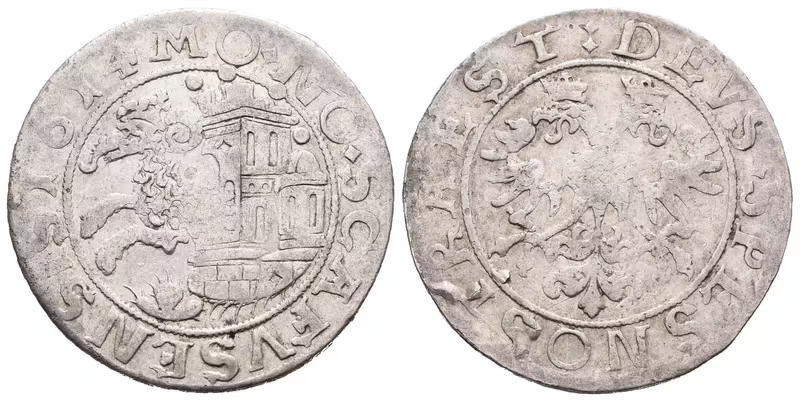
- Code: SSVY-SCHAFF1614
Švýcarsko - Schaffhausen, 24 Krejcar 1614
Švýcarsko, Schaffhausen Dicken/24 Kreuzer 1614, KM.18, pěkná zachovalost, patina, ned.
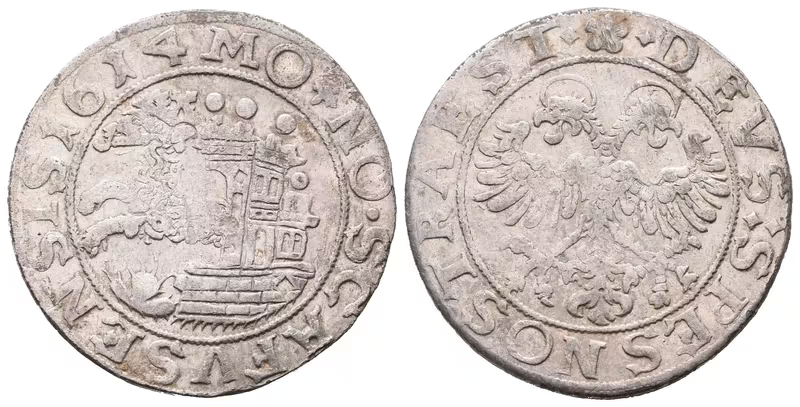
Skladem 1 ks - Code: SSVY-SCHAFF1614.1
Švýcarsko - Schaffhausen, 24 Krejcar 1614
Švýcarsko, Schaffhausen Dicken/24 Kreuzer 1614, KM.18, pěkná zachovalost, patina, ned., zbytky lesku
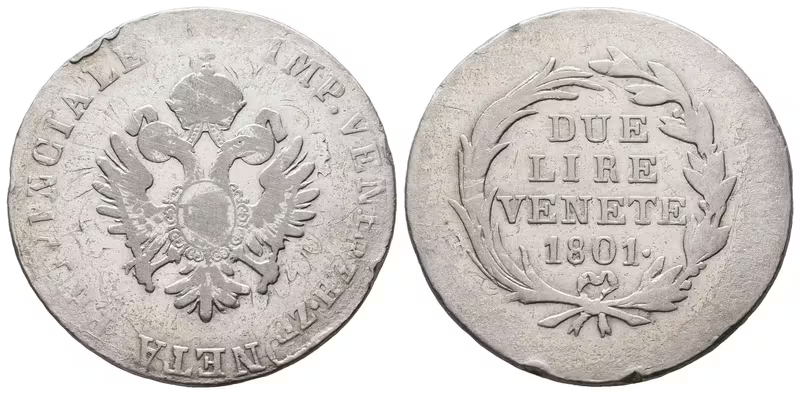
Skladem 1 ks - Code: M92110-1801A
František II., 2 Lira 1801
František II. (1792 - 1835) Due Lire Venete 1801, Ves.110, viditelná přeražba na 24 Krejcaru, oběhový stav, rysky, patina
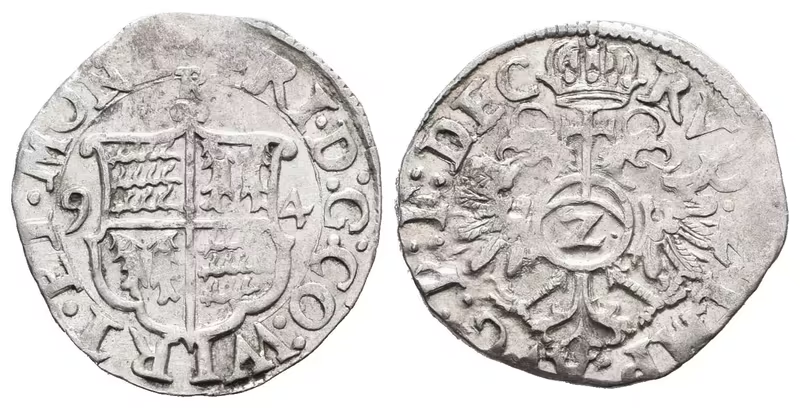
Skladem 1 ks - Code: NAWURMOM-C1594
Württemberg, 1/2 Batzen 1594
Württemberg-Mömpelgard, Friedrich, 1581 - 1608 1/2 Batzen 1594 (2 Krejcar), Klein.24, pěkná zachovalost, vzácný
Skladem 1 ks