7 Kreuzer
The 7 kreuzer (seven-kreuzer piece) is a silver coin whose value was in the Habsburg currency adjusted from the original 6 to 7 kreuzer. In the Czech lands one encounters it rather exceptionally, because it was long struck outside Prague and the Prague striking is documented only in a limited extent.
The 7 kreuzer has its origin in a coin which was under Leopold I struck as a silver denomination in a value of 6 kreuzer. A weight of 3.264 g is given, which corresponds to the fact that this was a smaller silver coin intended for more ordinary circulation. A fundamental turning point was brought by the instruction of 19 September 1695, which adjusted its value to 7 kreuzer, without a change of the denomination number on the coin – that is, it could continue to bear the mark '6', even though in accounting and circulation it was counted as seven kreuzer.
Such a solution was pragmatic in the monetary practice of the time. The change of tariff made it possible to react quickly to monetary conditions without having to change dies and artistic execution immediately. At the same time, however, it placed greater demands on the awareness of the market: anyone who did not know the current tariff might judge the coin according to the number on the obverse, while in reality it already had a different value. It is precisely this discrepancy between 'inscription' and 'validity' that makes the seven-kreuzer piece an interesting document of monetary policy, not merely another item in a series of denominations.
In the period of Maria Theresa the silver seven-kreuzer piece was struck only in Austrian mints; it was not struck in the Prague mint. This is important information for collectors, because with a number of Habsburg denominations a 'Prague trace' is automatically assumed, but with the 7 kreuzer this is not the case in this period. From the Czech point of view this is therefore a denomination which could enter local circulation rather through the broader monarchy than as a domestic striking.
History
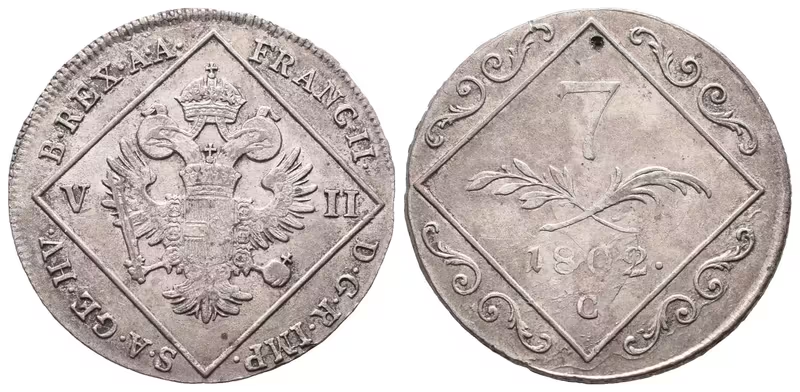
In Prague the 7 kreuzer appeared only markedly later: for the first and at the same time the last time under the reign of Francis II in the sole year 1802. For this Prague striking a weight of 4.68 g is given and as mintmaster F. Stöhr is usually mentioned. In practice this means that the Prague seven-kreuzer piece is very narrowly delimited by year and is therefore clear for collectors, but at the same time can be harder to obtain, because no long series of years arises which could be gradually 'filled in'.
The 7 kreuzer is collector-attractive mainly thanks to its unusual history. With older pieces connected with the adjustment of the tariff in 1695 it is key to understand that the coin could in fact be a seven-kreuzer piece, even though the mark of 6 kreuzer remained on it. When determining it is therefore not enough merely to 'read the number', but it is necessary to follow the ruler, the type, the period and the placement in a specific issuance logic.
With the Prague year 1802 the situation is simpler: the collector relies on the year, style and mint context. Because this is a silver circulating coin, the state of preservation markedly affects the value – smaller denominations tend to be more worn, have dents from circulation and sometimes also traces of cleaning. With the 7 kreuzer it is worth watching the sharpness of the legends and the details of the coat of arms or portrait, because these are precisely what decide the attractiveness of the piece in a collection.
How to recognise the seven-kreuzer piece and what to watch out for
Overall, the seven-kreuzer piece is a good example of how tariffs were worked with in the Habsburg currency and of how denominations were sometimes 'born' rather by an adjustment of value than as an entirely new coin. For collectors of the kreuzer period it is therefore a denomination which will give the collection not only another number, but also an interesting story of how the currency in practice adapted to reality.
In our auction and shop
- Code: M92066-1802C.1
František II., 7 Krejcar 1802 C
František II. (1792 - 1835) 7 Krejcar 1802 C, Praha, Ves.66, pěkná zachovalost, patina, zbytky lesku, rysky, viditelná přeražba
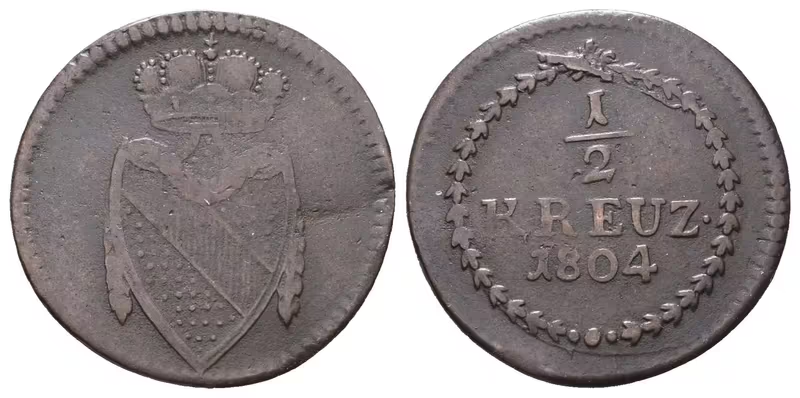
Skladem 1 ks - Code: NABAD-J1804
Baden, 1/2 Krejcar 1804
Baden, Karl Friedrich (1806 - 1811) 1/2 Kreuzer 1804, AKS.7, KM.133, patina, rysky_R!
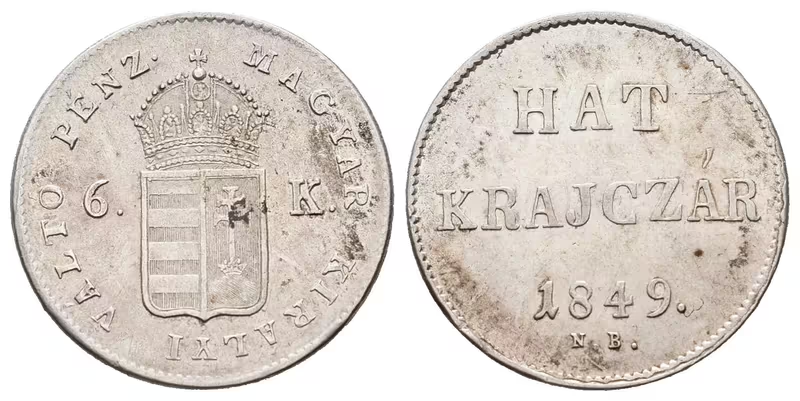
Skladem 1 ks - Code: M96007-1849
Revoluce, 6 Krejcar 1849 NB
Revoluce (1848 - 1849) 6 Krejcar 1849 NB - Velká Baňa, Ves. 7, velmi pěkná zachovalost, zbytky lesku, patina, drobné rysky
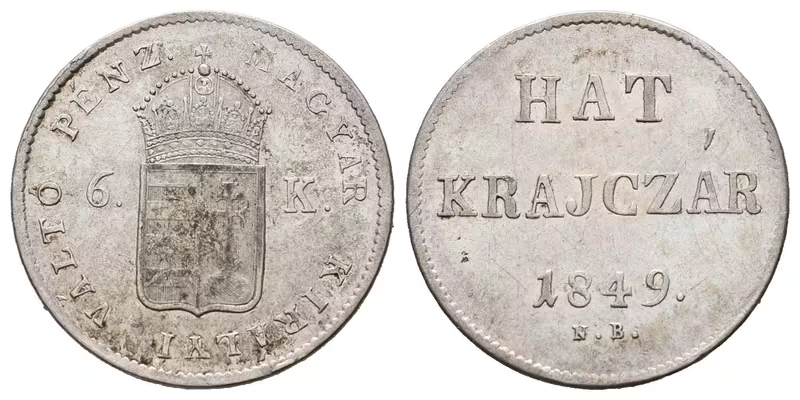
Skladem 1 ks - Code: M96007-1849.1
Revoluce, 6 Krejcar 1849 NB
Revoluce (1848 - 1849) 6 Krejcar 1849 NB - Velká Baňa, Ves. 7, velmi pěkná zachovalost, zbytky lesku, patina, drobné rysky
Skladem 1 ks