6 Kreuzer
The 6 kreuzer (six-kreuzer piece) is a silver coin which asserted itself markedly in the Czech lands from the second half of the 17th century and in various forms returned later. It belonged to the practical middle denominations and in contemporary speech it also acquired the name 'dvougros' or 'dvoučeskej'.
The 6 kreuzer was first struck in the Czech lands under the reign of Leopold I on the basis of an imperial decree of 28 March 1659. Specific parameters were set for this denomination: a weight of 3.733 g and a fineness expressed as a 'grain' of 0.438. This was a time when, after the monetary upheavals of the first half of the 17th century, greater emphasis was placed on clear denominations and controlled quality of metal, so that circulating coinage would appear credible and would be accepted without hesitation.
In Prague the six-kreuzer piece was struck in a number of years and with continuity with specific mintmasters: 1664–1665 (mintmaster K. Margalík), further 1674, 1678 and 1681–1687 (A. Janinalli), subsequently 1688–1689 and 1691–1693 (M. Waist). For understanding the contemporary terminology it is important that at that time the term 'groschen' was still often used for 3 kreuzer. Therefore with the six-kreuzer piece in Bohemia from the second half of the 17th century the name 'dvougros' (or 'dvoučeskej') took hold, that is a kind of 'two groschen' in kreuzer counting.
An interesting turning point was brought by the instruction of 19 September 1693, which adjusted the value of the six-kreuzer piece to 7 kreuzer, without changing the numerical (nominal) value on the coin. In practice this meant that people held in their hand still a 'six', but in accounting it was to be treated as seven kreuzer. Such interventions show how sensitively the state worked with the tariff of circulating coinage – and how what was written on the coin and what value it had at a given moment by decree could differ from one another.
History
Alongside the Czech mints the six-kreuzer piece was also abundantly struck in the Silesian mints, particularly in Wrocław, further in Kłodzko, Opole and Brzeg. In these mints we also encounter striking under the reign of Joseph I and Charles VI. After a pause the striking was renewed also in Prague with the years 1732–1736 and 1740 (F. Scharff) and at the same time also in Wrocław, which suggests that the denomination still had its place in circulation.
Under the reign of Maria Theresa only the Prague mint was already operating in Bohemia, and it struck the years 1743–1744 (F. Scharff) and 1746–1747 (I. Kramer). At the same time strikings with the name of her husband Francis I Stephen of Lorraine were produced with the years 1747–1748 (I. Kramer). Subsequently, however, another adjustment came: the instruction of 30 July 1748 reduced the 'grain' (that is the quality of the coin) and the further instruction of 7 November 1750 replaced the six-kreuzer piece with 7 kreuzer. Here too one can see the typical development of middle denominations – the state adjusts, merges or replaces them so that the denomination series corresponds to current needs and metal possibilities.
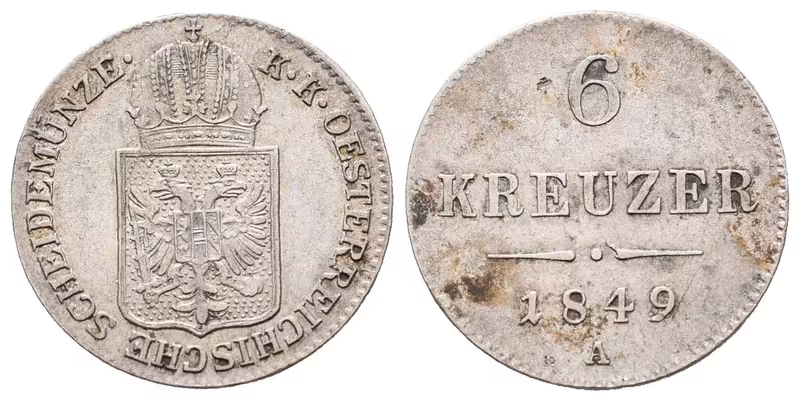
The six-kreuzer piece then returned several more times. The silver 6 kreuzer was renewed under Francis II and struck in Prague according to the instruction of 20 April 1795, being cited in the sole year 1795 (mintmaster I. Kendler). Later it was replaced by a copper six-kreuzer piece according to the imperial instruction of 21 December 1799 and was struck in Prague with the year 1800 (I. Kendler) with a weight of 13.13 g. Another return to silver is connected with Ferdinand V, who renewed the silver six-kreuzer piece by a decree of 1 June 1848 (the year 1848 was struck, mintmaster F. Leitner). Under Francis Joseph I a reduction of the weight then took place (a decline from 2.23 g to 1.91 g is given) and the year 1849 (A. Franc) is recalled as the last six-kreuzer piece struck in our lands.
Parameters, recognition and collector significance
The 6 kreuzer is a denomination which attracts collectors at several levels at once. On the one hand it is a typical circulating coin which in certain periods was struck in great quantities and commonly wore out. On the other hand it has a very 'study-worthy' history: the change of tariff in 1693 without a change in the number on the coin, the rotation of mints in Bohemia and in Silesia and the repeated returns (silver → copper → silver again) make of it a good example of how flexibly the monetary system adapted to reality.
For determining, the period and mint location tend to be key. The Prague years of the 17th century are tied to the cited mintmasters and are often recognised by the style and details of the legends; Silesian strikings are in turn collected as a separate 'branch' with their own mints. With later returns (1795 silver, 1800 copper, 1848–1849 silver) it is an advantage that they are narrowly delimited by year, and therefore in a collection they stand out well as clear milestones.
In state of preservation one must reckon with the fact that this is often a coin 'from work': worn legends, dents on the edge and small grooves are common. With silver pieces a natural patina is valued, while with copper pieces it is important to watch corrosion and unprofessional interventions in the surface. If one manages to obtain a piece with sharp details and legible inscriptions, this is with the six-kreuzer piece a noticeable qualitative leap – and also the most rewarding variant for collectors.
In our auction and shop
- Code: MA011-1849A.1
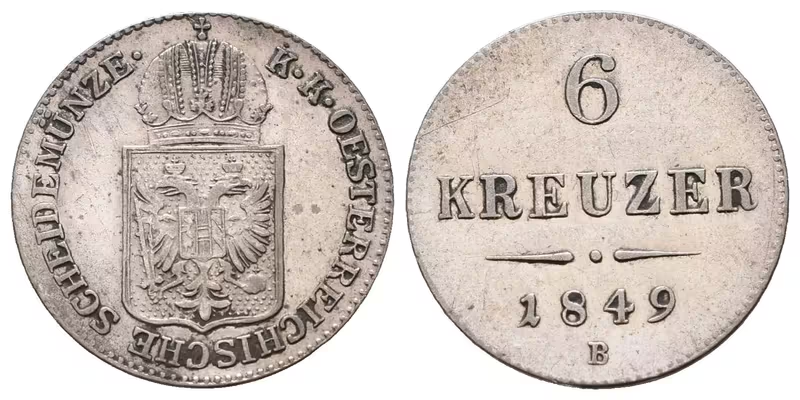
- Code: MA011-1849B
6 Krejcar 1849 B
František Josef I. (1848 - 1916) 6 Krejcar 1849 B - Kremnica, Ves. 11, patina, rysky, velmi vzácný_R!
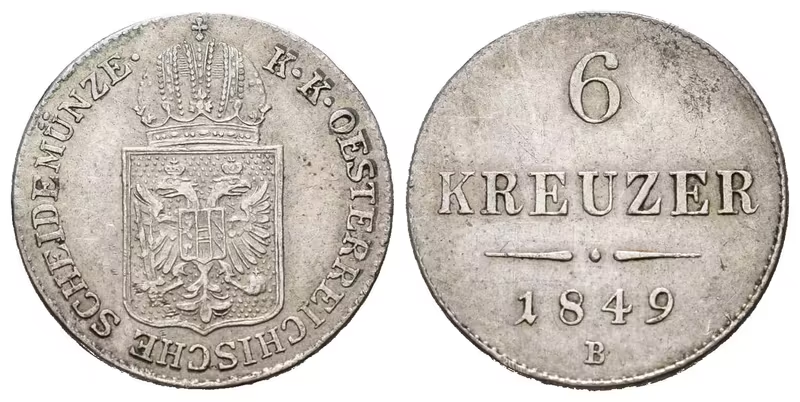
Skladem 1 ks - Code: MA011-1849B.1
6 Krejcar 1849 B
František Josef I. (1848 - 1916) 6 Krejcar 1849 B - Kremnica, Ves. 11, velmi pěkná zachovalost, patina, drobné rysky, velmi vzácný_R!
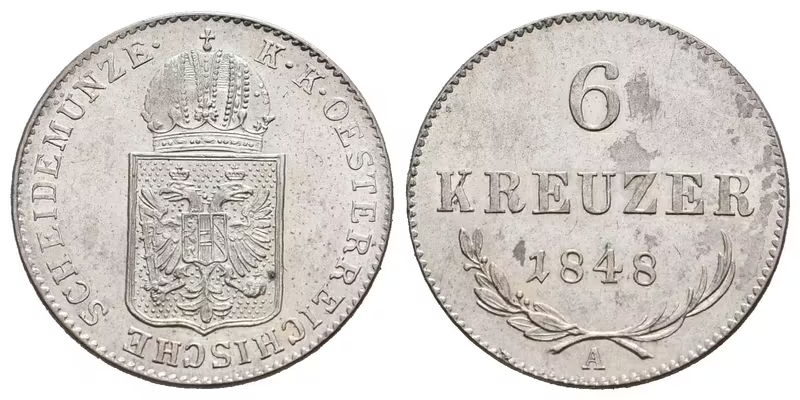
Skladem 1 ks - Code: M96001-1848A.1
Revoluce, 6 Krejcar 1848 A
Revoluce (1848 - 1849) 6 Krejcar 1848 A - Vídeň, Ves. 1, krásná zachovalost, lesk, patina, drobné rysky
Skladem 1 ks