70 Kreuzer
The 70 kreuzer is a silver denomination which appears in the Czech lands at the turn of the estates period and the early reign of the Habsburgs in the turbulent years around 1620. In practice this was a high kreuzer value tied to the thaler system, so it is often understood as a coinage expression of the half-thaler.
The 70 kreuzer is associated in our lands particularly with the crisis period of the beginning of the 17th century, when political conditions and confidence in the currency were changing rapidly. According to contemporary context and numismatic tradition, the seventy-kreuzer piece was struck under Frederick of the Palatinate (1619–1620) in Prague and Kutná Hora in 1620. These strikings reflect the short episode of the estates state, when the coin served not only for payment but also for the expression of royal legitimacy and for consolidating the image of the new rule in the eyes of the public.
After the defeat of the Estates Uprising and the consolidation of the power of Ferdinand II (1619–1637), the denomination is encountered further, this time in Kutná Hora. The years 1620 and 1621 are cited, and the seventy-kreuzer piece is interpreted as a 1/2 thaler with a weight of 14.71 g. Precisely such a 'switching' between kreuzer and thaler expression is typical of the period: people in practice counted in various units and coins often functioned as a bridge between accounting customs and real circulating coinage.
The theme of the so-called kipper coinage also reaches into the picture of the seventy-kreuzer piece. This is a period when in part of the issues the quality of metal deteriorated and the real value of silver coins rapidly changed. In such an environment importance is acquired not only by the denomination on the coin, but also by its actual parameters and the trust with which people accepted it. The seventy-kreuzer piece of 1620–1621 is therefore a good document of a time when high silver denominations could become part of broader monetary tension: they are struck, they circulate, but at the same time they are sensitive to how monetary policy and the quality of strikings are just then developing.
History
From the Czech lands' point of view it is also important that seventy-kreuzer pieces are tied to key mint centres. Prague and especially Kutná Hora belonged to the places where in decisive moments the striking of higher silver denominations was concentrated. With Kutná Hora this is connected not only with the tradition of the Italian Court but also with the organisational ability of the mint to react to the needs of circulation. High denominations such as the 70 kreuzer thus in a certain sense show how much the state at the given moment relied on 'large silver' as a bearer of value.
The 70 kreuzer belongs among strikings that attract collectors by a combination of short time span and strong historical context. If a link to a 1/2 thaler of a weight of 14.71 g is cited, this is an important orientation point in determining and assessing, because with coins from crisis years it may be precisely the weight and the overall 'feel of metal' that is an essential trace for understanding to which issuance wave the coin belongs. At the same time it must be taken into account that with strikings from a period of monetary tension differences in quality and in execution may exist.
In collector determination the mint plays a role above all (Prague versus Kutná Hora), the year and the typological form. With strikings associated with Frederick of the Palatinate there is moreover an added 'story' value: these are coins connected with a very short and dramatic period of Czech history, so they are sought after even outside a narrowly specialised collection of kreuzer denominations. With Kutná Hora strikings of 1620–1621 the collector then often also addresses whether the coin bears the marks of issues from around the kipper time, or whether it corresponds to 'more honest' parameters.
Appearance, parameters and collector context
From the point of view of state of preservation it holds that higher silver denominations have sometimes survived in better condition than small coins, because they were not as intensively 'spun' in everyday payments. On the other hand, it is precisely coins from crisis years that may often have been reckoned, tested and also withdrawn or melted down, which may reduce their survival. For the collector it is therefore important to follow the sharpness of details, the legibility of legends, the original surface and also to avoid pieces which have undergone aggressive cleaning.
In our auction and shop
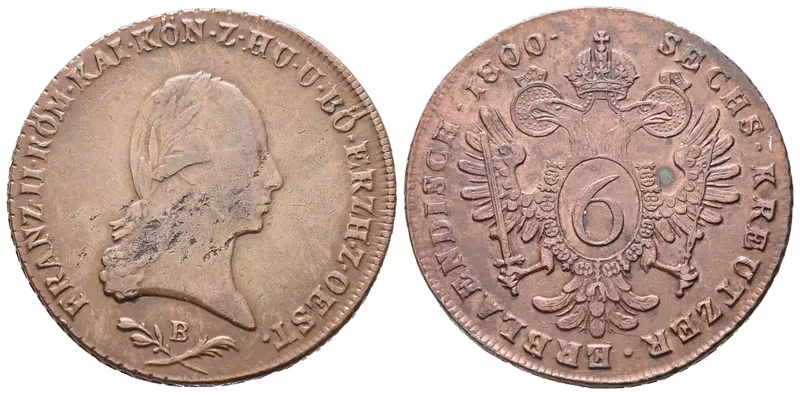
- Code: M92070-1800B.2
František II., 6 Krejcar 1800 B
František II. (1792 - 1835) 6 Krejcar 1800 B, Kremnica, Ves.70, zbytky lesku, patina, vady střížku
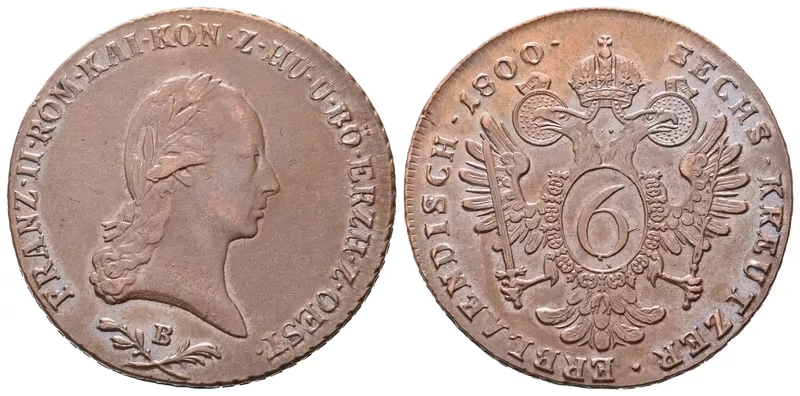
Skladem 1 ks - Code: M92070-1800B
František II., 6 Krejcar 1800 B
František II. (1792 - 1835) 6 Krejcar 1800 B, Kremnica, Ves.70, pěkná zachovalost, patina, rysky
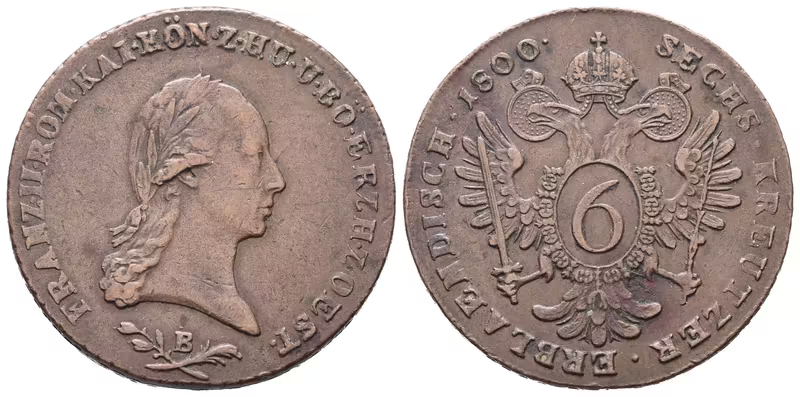
- Code: M92070-1800B.1
František II., 6 Krejcar 1800 B
František II. (1792 - 1835) 6 Krejcar 1800 B, Kremnica, Ves.70, patina, oběh
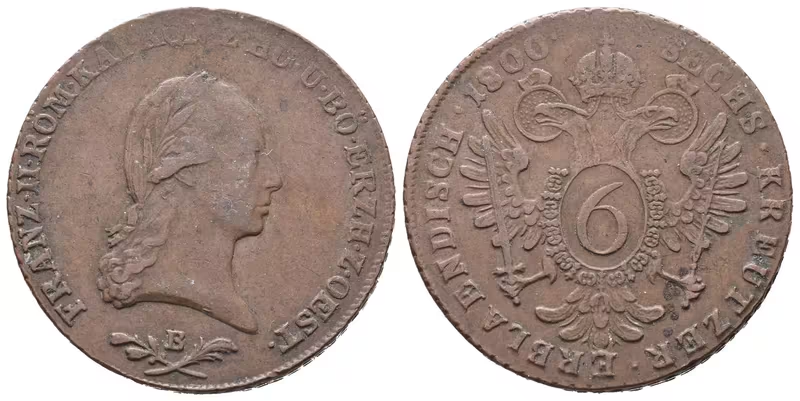
- Code: M92070-1800B.3
František II., 6 Krejcar 1800 B
František II. (1792 - 1835) 6 Krejcar 1800 B, Kremnica, Ves.70, velmi pěkná zachovalost, zbytky lesku, patina, drobné rysky