Anna Ivanovna
Anna Ivanovna was the Russian tsarina (empress) from 1730 to 1740, niece of Peter I the Great and daughter of Tsar Ivan V. Her reign is associated with the strengthening of court power, the influence of favourites and the continuation of the modernisation of the empire, which was also reflected in minting.
Anna Ivanovna was born in 1693 into the Romanov dynasty. After the death of Peter I and the short reigns of his successors, the struggle in Russia over who would head the empire and on what conditions became more acute. When the young Emperor Peter II died in 1730, a group of the highest dignitaries (the Supreme Privy Council) invited Anna to the throne and tried to limit her power with a set of conditions intended to bind the monarch. After her arrival in Moscow, however, Anna rejected these conditions and relied on part of the nobility and on the guards, thereby restoring strong autocratic rule.
Her era is described as a period of marked influence of the court circle and favourites, with Ernst Johann von Biron most often mentioned. In practice this meant that careers, contracts and political decisions were often decided not only by offices but also by court ties. At the same time, however, the professionalisation of state administration and the army continued and Russia continued to consolidate itself as a European great power. Under Anna Ivanovna the empire engaged in the great international conflicts of its time, including the War of the Polish Succession and later the war with the Ottoman Empire, which burdened finances and increased the importance of a stable foundation for tax collection and army supply.
History
The internal life of the empire was also marked by tensions between the centre and the provinces and between the traditional notions of the nobility and the demands of a modern state. The court was ostentatious and representative, but at the same time it was necessary to finance the army, administration and infrastructure development. These needs were indirectly reflected in money circulation: the state had to maintain confidence in coinage and ensure a sufficient supply of both small and larger denominations for everyday trade and for state payments. Anna Ivanovna died in 1740 and the succession after her resulted in another period of court upheavals typical of 18th-century Russia.
Anna Ivanovna is present in numismatics above all through coins struck with her name and titles and with the ruler's symbolism of the Russian Empire. On the coins one usually encounters the traditional motif of the double-headed eagle as a state emblem, while on some higher denominations the ruler's portrait also appears. It is precisely portrait strikes that are attractive to collectors, because they make it possible to date the type well and to follow the engraving style of the period.
Coins of Anna Ivanovna and their collector significance
The 18th century was also a time when Russian minting tried to standardise striking for the needs of a large empire: alongside coins intended for large payments there existed a wide range of small denominations, which were key for the everyday market. Coins from this period commonly survive in various qualities — from heavily circulated pieces to better-preserved specimens that appear more representative. Collector value is therefore substantially influenced by the legibility of the legends, the preservation of the details of the eagle or the portrait and also a natural surface without harsh cleaning.
It is also interesting for collectors that coins from the reign of Anna Ivanovna often reflect state propaganda: the titulature and symbols emphasise the continuity of the empire and the legitimacy of the ruler's power. If a collection focuses on "rulers on coins", Anna Ivanovna belongs as an important link between Petrine modernisation and the later reforms of the 18th century. In practice it pays to follow also the variants of strikes (years, small differences in drawing and legend), because these form the core of systematic collecting of this period.
In our auction and shop
- Code: RAVIT-2023ANLNew
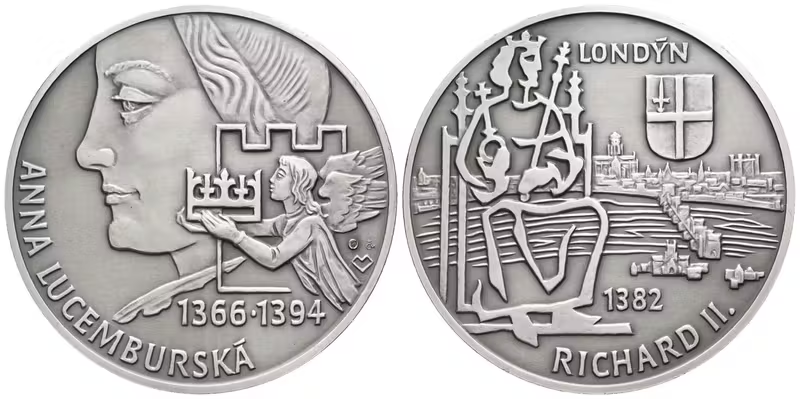
Vitanovský Michal - Anna Lucemburská
Vitanovský Michal (1946 - ) AR Medaile 2023 - Anna Lucemburská. Z edice Slavné nevěsty. Ag 0,999, 50 mm (42 g), provedení standart patina, etue, krabička, přebal, náklad 500 ks
Skladem 1 ks - Code: RAVIT-2022ANANew
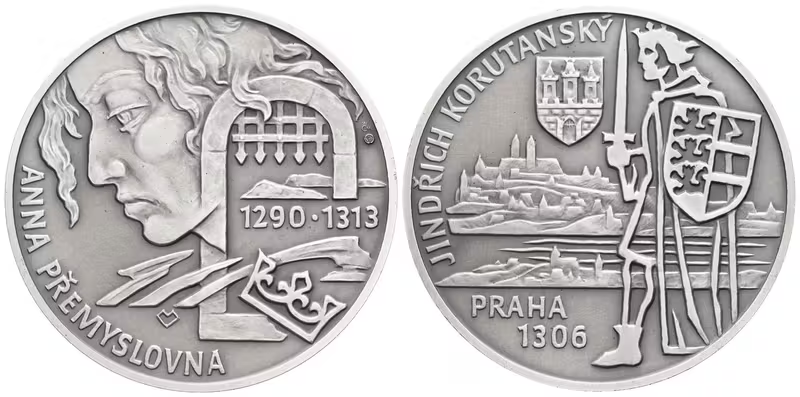
Vitanovský Michal - Anna Přemyslovna
Vitanovský Michal (1946 - ) AR Medaile 2022 - Anna Přemyslovna. Z edice Slavné nevěsty. Ag 0,999, 50 mm (42 g), provedení standart patina, etue, krabička, přebal, náklad 500 ks
Skladem 1 ks - Code: BUSZMD49
Amerika, 2/9 Dollaru 1770
Britské kolonie v Americe / Thirteen Colonies (1607 - 1776) 2/9 Dollar - Maryland, Annapolis, 1. 3. 1770, Friedberg MD.49, vzácný, přetržený, chybějící část, dobově podlepený 5/PR
Skladem 1 ks - Code: SVYS-D1835
Východoindická společnost, 1/2 Anna 1835
Britská Východoindická společnost Half Anna 1835, minc. Bombay, KM.447