Artex Mint
The Artex Mint is the designation for a private minting establishment and its output, known above all for high-quality modern strikes and replicas of historical coins and medals. In numismatics it is encountered chiefly in pieces from the second half of the 20th century, which may at first sight be very similar to original strikes.
The Artex Mint entered collector consciousness above all in connection with modern strikes that arose at a time when there was great interest in historical coins but at the same time it was not always easy to obtain original pieces in good preservation. The second half of the 20th century brought a marked growth in collecting and trading of coins and medals, and along with it the offer of restrikes, replicas and so-called after-strikes expanded. Artex in this environment established itself as a producer capable of offering technically accomplished pieces — often with very precise detail and a "clean" impression of striking.
In practice, Artex is most often associated with strikes that imitate older historical types, particularly from the central European sphere. Some pieces arose as collector replicas, others tend to be described as after-strikes or later strikes from historical patterns. This is important to distinguish: while original coins are the product of their time and monetary system, modern strikes are the result of collector demand and the technological possibilities of the 20th century. Even so, they can be interesting for numismatics, because they show how collecting developed, which types were sought after and how original motifs were treated.
Identification is a specific topic. With part of the output, distinguishing marks exist that are meant to indicate that this is not an original strike — for example small marks, different details in the legends or a different treatment of the edge. Alongside these, however, there are also pieces in which recognition is more difficult, because the similarity to the original is high and the differences may be very subtle. For this reason Artex has become a term often mentioned by collectors in connection with the need for careful comparison, work with the literature and experience with specific types.
History
In a broader view, Artex is part of the phenomenon of the "second numismatic layer" of the 20th century: alongside original coins a world of collector strikes arises that are not intended for circulation but for preservation, display and the supplementing of collections. For some collectors such pieces are an addition, for others a separate field, since they have their own variants, provenance and sometimes surprising rarity. What is always important, however, is to describe clearly that a piece is a modern strike, so as not to cause confusion in sales or in the identification of collection groups.
The Artex Mint is interesting to collectors above all because its strikes may be very high in quality and can at first sight appear "almost too neat" for their declared historical pattern. They are often characterised by sharper relief, a more even surface and the impression of newer production, which can be a clue particularly in types that have generally come down to us only in circulated condition. With some pieces, small markings or deviations in details can be observed as a distinguishing feature — typically in the script, in the shape of the marks, in the execution of the crown, eagle, or in small details of the portrait.
The edge also plays a major role. Historical coins tend to have a certain typical edge treatment (plain, milled, or lettered), and with modern strikes one sometimes encounters a variant that differs from the original. For a precise identification it is useful to compare the specific year, mint and variant with verified photographs and descriptions. With more expensive types, caution is worthwhile: pieces without clear marking may also appear on the market, and then experience, weight, diameter, style and the microdetails of the die decide.
How to recognise Artex and why it is interesting to collectors
Artex strikes can have collector value in themselves, especially in the case of sought-after types or less common variants. At the same time it holds that they are assessed differently from originals: with a modern strike, what is valued is not "historical circulation" but the quality of execution, the traceability of the variant and clear identification of origin. If a coin is correctly identified and transparently described as a modern strike, Artex can be an interesting and instructive addition for collectors, broadening the perspective on how numismatics developed in the 20th century as well.
In our auction and shop
- Code: XB-1000
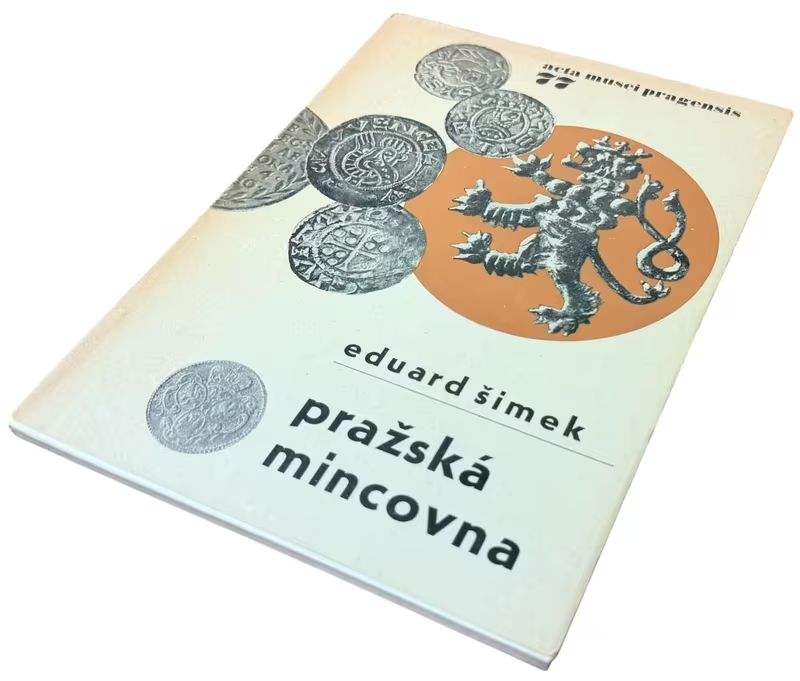
Pražská mincovna
Šimek, Eduard Pražská mincovna devět století české mince - katalog výstavy Praha 1977, 38 stran a 48 stran vyobrazení, brožované, pěkná zachovalost
Skladem 1 ks - Code: MC138-PROOF6
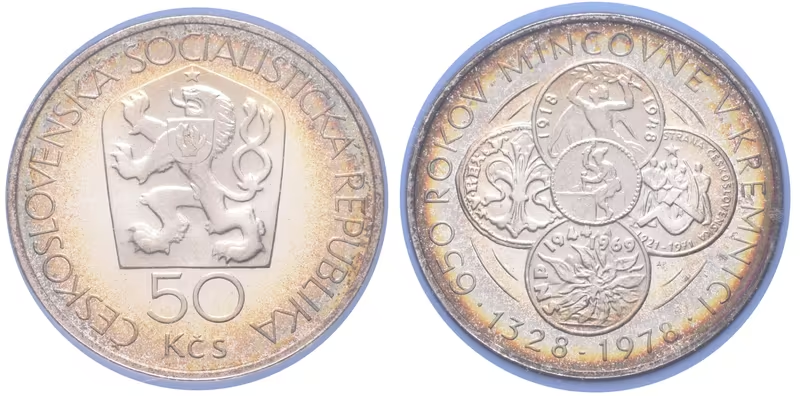
50 Kčs 1978 - Mincovna Kremnica, PROOF
Československo (1953 - 1993) 50 Koruna 1978 - 650. výročí mincovny v Kremnici, autor Andrej Peter, Aurea 138, PROOF Ag 0,700, 31 mm (13 g), raženo 70 076 ks (běžná kvalita), 2 708 ks (proof), původní plastová kapsle, patina v ploše - viz foto
Skladem 1 ks - Code: MC138-PROOF5
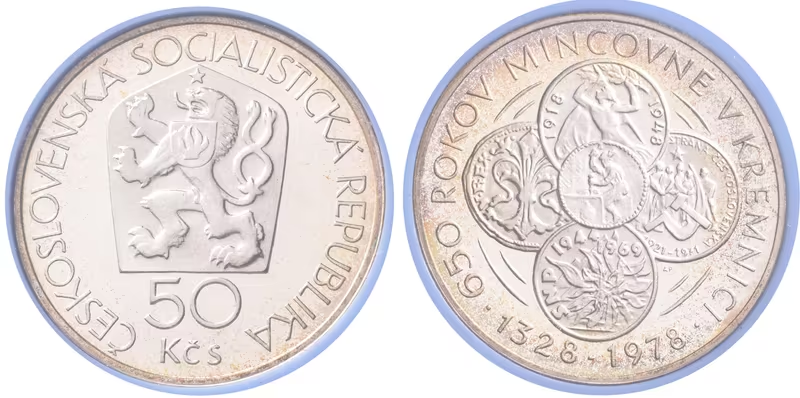
50 Kčs 1978 - Mincovna Kremnica, PROOF
Československo (1953 - 1993) 50 Koruna 1978 - 650. výročí mincovny v Kremnici, autor Andrej Peter, Aurea 138, PROOF Ag 0,700, 31 mm (13 g), raženo 70 076 ks (běžná kvalita), 2 708 ks (proof), původní plastová kapsle, patina v ploše - viz foto
Skladem 1 ks - Code: MC138-PROOF4
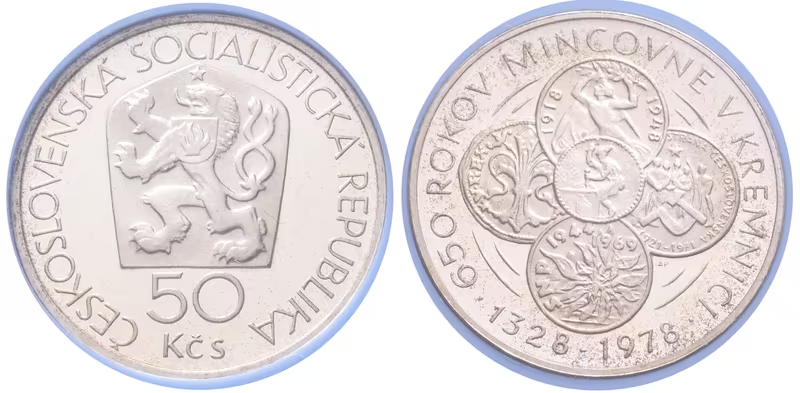
50 Kčs 1978 - Mincovna Kremnica, PROOF
Československo (1953 - 1993) 50 Koruna 1978 - 650. výročí mincovny v Kremnici, autor Andrej Peter, Aurea 138, PROOF Ag 0,700, 31 mm (13 g), raženo 70 076 ks (běžná kvalita), 2 708 ks (proof), původní plastová kapsle, patina v ploše - viz foto
Skladem 1 ks