Beatrix of the Netherlands
Beatrix of the Netherlands was Queen of the Netherlands (1980–2013), whose portrait became the obverse motif of Dutch circulating coins and of the first Dutch euro coins. In numismatics you encounter her chiefly on coins of the gulden currency and on euros of the years 1999–2013.
Beatrix succeeded to the Dutch throne after the abdication of her mother Juliana and reigned at a time when Europe was changing rapidly both politically and economically. For the monetary history of the Netherlands her era was a turning point in that it included both the last decades of the national currency, the gulden, and the transition to the euro. The appearance of coins always remains a prominent element of state identity: even when economic circumstances change, coins bear a stable "issuer's mark" in the form of the ruler or a state symbol.
In the gulden period Beatrix appeared on regular circulating denominations that continued the long tradition of Dutch coinage. The ruler's portrait on the obverse fulfilled a double function here: it was easily recognisable to the public and at the same time confirmed that the coin was issued by the state. In cataloguing practice, therefore, Dutch coins are often sorted according to "reigning periods"; Beatrix forms one of the main chapters of the modern Dutch series.
History
The next fundamental stage was the arrival of the euro. The Netherlands was among the countries that began to strike euro coins dated 1999, that is, even before their introduction into cash circulation in 2002. On the national side of Dutch euro coins from 1999 to 2013 there appeared a portrait of Queen Beatrix, surrounded by the twelve stars of the European Union and supplemented by a Dutch legend with her title. In 2013 Beatrix abdicated, and since 2014 a new sovereign has appeared on Dutch euro coins, so the period bearing her portrait has a clearly delimited chronological frame.
Beatrix does not appear on coins only as a "head of state" but also as part of state continuity: from the national currency to the euro, from the traditional portrait to the modern rules of the common European currency. Precisely for this reason Dutch coins with her portrait are useful in describing monetary history: they show how the monetary system changes while the national identification on the coin remains legible.
The portrait on coins, inscriptions and distinguishing marks
On Dutch circulating coins Beatrix is depicted as a profile portrait with a fairly restrained artistic conception. On euro coins of 1999–2013 the portrait is supplemented by the twelve stars of the EU and a legend of the type BEATRIX KONINGIN DER NEDERLANDEN together with the year. The distinguishing mark is therefore a combination of portrait, language of legend and year, which makes it possible quickly to distinguish the Dutch national side from the common European reverse.
For technical description, the denomination, metal composition, weight, diameter and type of edge (smooth, milled or with an inscription) are given; on modern coins these parameters are standardised and serve also for machine recognition in circulation. With gulden denominations and commemorative issues, it is also tracked whether it is an ordinary circulating strike or a special type with a different legend and motif. Within the euro coins the interval 1999–2013 is important: in it Beatrix appears consistently on the national side, while from 2014 the national motif is connected with the accession of a new sovereign. These features, portrait, legend, year and standard parameters, form the basis for unambiguous identification of the coin.
In our auction and shop
- Code: SNIZ96-C1990
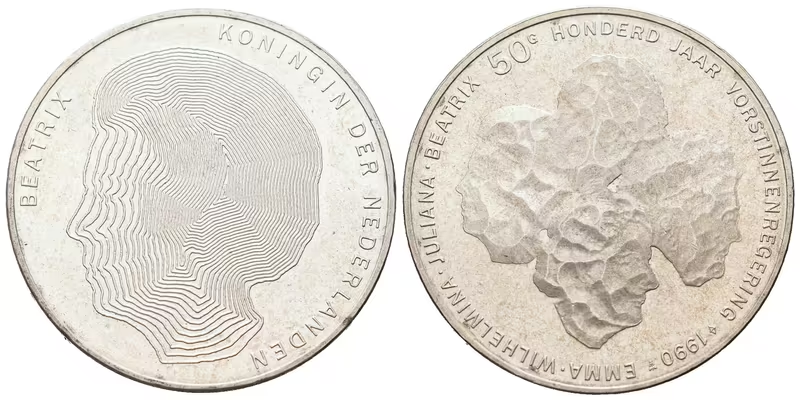
Nizozemí, 50 Gulden 1990 - Nizozemské královny
Nizozemsko, Beatrix (1980-2013) 50 Gulden 1990 - Nizozemské královny, KM# 214 Ag (.925), 38 mm (25 g), v kapsli. Mincovna: Královská holandská mincovna - Utrecht. Hrana s nápisem "★ GOD ★ ZIJ ★ MET ★ ONS". Autor: Peter Struycken. Stříbrná pamětní…
Skladem 1 ks - Code: SNIZ96-E1995
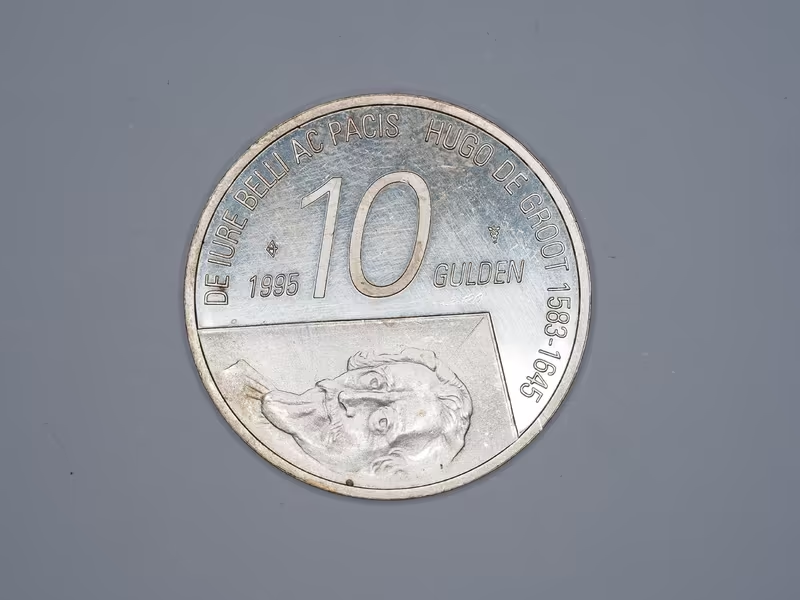
Nizozemí, 10 Gulden 1995 - Hugo de Groot
Nizozemsko, Beatrix (1980-2013) 10 Gulden 1995 - Hugo de Groot, KM# 220 Ag (.800), 33 mm (15 g). Mincovna: Královská holandská mincovna - Utrecht. Hrana s nápisem "★ GOD ★ ZIJ ★ MET ★ ONS". Stříbrná pamětní oběžná mince - vydaná k 350. výročí úmrtí…
- Code: SNIZ96-D1997
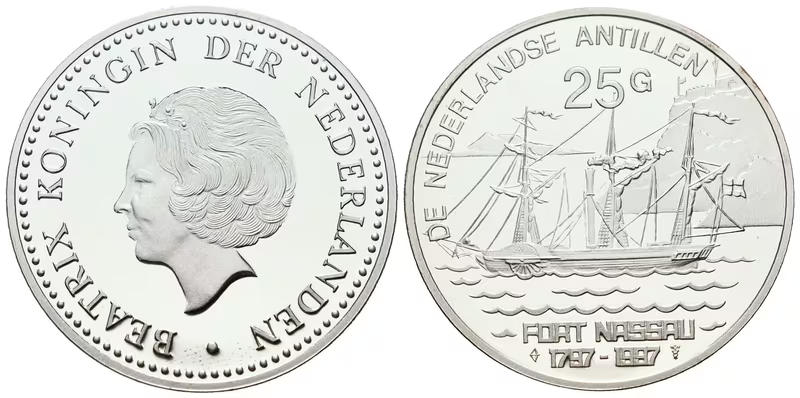
Nizozemí, 25 Gulden 1997 - Fort Nassau
Nizozemsko, Beatrix (1980-2013) 25 Gulden 1997 - Fort Nassau, KM# 42 Ag (.925), 38 mm (25 g), proof, v kapsli, luxusní stav. Emise: 1 000 ks. Mincovna: Královská holandská mincovna - Utrecht. Hrana: hladká. Autor: J. C. Hekman. Stříbrná pamětní neoběžná…
- Code: SNIZ95-C1982
Nizozemí, 50 Gulden 1982
Nizozemí, Beatrix (1980 - 2013) 50 Gulden 1982 - Americko-Holandské přátelství, KM.207, krásná zachovalost Ag 0,925 38 mm (25 g)