Bhutan
Bhutan is a Himalayan kingdom in South Asia, known for its emphasis on the protection of nature and cultural continuity. In numismatics it appears mainly through modern coins and banknotes of the ngultrum currency, which bear Buddhist symbolism and state motifs.
Bhutan historically developed as a mountainous state with relatively isolated valley regions, where culture and administration were formed under the strong influence of Tibetan Buddhism. Monetary circulation in such an environment long bore regional features: barter trade and the use of coins coming from surrounding areas played a significant role. With the growth of modern state administration, however, the need arose for a unified currency that would enable the collection of fees, the functioning of the market and the management of public expenditure.
Modern Bhutanese currency is linked with state institutionalisation in the 20th century and with the gradual development of financial institutions. The emergence of a national currency is not merely a technical matter: it requires issuance, control of circulation, protection against counterfeiting and the ability to maintain public trust. For Bhutan it was also important that its economic ties bind closely to the surrounding region, and so monetary practice is traditionally closely interwoven with the Indian environment, including how banknotes and coins are used in everyday payments.
History
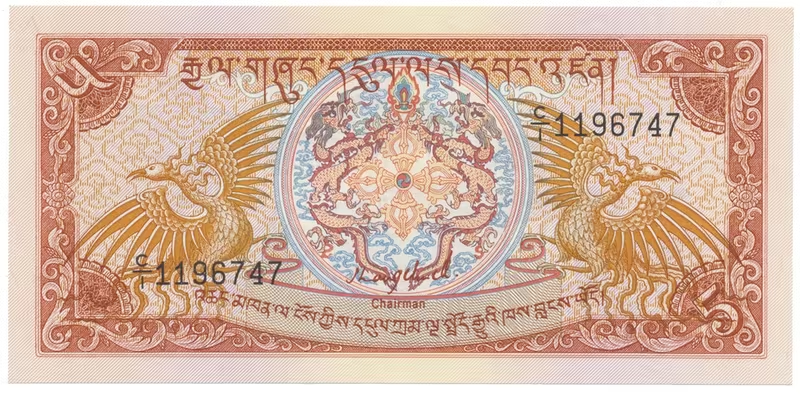
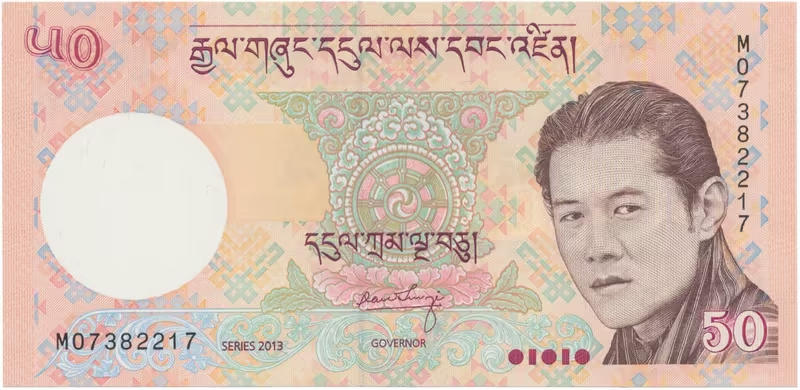
Numismatically, Bhutan is interesting in how distinctly it works with symbolism. Modern banknotes and coins often bear motifs linked with Buddhism, state emblems and nature. In the visual language traditional ornaments, protective symbols and architecture may appear, which distinguishes Bhutanese issues from purely "technocratic" designs chosen by some other states. At the same time, modern issues apply standard international practice: a clear denomination, year, issuer marking and security features on banknotes.
Bhutan is also an example of a state where modern money has become part of a wider narrative of identity. In circulation it is not only a means of payment but also a small carrier of state symbols, language and cultural motifs. For numismatics this means that even relatively young issues can be readily legible and typologically clear, since modern description standards (denomination, date, issuer) are usually plainly stated on the objects.
Currency, denominations and identifying features of issues
The basic monetary unit is the ngultrum, which in circulation is divided into smaller units and is used in combination with ordinary modern cash practice. For coins, the metal composition (standard circulation alloys), weight, diameter and type of edge are key, since these parameters determine usability in circulation and distinguishability of denominations. For banknotes, dimensions, paper type, serial designation and security features that enable authentication are monitored.
Identification of Bhutanese money rests on the language of inscriptions, state identification and visual motifs. On coins the denomination and state symbolism are usually found; on banknotes, alongside the denomination, also multi-layered graphic elements and protective details (watermark, strip, microtext, optical effects depending on the issue). A description therefore gives: denomination, year/series, motifs on obverse and reverse, material (for coins) or security features (for banknotes). These parameters are decisive for modern issues and allow accurate classification even without complex historical typology.
In our auction and shop
- Code: BBHUT014
- Code: BBHUT029
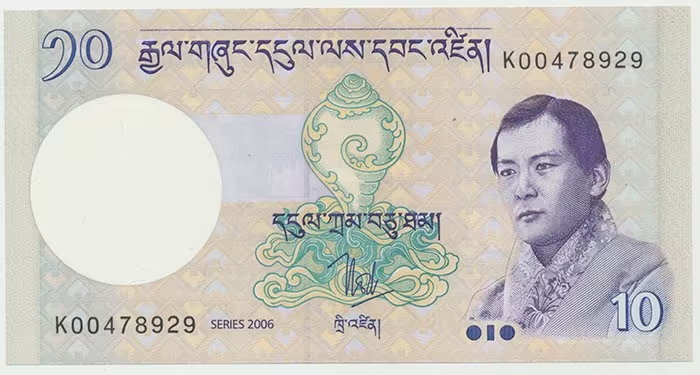
Bhútán, 10 Ngultrum 2006~2013, P.29
Bhútán / Bhutan 10 Ngultrum 2006~2013, P.29, v případě konkrétního roku je foto pouze ilustrační N/UNC
Skladem 1 ks - Code: BBHUT030
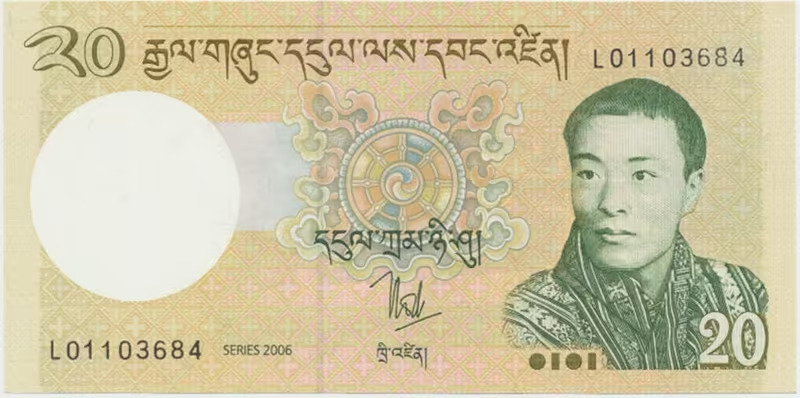
Bhútán, 20 Ngultrum 2006-2013, P.30
Bhútán / Bhutan 20 Ngultrum 2006~2013, P.30, v případě konkrétního roku je foto pouze ilustrační N/UNC
Skladem 4 ks - Code: BBHUT031B