Ngultrum
The ngultrum is the national currency of the Kingdom of Bhutan, a Himalayan state between India and China, introduced in 1974. The name in Dzongkha (the Bhutanese language) means silver and symbolises the economic independence of this Buddhist monarchy.
Bhutan was for centuries an isolated country without its own coinage. Trade was conducted by barter or with Tibetan and Indian coins. In the 19th century, various currencies circulated in Bhutan - Tibetan tangkas, British rupees, later Indian rupees. The first attempts at a domestic currency took place under the reign of the second king, Jigme Wangchuck, who in 1929 had silver and copper coins struck, but these issues were limited and did not replace foreign currencies. After gaining UN membership in 1971, Bhutan accelerated modernisation, including the creation of its own monetary system.
The ngultrum was officially introduced on 1 April 1974 as part of the reforms of the third king, Jigme Dorji Wangchuck. The Royal Monetary Authority of Bhutan was founded in 1982 as the central bank. The first banknotes were printed by India's Security Printing and Minting Corporation and depicted the king and Buddhist symbols. Coins were struck in Calcutta. The ngultrum was from the outset pegged to the Indian rupee owing to economic dependence on India - most of Bhutanese trade is conducted with India, and the Indian government finances a substantial part of Bhutan's budget.
History
The fourth king, Jigme Singye Wangchuck, who reigned from 1972 until his abdication in 2006, used the ngultrum as an instrument of controlled modernisation. His concept of Gross National Happiness influenced monetary policy as well - Bhutan rejects rapid economic liberalisation. The current king, Jigme Khesar Namgyel Wangchuck, continues this cautious policy. The ngultrum remains firmly pegged to the rupee, which provides stability but limits monetary sovereignty. Bhutan rejects free convertibility in order to protect its culture from globalisation.
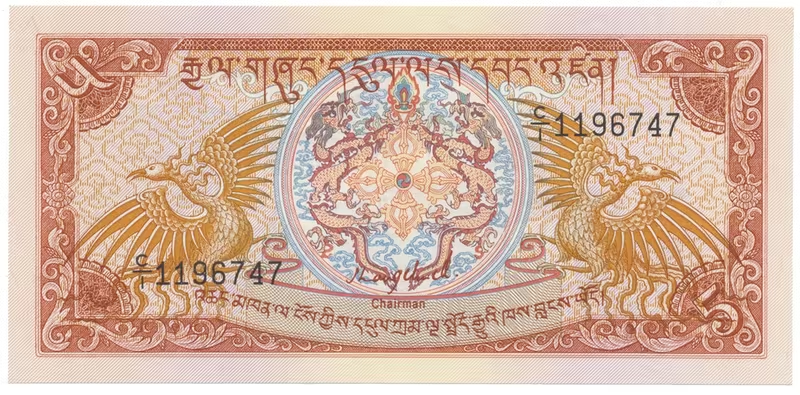
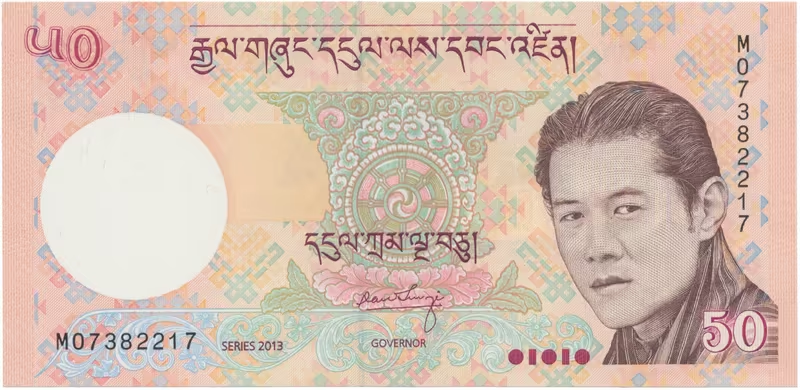
The ngultrum is denoted Nu. and is divided into 100 chhertum (also written chetrum). Bhutanese banknotes exist in denominations of 1, 5, 10, 20, 50, 100, 500 and 1000 ngultrum. Coins are 5, 10, 20, 25, 50 chhertum and 1 ngultrum. The design of the legal tender reflects Buddhist culture - the eight auspicious symbols, dragons, dzong fortresses, kings in the traditional gho dress. A point of interest is the absence of politicians other than the king - Bhutan emphasises the continuity of the monarchy.
The ngultrum in the Bhutanese system
Indian rupees are legal tender in Bhutan, but the ngultrum is not accepted in India outside border areas. This asymmetry reflects economic reality. Technically, Bhutanese tender is of high quality - newer series have advanced security features including dragon holograms. Banknotes are printed by European printers such as Oesterreichische Banknoten, while coins are struck by mints in India and Britain. The Royal Monetary Authority issues gold and silver commemorative coins with Buddhist motifs and endangered animals such as the takin (the national animal). These coins, in denominations of up to 10,000 ngultrum, are popular among collectors. The ngultrum symbolises Bhutan's endeavour to preserve its identity while gradually modernising.
In our auction and shop
- Code: BBHUT014
- Code: BBHUT029
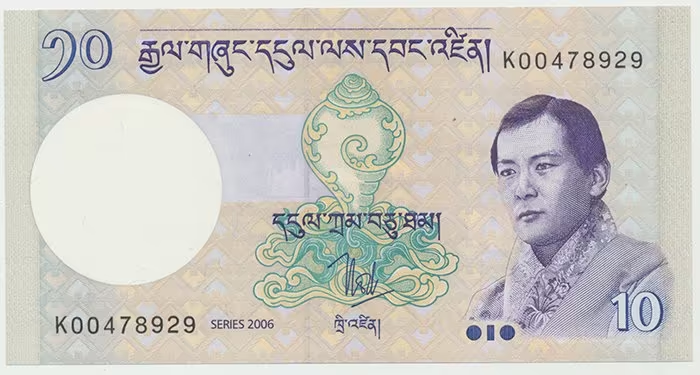
Bhútán, 10 Ngultrum 2006~2013, P.29
Bhútán / Bhutan 10 Ngultrum 2006~2013, P.29, v případě konkrétního roku je foto pouze ilustrační N/UNC
Skladem 1 ks - Code: BBHUT030
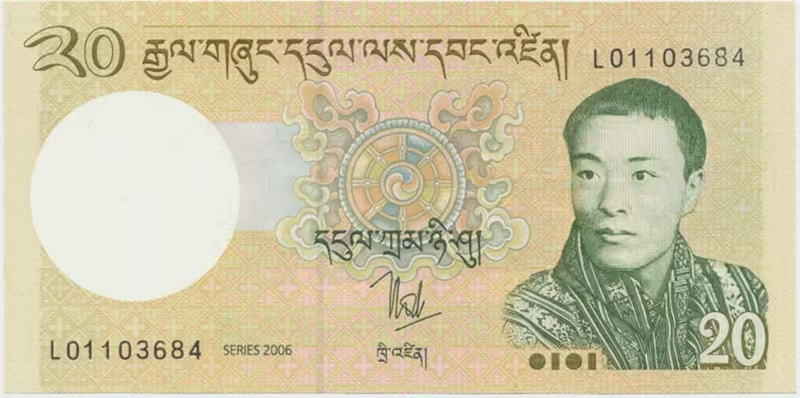
Bhútán, 20 Ngultrum 2006-2013, P.30
Bhútán / Bhutan 20 Ngultrum 2006~2013, P.30, v případě konkrétního roku je foto pouze ilustrační N/UNC
Skladem 4 ks - Code: BBHUT031B