Bretislaus I
Bretislaus I was a Přemyslid duke (reigned 1034–1055) who strengthened the power of the Czech state, became renowned for a campaign into Poland and for efforts to consolidate domestic affairs. In numismatics he is associated also with an important reform of the denarius coinage in the middle of the 11th century.
Bretislaus I belongs among the most distinctive rulers of early medieval Bohemia. He was the son of Duke Oldřich and Božena, and even before taking the Prague throne he acquired important experience as apanage duke in Moravia. Moravia was in the 11th century a sensitive space between the Czech duchy, Poland and Hungary, and the ability to keep it in Přemyslid hands was the key to the long-term stability of the country.
Bretislaus's internal and foreign policy unfolded in an environment in which the German king and later emperor had fundamental influence. The Czech duke had to move between his own ambitions and the real possibilities afforded by the imperial order. Bretislaus, however, was able to take advantage of the situation in Central Europe: when the Polish state found itself weakened, he undertook a campaign into Poland in 1039. He captured several important centres and brought back to Bohemia not only plunder but also exceptionally valuable relics — above all the remains of St Adalbert and St Radim. The transfer of the relics to Prague was not merely a pious act; it was a considered step intended to strengthen the prestige of the Přemyslid centre and to support the ecclesiastical and political ambitions of the Czech state.
The campaign into Poland at the same time alarmed the German King Henry III and led to open conflict. In 1040 an imperial expedition advanced into Bohemia, but was unsuccessful. The next campaign was more cautious: part of the country was devastated and the pressure of the empire ultimately compelled Bretislaus to a compromise. The result was that Bretislaus recognised imperial suzerainty and received Bohemia, Moravia and also Silesia as a fief. In practice this meant a certain restriction of his freedom in foreign policy, but at the same time the confirmation of his position and the stabilisation of conditions outwardly.
In internal administration, Bretislaus sought to consolidate order and the authority of ducal power. The so-called Bretislaus Decrees are traditionally associated with his name; these touched on the punishment of crimes and offences, marriage, observance of ecclesiastical feast days and other principles. The purpose of such measures was to set more intelligible rules for a society in which law and order were often based on local customs and the authority of the lord. Although today's interpretation of the specific form and reach of these regulations may differ, Bretislaus's reign is generally perceived as a period in which the duchy sought to operate in a more organised and purposeful manner than before.
History
Towards the end of his life, Bretislaus also addressed the question of the succession. To limit strife among his descendants he promoted the seniorate — the idea that rule should always be taken up by the eldest living Přemyslid. This model was meant to guarantee continuity, but in further generations it also became a source of disputes, since "the eldest" and "the most suitable" were not always the same person, and the ambitions of individual branches of the dynasty clashed with actual practice.
Bretislaus died in 1055 during a campaign into Hungary. His legacy rests on the combination of military energy, the ability to negotiate with the empire and the effort to bring firmer rules into the country. For numismatics it is moreover essential that his time falls within the period when Czech currency developed from the early denarii to a better-organised coinage, which had to adapt both to domestic needs and to the surrounding monetary environment.
Denarii from the time of Bretislaus I belong to the long tradition of Czech denarius currency, which was the main means of payment of everyday economy. In his strikes several typical features of the 11th century come together: simple, well-legible symbols (cross, chapel) and varied legends in Latin in which the ruler's name appears. On some issues you will also encounter motifs described in the expert literature as an "anchor" or stylised "diadem", and sometimes also names interpreted as personal names linked with the minting administration appear in the legends.
Special attention is due to the minting reform around the year 1050, with which Bretislaus's name is traditionally associated. Within its framework the basic weight unit from which denarii were derived was meant to change: instead of the original "libra" the mark (hřivna) took hold, and with it came a new setting of the number of coins struck from the given unit. The practical consequence was a reduction in the diameter of the denarii and a slight decrease in their weight — for many pieces it falls just below 1 gram. Such steps were not exceptional in the Middle Ages: the ruler and the minting administration had to respond to the availability of metal, the need for currency and the surrounding monetary conditions.
The denarii of Bretislaus I and the monetary reform
For collectors it is important that Bretislaus's denarii exist in a range of types and variants. Differences may lie in the composition of the symbol, in the shape of the letters, in punctuation marks and in the legibility of the legend itself. With denarii, moreover, a phenomenon of gradual "redrawing" often manifests itself: dies were made from older models, and with repeated copying the inscriptions easily became garbled, turning into hardly intelligible clusters of signs. This is one of the reasons why preservation is so prized with these coins and why expert identification by typology carries great weight.
When identifying the denarii of Bretislaus I, it pays to follow simultaneously the motif, the remnants of the legend and the overall size and weight. Well-legible pieces with a clearly recognisable ruler's name are among the sought-after, as are types that can be safely placed in specific groups of strikes. In the context of Czech coinage of the 11th century, Bretislaus's denarii represent an important "milestone" between the early, often very varied issues and the later stages, when monetary circulation gradually expanded and stabilised.
In our auction and shop
- Code: XB935-S1
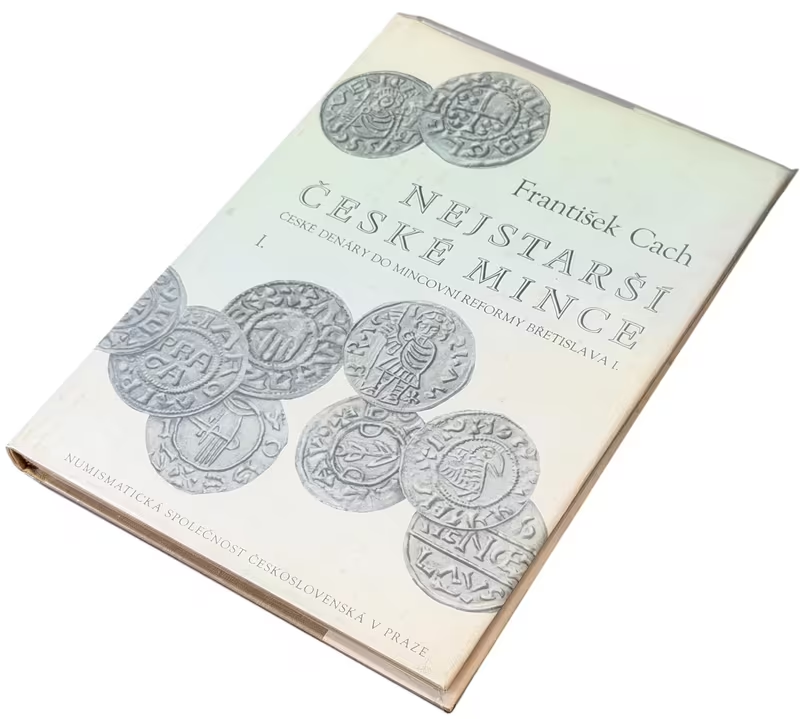
Nejstarší české mince, I. díl
Cach, František České denáry do mincovní reformy Břetislava I., I. díl Praha 1970, 96 stran, mnoho vyobrazení, vázané, pěkná zachovalost
- Code: XB935-4
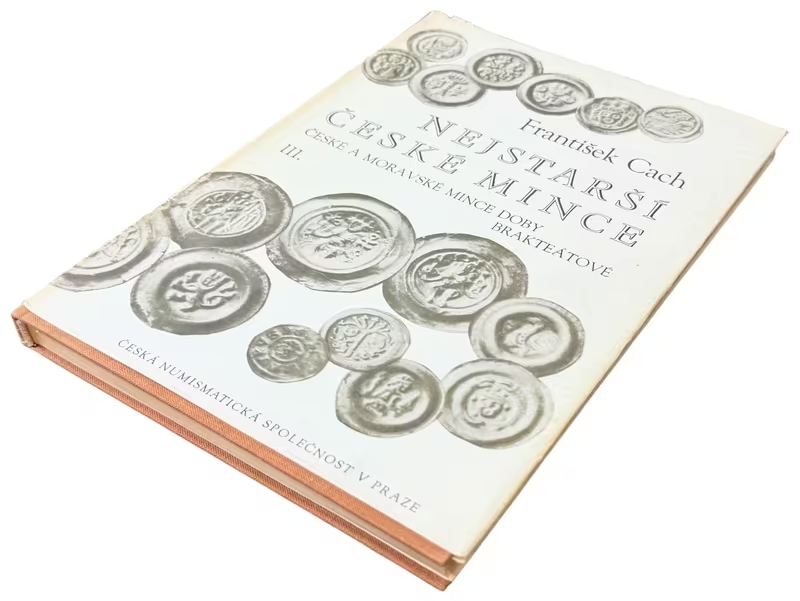
Nejstarší české mince, I. - IV. díl
Cach, František Nejstarší české mince, I. - IV. díl, České denáry do mincovní reformy Břetislava I., Denáry a brakteáty od ref. Břetislava a mince doby brakteátové + dodatky Praha 1970-1982, celkem 4 knihy, celkem 361 stran, 77 tab., vázané, papírové…
- Code: XB0935-1
Nejstarší české mince, I. díl
Cach, František Nejstarší české mince, I. díl, České denáry do mincovní reformy Břetislava I. Praha 1970, 96 stran a mnoho vyobrazení, nová vazba
- Code: XB935-3
Nejstarší české mince, I. - III. díl
Cach, František Nejstarší české mince, I. - III. díl, České denáry do mincovní reformy Břetislava I., Denáry a brakteáty od ref. Břetislava a mince doby brakteátové Praha 1970-1974, celkem 3 knihy, mnoho vyobrazení, vázané,