Christiane Charlotte
Christiane Charlotte of Württemberg-Winnental (1694-1729) was a German princess from the Winnental line of the House of Württemberg, who by marriage became Margravine of Brandenburg-Ansbach. After her husband's death she ran the administration of the principality as regent until her son came of age.
Christiane Charlotte of Württemberg-Winnental was born on 20 August 1694 in Kirchheim unter Teck into the cadet (Winnental) branch of the House of Württemberg. Her father was Friedrich Karl of Württemberg-Winnental and her mother Eleonora Juliana of Brandenburg-Ansbach, which alone shows that this was a dynastically considered milieu, where family ties were used to strengthen one's standing among the imperial princes. During her childhood and adolescence the Holy Roman Empire was a space of many smaller states in which political influence rested not only on armed forces and diplomacy, but also on the ability to maintain stable finances, a representative court and good relations with the estates.
In 1709 Christiane Charlotte married Wilhelm Friedrich of Brandenburg-Ansbach from the House of Hohenzollern and by this marriage became Margravine of Brandenburg-Ansbach in Franconia. The union was at the same time a joining of two related family circles, typical of the high aristocracy of the early 18th century. Of their children the most important was the son Karl Wilhelm Friedrich of Brandenburg-Ansbach, the later ruler of the principality; other offspring died in early childhood, which at that time was not exceptional and at the same time strengthened the importance of the sole heir.
After the death of her husband in 1723 Christiane Charlotte took on the regency for her under-age son. The regency period in small imperial states was usually not merely a formal "waiting", but a genuine administrative burden: it included oversight of the court, of finance, of the judiciary, and of ensuring that the country held its own in the network of relations of the surrounding principalities. In Franconia, moreover, trade routes intersected and economic competition between the individual domains was perceptible, so that even a small fiscal decision could have a direct impact on towns, markets and subjects. For such regents the ability to rely on dependable officials, to maintain discipline in the collection of revenues and at the same time not to undermine the trust of the estates was important, because it was often the estates who decided whether extraordinary expenditures would be accepted without conflict.
History
Christiane Charlotte died on 25 December 1729. Her death ended the regency at the moment when her son could take over the rule himself, and in the memory of the court she remained as the mother of the sovereign and the administrator of the country in a time when dynastic continuity depended on a single heir.
In the milieu of the imperial principalities the regency had a direct relationship to the monetary circulation, even though specific coinage decisions were often based on the advice of specialists and on the practice of mintmasters. The ruling house had to continually address the needs of ordinary payments, the collection of taxes and the meeting of court and administrative costs. In Christiane Charlotte's time, moreover, various accounting conventions and denominations long existed side by side in the German lands, so it was crucial for a smaller state that its coins be accepted without mistrust in the surrounding region. Trust rested on a comprehensible denomination, on appropriate fineness and on the fact that the strikes kept to established standards which merchants and towns knew from practice.
For collectors Christiane Charlotte is significant above all indirectly: as regent she stands at the start of a period in which the coinage of the principality is linked to dynastic continuity and to the transfer of power to her son. In such cases the titulature and heraldic ornament of the ruling house are typically used on the coins, while the actual management of coinage takes place in the background within the financial administration. For numismatics the very context of the Franconian Hohenzollern states is attractive, where collectors often assemble series by rulers, year-dates and mints and follow small variants of legends or coats of arms. On circulating coins ordinary wear is common, which is why the importance of preservation, legibility and natural patina grows; on more representative pieces the cleanness of the strike and the artistic level are valued.
Regency and connections with coinage
If the entry is read as "genealogical", it is worth recalling that women in the role of regent often ensured stability during an heir's minority. In practice that meant holding together both the administration of the state and the court so that the transfer of power would not weaken the authority of the house. And because money is one of the most visible instruments of state power, even such a regency is reflected in collector interest in a period when politics, family strategy and financial administration meet in the everyday reality of the market.
In our auction and shop
- Code: RX-Z-013
Dánsko, Speciedaler 1673 - Portrét Christiana V., dánský státní znak, replika
Dánské království - Kristián V. (1670-1699) Speciedaler 1673 - Portrét Christiana V., dánský státní znak Ag (.999), 40 mm (20 g), v kapsli. Stav mince odpovídá fotografii.
Skladem 1 ks - Code: SDANS-84F1841
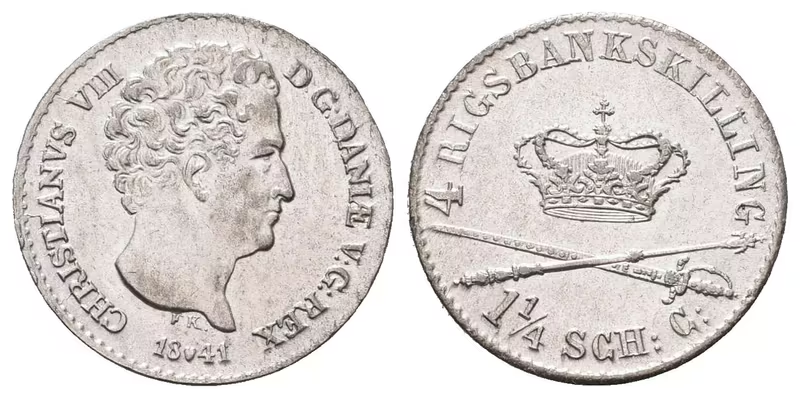
Dánsko, 4 Šilink 1841
Dánsko, Christian VIII., 1839 - 1848 4 Skilling / 1 1/4 Schilling Courant 1841, KM.721, krásná zachovalost
Skladem 1 ks - Code: SDANS84-H1942
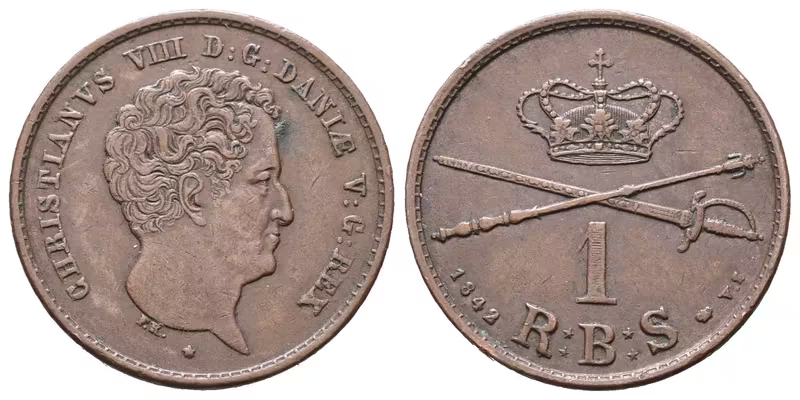
Dánsko, 1 Šilink 1842 VS
Dánsko, Christian VIII., 1839 - 1848 1 Rigsbankskilling 1842 VS, KM.726, patina, oběh, rysky
Skladem 1 ks - Code: NABRAAN-D1762
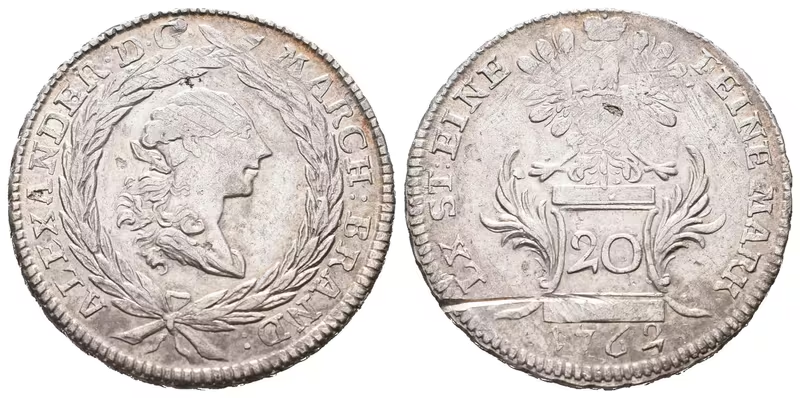
Braniborsko - Ansbach, 20 Krejcar 1762
Brandenburg - Ansbach, Christian Frederick Charles Alexander (1757 - 1791) 20 Kreuzer 1762, minc. Schwabach, KM.246, pěkná zachovalost, zbytky lesku, patina, vady střížku
Skladem 1 ks