Francis II Rakoczi
Francis II Rakoczi was a Hungarian magnate and Transylvanian prince, leader of the anti-Habsburg uprising in the years 1703 to 1711, whose Kuruc War represented the last serious attempt at Hungarian independence before the Austro-Hungarian Compromise. In numismatics Francis II Rakoczi represents a symbol of the Hungarian struggle for liberty, with his sil…
Francis II Rakoczi was born on 27 March 1676 at Borsi Castle as the son of Francis I Rakoczi and Helena Zrinska, a descendant of the most significant Hungarian magnate houses. After his father's death and the execution of his grandfather Peter Zrinski for an anti-imperial conspiracy, he was raised by the Jesuits in Vienna under the supervision of Emperor Leopold I. Despite his Habsburg upbringing he inherited the family tradition of resistance against Viennese centralisation. His enormous estates in eastern Hungary and Transylvania made him one of the wealthiest magnates of the monarchy.
Rakoczi's uprising broke out in 1703 as a reaction to Habsburg oppression after the Peace of Karlowitz. He used the dissatisfaction with high taxes, recruitment into the Austrian army, and the religious oppression of Protestants. Francis II Rakoczi was elected leader of the confederation of Kuruc estates and in 1704 prince of Transylvania. His army of Hajduks, brigands, and lesser nobility controlled most of Hungary and Transylvania. Rakoczi created a functional state apparatus with a senate, court chancellery, and his own coinage.
History
The economic securing of the uprising was crucial. Rakoczi confiscated Habsburg and pro-Josephine estates and controlled the copper mines in the Slovak Ore Mountains. His mints at Kremnica, Kosice, and Nagybanya struck their own coins - silver thalers with the motto "Pro Libertate", copper polturas called "kongresaky" after the diet at Onod. These libertas coins financed the Kuruc army and symbolised Hungarian independence. The inflation of the copper money, however, gradually undermined the economy of the insurgent state.
Military failures after the Battle of Trencin in 1708 and economic collapse led to the disintegration of the uprising. The Peace of Szatmar in 1711 meant amnesty for the rebels, but Rakoczi refused capitulation and went into exile. He spent the rest of his life in Poland, France, and Turkey, where he died on 8 April 1735 in Rodosto. His remains were transferred to Kosice only in 1906 as a national hero. Although Rakoczi's uprising did not succeed, it laid the foundations of Hungarian national consciousness and resistance against Germanisation.
Kuruc coinage
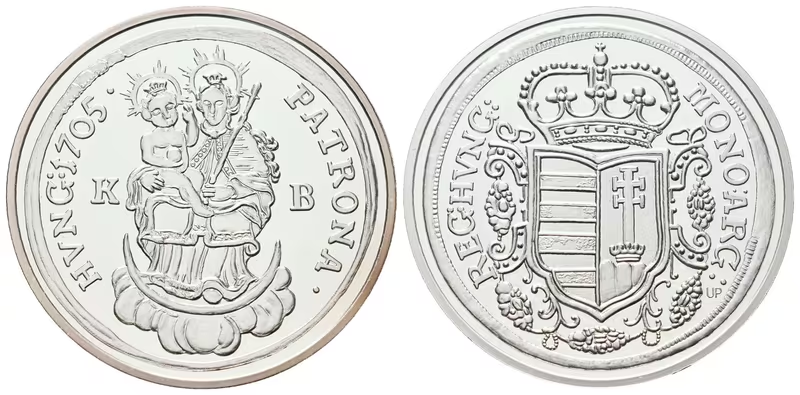
Rakoczi's coinage was improvised but extensive. The principal denominations were the silver thaler (28 g), the half-thaler, the copper poltura, and the denarius. The design featured the Madonna (patroness of Hungary), Rakoczi's monogram, and the motto "PRO LIBERTATE". The copper congressional polturas of 1704-1707 were mass-struck emergency money that quickly succumbed to inflation.
Technically the Kuruc mints used confiscated Habsburg equipment. The quality varied - from masterly thalers from Kremnica to crude emergency coins. Counterfeiting was widespread; Rakoczi punished counterfeiters with death. The total production reached millions of pieces, mostly copper. After the Peace of Szatmar the Kuruc coins were withdrawn and overstruck, which makes originals rare.
In our auction and shop
- Code: RG-ZREP19
Replika - Historický 1/2 tolar - František Rákóczí II. 1705
Replika - Historický 1/2 tolar - František Rákóczí II. 1705 Ag - 333/1000, 10,37 g, vč. certfifikátu a kapsle
- Code: ZEM-KRALOVE
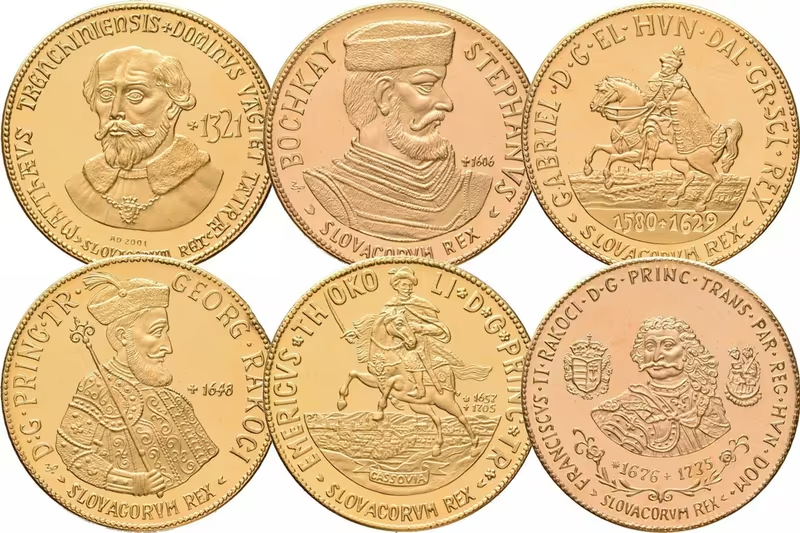
Sada dvoudukátů - Nekorunovaní králové Slovenska
Slovenská Republika (1993 - ) Sada dvoudukátů (L. Bódi, V. Santer) - Nekorunovaní králové Slovenska, Matúš Čák, Štefan Bočkaj, Gabriel Betlen, Juraj I. Rákoci, Imrich Töokoly, František II. Rákoci 6x Au 0,986, 25 mm (7 g), certifikát, dřevěná etue, zcela…