Frederick William IV of Prussia
Frederick William IV was the King of Prussia reigning from 1840 to 1861, known as the romantic on the throne. His reign was marked by the revolutionary year of 1848 and unsuccessful attempts to unify Germany under Prussian leadership.
Frederick William IV was born on 15 October 1795 in Berlin as the eldest son of King Frederick William III and Queen Louise of Mecklenburg. He grew up at the time of the Napoleonic Wars and Prussia's defeat at the Battle of Jena and Auerstedt in 1806. He received an excellent humanistic education and took an interest in architecture, art, and medieval history. His romantic notions of a Christian state and medieval chivalry significantly influenced his later reign.
Upon acceding to the throne in 1840 he raised the hopes of liberals by relaxing censorship and granting amnesty to political prisoners. It soon became apparent, however, that his views on the state were deeply conservative. He believed in the divine right of kings and rejected constitutional monarchy. He wanted to restore the estates-based state on the medieval model. His greatest passion was architecture, and during his reign Cologne Cathedral was completed and many neo-Gothic buildings were erected in Prussia.
History
The revolutionary year of 1848 caught the king unprepared. After street fighting in Berlin in March 1848, in which over 200 people perished, he was forced to give way to the revolutionaries. He had to convene a constituent assembly and promise a constitution. He declared that Prussia would merge with Germany. When the revolution weakened, the king dissolved the parliament and in December 1848 imposed his own constitution, which preserved a strong royal power. In 1849–1850 he attempted to create a Lesser German unification under Prussian leadership through the Erfurt Union. This attempt foundered on Austrian opposition, and at Olomouc Frederick William IV had to capitulate.
The greatest humiliation for the king was when, in 1849, the Frankfurt Parliament offered him the crown of a united Germany. He rejected it as a crown from the gutter, because it came from revolutionaries and not from the German princes. From 1857 the king suffered several strokes, which led to his mental illness. In 1858 he had to hand over the powers of government to his brother William as regent. Frederick William IV died on 2 January 1861 at Sanssouci Palace in Potsdam without descendants.
Minting under Frederick William IV
Prussian minting under Frederick William IV underwent significant reform connected with the creation of the German Customs Union. In 1857 the new currency, the Vereinstaler, was introduced according to the Vienna Mint Treaty, which unified the monetary system of the German states. Gold crowns and half-crowns, silver double thalers, Vereinstaler, and smaller denominations were struck. The coins bore the king's portrait with a laurel wreath, and on the reverse the Prussian eagle with the motto Gott mit uns.
A characteristic feature of this period was the high artistic quality of the coins. The king personally oversaw their appearance and often intervened in the designs. Numerous commemorative coins were struck for various events, such as the completion of Cologne Cathedral or the anniversaries of Prussian victories. The double thalers with the king's portrait rank among the most beautiful Prussian coins of the 19th century. The mints in Berlin and Wrocław worked with the most modern technology, including steam presses.
In our auction and shop
- Code: NAPRU97-B1861
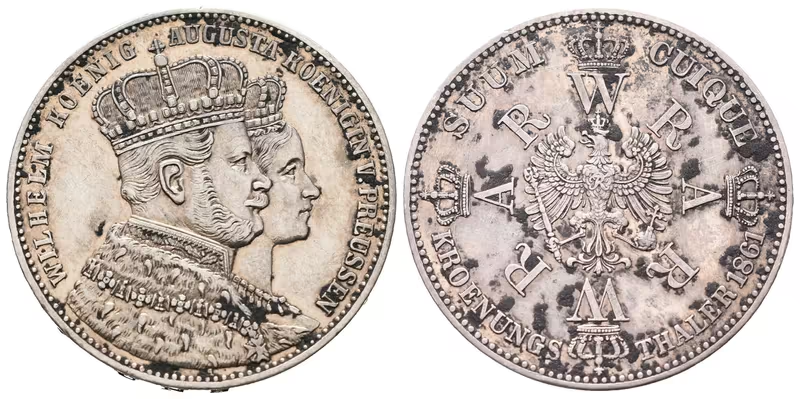
Prusko, Tolar 1861 - Korunovační
Pruské království, Friedrich Wilhelm IV. (1840 - 1861) Tolar 1861 A - Ke korunovaci Viléma a Augusty Sasko-Výmarské, KM.488, Dav.778, tmavá patina, rysky, oběh