Friedrich Ulrich
Friedrich Ulrich of Brunswick-Wolfenbüttel (1591–1634) was a Welf duke of Brunswick-Lüneburg and prince of the Brunswick-Wolfenbüttel branch, who reigned from 1613 to 1634. His era falls at the beginning of the Thirty Years' War, and in minting is associated with a series of silver strikes.
Friedrich Ulrich of Brunswick-Wolfenbüttel was born on 5 April 1591 at Wolfenbüttel as the eldest son of Duke Henry Julius of Brunswick-Wolfenbüttel and his second wife Elizabeth of Denmark. His upbringing matched the standing of an imperial prince: he studied at the universities of Helmstedt and Tübingen, and supplemented his education with travels through western Europe. When in 1613 he succeeded his father, he took over a country burdened with considerable debts as well as strained relations with some of its towns, especially with the free town of Brunswick, which jealously guarded its privileges and financial autonomy.
Shortly after taking power, the dispute over money and prerogatives came to a head: in 1615 Friedrich Ulrich attempted to compel Brunswick by military force to make concessions, but a months-long siege ended without a decisive result. The internal administration of the principality gradually fell into the hands of court officials and councillors; the sources of the time describe the ruler as rather indecisive, easily influenced, and not greatly focused on day-to-day governance. Family ties also played a fundamental role: his mother maintained strong contacts with the Danish court, and the wider Welf network of kinsmen entered into political calculations. Friedrich Ulrich married Anna Sophia of Brandenburg, daughter of the Brandenburg elector John Sigismund; the marriage, however, remained childless, which later had a direct impact on the succession.
History
The hardest part of his reign took place after 1618, when the conflict in the Empire spilled over into the long and devastating Thirty Years' War. Friedrich Ulrich at first strove for neutrality, since a small principality between more powerful neighbours had only limited defensive options. The situation, however, quickly changed: the area of Lower Saxony became a corridor traversed by armies, and the country was repeatedly burdened by contributions, requisitions, and the quartering of troops. In 1626 he even handed over part of his powers to his younger brother Christian of Brunswick-Wolfenbüttel, known as the "Mad Halberstädter", who was actively involved in war operations. The subsequent manoeuvring between the imperial side, the Catholic League, and Danish interests brought the country no relief; on the contrary, it was among the regions that the war hit particularly hard. Friedrich Ulrich died on 11 August 1634 in Brunswick. As he had no descendants, his Wolfenbüttel branch died out and the principality was taken over by the related line headed by Augustus the Younger of Brunswick-Lüneburg, which opened a new chapter in the history of Wolfenbüttel.
During the reign of Friedrich Ulrich, mainly silver circulation coins intended for everyday payments and higher denominations for larger transactions were struck in Brunswick-Wolfenbüttel. In the German lands at that time the thaler-based accounting and a wide range of smaller values (including groschen and kreuzer types) functioned side by side, while the quality of the coin — its weight and fineness — was crucial for trust in the markets. It was precisely in wartime that the differences between "good" and "bad" coin deepened, since many lands resorted to debasing the mint standard in order to obtain rapid revenue.
Coins and monetary conditions under Friedrich Ulrich
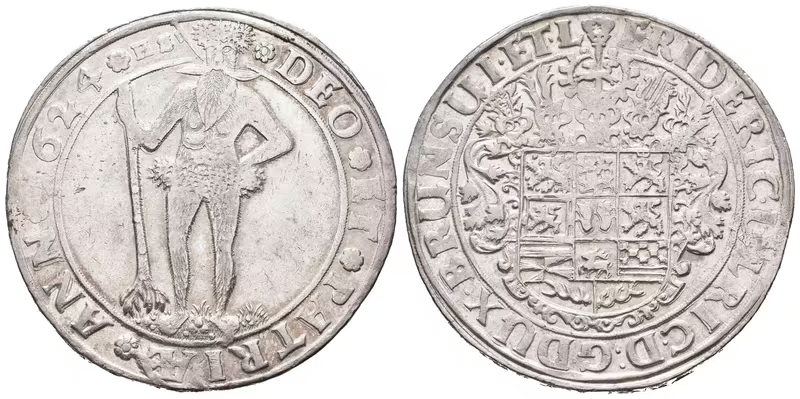
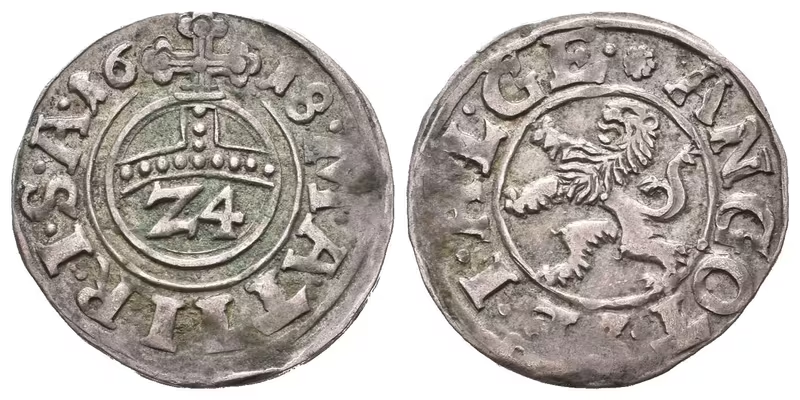
In the case of Friedrich Ulrich, the strikes of the Mariengroschen and Marien-gulden types are often mentioned by collectors, appearing in several multiples (for example 1, 2, 4, or 10 Mariengroschen). For some of these strikes an exceptionally high silver fineness is reported, which stands in sharp contrast to coins debased during the war years in other parts of the Empire. Alongside the smaller silver values, thalers were also struck, which today belong among the most sought-after pieces thanks to their striking artistic execution and good identifiability by year-date and legend. For practice, it is important that the coins from Wolfenbüttel circulated in a space where different monetary customs of neighbouring lands commonly met — and so the acceptability of the coin was often just as important as its nominal value.
When identifying these strikes, it pays to observe the ruler's titulature, the appearance of the territorial coats of arms, and any mint or mint master marks. With circulation coins, wear is common, and so the importance of the grade, legibility of the legends, and natural patina grows. Collectors are also attracted by the short and historically dramatic period of his reign: the year-dates fall in years when financial and monetary pressures changed rapidly, and the coins thus indirectly reflect how the principality reacted to wartime reality. Within "German states" collections, Friedrich Ulrich fits well into a continuous series of Welf rulers and makes it possible to build a coherent set by ruler, denomination, and regional type.
In our auction and shop
- Code: NABRAUL-B1624
Brunšvick-Lüneburg, Tolar 1624 HS
Braunschweig - Wolfenbüttel, Friedrich Ulrich (1613 - 1634) Reichsthaler 1624 HS, Zellerfeld-Schluter, KM.52, Welt.1057a, Dav.6303, velmi pěkná zachovalost, patina, rysky a drobné vady střížku
Skladem 1 ks - Code: NABRAUL-H1618
Brunšvick-Lüneburg, Groš 1618
Braunschweig - Wolfenbüttel, Friedrich Ulrich (1613 - 1634) 1/24 Taler 1618 , s tit. Matyáše, Welt.1237, pěkná zachovalost, patina
Skladem 1 ks