
Arnold Hartig
Arnold Hartig (1878–1972) was a sculptor and medallist from the Bohemian lands who worked in Vienna for six decades. He produced some 600 works and is among the most prolific Central European medallists of the first half of the 20th century.
Life and work
He was born on 12 August 1878 in Brand near Tannwald, today Tanvald-Žďár. He trained under Rudolf Zitte at the technical school in Gablonz (Jablonec nad Nisou); as a gifted pupil he received a state scholarship and in 1898 moved to the Vienna Kunstgewerbeschule under Professor Stefan Schwartz. He then worked for the Viennese medal firms Brüder Schneider and Pittner and set up on his own in 1903. According to the Wien Geschichte Wiki he became a member of the Vienna Künstlerhaus in 1908, according to the German Wikipedia as early as 1905. He went blind at about the age of eighty-five; his last works date from 1962. He died on 2 February 1972 in Purkersdorf near Vienna. His sculptural works include the Raphael Donner memorial plaque in Essling, the statue of Christ in Gablonz and the Sermon on the Mount relief in Aussig (Ústí nad Labem). He published his memoirs, Aus meinem Leben, in 1964.
Coins and medals
During the First World War he designed numerous medals with portraits of members of the imperial house and army commanders for war welfare. He worked with the Vienna Main Mint, for which he designed a number of schilling coins of the First Austrian Republic, among them the gold 25 and 100 schilling pieces of 1926–1934. The Kunsthistorisches Museum in Vienna is preparing an annotated catalogue of his medals based on his estate held at the Museum Lauriacum in Enns.
From the work in the AUREA range
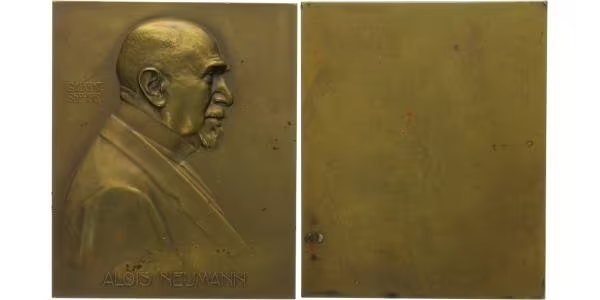
The AUREA range includes his bronze plaquette of 1912 with the portrait of Alois Neumann, 90 × 74 mm. The plaquette represents the type of portrait work with which Hartig won a wide circle of private and institutional patrons in pre-war Vienna.
Related artefacts currently at auction
- Code: RAHART-1912
Hartig Arnold - Alois Neumann
Hartig Arnold (1878 - 1972) AE Plaketa 1912 - Alois Neumann, 90 x 74 mm
Skladem 1 ks
Further in the encyclopaedia
More entries in the category rytci. Continue browsing or return to the full encyclopaedia.