Isabella and Ferdinand of Spain
Isabella and Ferdinand of Spain were the 15th-century royal pair known as the "Catholic Monarchs": Isabella I of Castile and Ferdinand II of Aragon. Their marriage united two key Iberian kingdoms, completed the Reconquista and laid the foundation for the rise of the powerful Spanish monarchy.
Isabella and Ferdinand of Spain entered history above all as the pair that succeeded in transforming the fragmented political space of the Iberian Peninsula into a dynastic union with growing international weight. Isabella (1451-1504) became Queen of Castile in 1474, while Ferdinand (1452-1516) ruled the Crown of Aragon from 1479. Their marriage of 1469 was crucial, because it linked Castile and Aragon - not by merger into a single state, but by a common dynasty and coordinated policy. Both crowns long retained their own institutions, law and finances, and yet thanks to unified leadership a common foreign and power strategy gradually asserted itself.
After Isabella's accession to the head of Castile her legitimacy had to assert itself in a tense internal situation. The key clash was the War of the Castilian Succession (1475-1479), in which Isabella and Ferdinand faced rivalry supported by Portugal. The outcome of the conflict consolidated their position and opened the way to firmer rule. The following years they devoted to strengthening royal authority against part of the higher nobility and also to efforts at more effective administration. In this period also their title "Catholic Monarchs" was consolidated, which expressed the linking of royal legitimacy with a religious programme and the support of ecclesiastical institutions.
The best-known chapter of their reign is the completion of the Reconquista. In 1492 Granada fell, the last Muslim kingdom on the Iberian Peninsula, and for the Spanish monarchy this meant not only a military triumph but also a strong symbolic moment. The same year, however, is significant in other ways: the royal court supported the expedition of Christopher Columbus, which led to the European contact with America and started a long process of Spanish expansion and colonisation. From the viewpoint of history of power, a new dimension of Spanish influence thereby arose - overseas, commercial and later also financial, based among other things on the inflow of precious metals.
History
The policy of the "Catholic Monarchs" also had a harsh religious side. The Spanish Inquisition, operating already from the end of the 15th century, became an instrument of control of religious unity and at the same time an important element of internal policy. In 1492 an order was issued that led to the expulsion of the Jewish population from Castile and Aragon, and later further measures came against Muslims and converts in various forms and time waves. These steps significantly changed the social and economic structure of part of Iberian society and to this day belong among the most discussed aspects of their reign.
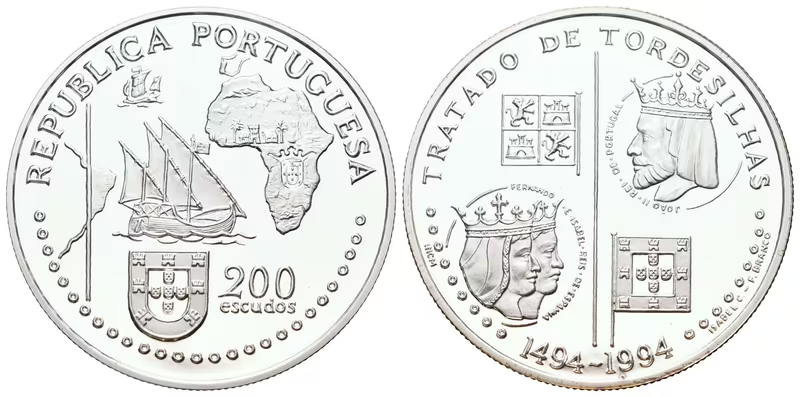
In foreign policy Isabella and Ferdinand asserted themselves as players of European format. They used marriage diplomacy, consolidated influence in the Mediterranean and conducted conflicts and negotiations that opened Spain's way to a power position in Italy. An important milestone for overseas ambitions was the agreement on the division of spheres of influence with Portugal (which includes the Treaty of Tordesillas of 1494). At the close of their era the monarchy rested on the dynastic interconnection of European houses: their daughter Joanna married Philip I the Handsome of the House of Habsburg, thereby creating the basis of the later Habsburg "world" power that their grandson Charles V was to make famous.
With rulers at the turn of the Middle Ages and the modern era, representation had extraordinary importance - and coins belonged among the most visible media of power. Under Isabella and Ferdinand the traditional monetary systems were still used in Castile and Aragon (for example the maravedí as an accounting unit in Castile and various local denominations in the Aragonese lands), but at the same time efforts grew at greater clarity and authority of the royal coinage. In practice this meant emphasis on clear titulature, heraldry and symbols that were to confirm legitimacy and the dynastic union of the two crowns.
Royal representation and coins
On some strikes united arms and motifs appear that refer to the Castilian lion and castle, the Aragonese pales and other territorial heraldry. Such coins are today valuable not only as means of payment of their time but also as "small documents" of political change: they show how the rulers publicly communicated the formation of a new power configuration. Among the numismatic tradition also belong gold and silver issues linked to the end of the 15th century, on which the quality of execution and a clear programme of royal authority are often emphasised.
For collectors it is useful to perceive that "Spain" of this time was not a unified state with a single mint and a single system. The strikes are tied to various lands of the Castilian and Aragonese Crowns, differing in place of production and in small heraldic details. It is precisely these differences that are important in identifying the coins: artistic features, inscriptions and mint marks may indicate whether it is a Castilian, Aragonese or other regional strike linked to the period of the "Catholic Monarchs".
In our auction and shop
- Code: SZ-NEJ-SPAN-1853
Stříbrná známka - Španělsko - královna Isabela z roku 1853 - Ag 7 g - 999/1000
Stříbrná známka - Španělsko - královna Isabela z roku 1853 - Ag 7 g - 999/1000
Skladem 1 ks - Code: SNIZSPA-F1612
Španělské Nizozemí, Escalin b.l. (1612 - 1621)
Španělské Nizozemí - Brabantsko, Albrecht V. a Isabella Španělská, 1598 - 1621 Escalin/Schelling b.l. (ražen 1612-1621), minc. Brusel, KM.47, Van.623 var., pěkná zachovalost a patina, dobově ořezaný
Skladem 1 ks - Code: SPORT-O1995B
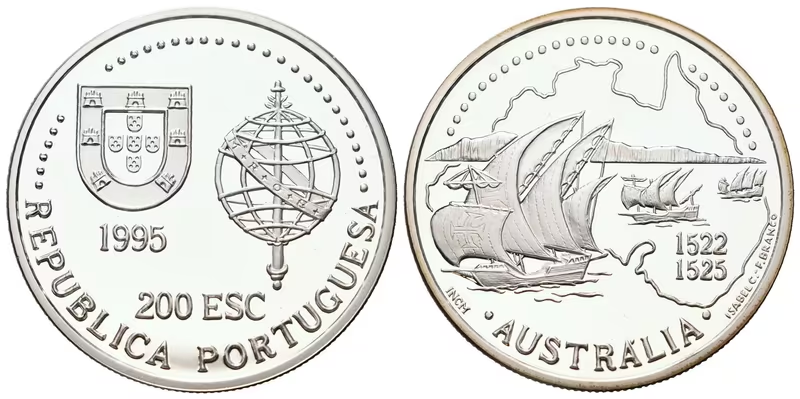
Portugalsko, 200 Escudos 1995 - Austrálie
Portugalská republika (1911-2001) 200 Escudos 1995 - Objevení Austrálie portugalskými mořeplavci, KM# 684a Ag 0,925, 36 mm (26,5 g), proof, v kapsli. Emise: 10 000 ks. Mincovna: Lisabon - Portugalsko. Autor: Isabel Carriço, Fernando Branco. Série:…
- Code: SPORT-O1994B
Portugalsko, 200 Escudos 1994 - Tordesillaská smlouva
Portugalská republika (1911-2001) 200 Escudos 1994 - 500. výročí Tordesillaské smlouvy, KM# 671a Ag (.925), 36 mm (26,5 g), proof, v kapsli. Emise: 13 000 ks. Mincovna: Lisabon - Portugalsko. Autor: Isabel C., F. Branco. Série: "Portugalské objevy 5".