John Adolf of Schleswig-Holstein-Gottorp
John Adolf of Schleswig-Holstein-Gottorp (1575–1616) was a duke of the House of Oldenburg who led the Gottorp branch of Schleswig and Holstein at the turn of the 16th and 17th centuries. He ruled in a region where the interests of the Danish crown, imperial law and the North German Protestant princes intersected.
John Adolf of Schleswig-Holstein-Gottorp was born in 1575 into an environment in which dynastic ties carried exceptional weight. Schleswig and Holstein formed a complex whole: Schleswig was traditionally linked with the Danish crown, while Holstein belonged within the framework of the Holy Roman Empire. The Gottorp branch appeared here as an independent princely power, but at the same time had constantly to seek balance between loyalty to the Danish king and the defence of its own rights. It was precisely this "dual" character of the land that shaped the policy of the local dukes more than any ostentatious court ambitions.
John Adolf assumed rule as a young sovereign, and his era falls in a time when Europe was gradually polarising both religiously and politically. Northern Germany was predominantly Lutheran, and the princes watched carefully as conditions in the Empire changed — especially the growing tension between the Protestant and Catholic powers. Although the Thirty Years' War only broke out fully after his death, even in his time it was clear that disputes over religious and political balance would have wider consequences. For small and medium-sized lands such as the Gottorp duchy, this meant the need for cautious diplomacy: a wrong choice of alliance could threaten trade, finance and one's own security.
In domestic administration the duke had to rely on a network of offices and on cooperation with the estates. In the North German lands the administration of the domains, revenues from customs and town markets, and control over economic resources including agriculture and fishing were important. At the same time it was a region with a lively trade, which profited from the connection of the Baltic and North Seas and from contact with the Hanseatic towns. Good rule here meant fewer grand gestures and more careful day-to-day administration: to maintain order, ensure the collection of revenues and protect trade routes at a time when the region could easily become vulnerable to pressure from stronger neighbours.
History
An important part of sovereign policy was also dynastic anchoring. Marriages and kinship connected the Gottorp dukes with the Danish and North German environment and strengthened their prestige, but at the same time they brought expectations and commitments. In such a framework, rule was not merely "the administration of a territory", but also a continuous negotiation about the standing of the family and about the degree of independence the duchy would maintain in relation to the Danish crown. John Adolf thus represents the type of sovereign whose significance lies not in one great event, but in his having ruled the land in a sensitive period when the lines of power in northern Europe were being shaped for the entire 17th century.
John Adolf of Schleswig-Holstein-Gottorp is remembered in numismatics above all as an issuer of coins in the North German region, where strikes of many principalities, towns and larger states mingled in circulation. At this time the coin had a dual function: practical (to ensure a sufficient supply of currency for the market and administration) and symbolic (to confirm visibly who ruled the land and for what standard he stood guarantor). For this reason coins usually carry sovereign titulature and heraldry, which allow rapid identification of origin.
In the region both small denominations for everyday payments and larger silver coins for higher transactions and trade were used. For collectors, larger silver strikes and their fractions tend to be characteristic, because the portrait, arms and quality of workmanship stand out better on them. At the same time, however, it is precisely the small coins that best show the reality of the economy: frequent circulation, wear and the need for "fine" values for markets and wages.
Ducal representation and coins of the Gottorp branch
For North German coins of the turn of the 16th and 17th centuries, it is common for the same denomination to occur in several variants according to the mint, year of issue and details in the legends. With Gottorp strikes, careful identification therefore plays a role: besides the sovereign and the year, the execution of the arms, the layout of the titulature and minor differences in the engraving are tracked. What makes this area attractive for collecting is precisely the combination of politically complex conditions with the "legibility" of the coin — a small piece of metal can show with surprising precision how the duke presented himself and how he wished to be perceived in regional circulation.
In our auction and shop
- Code: SVAT-E1979
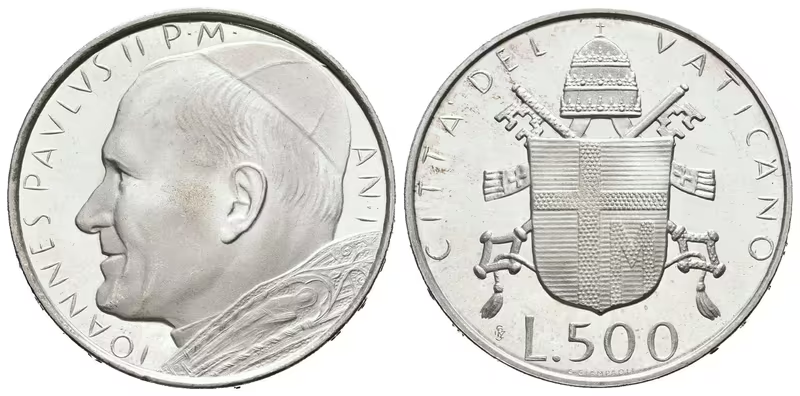
Vatikán, 500 Lire 1979 - Jan Pavel II., papežský erb, tiára, zkřížené klíče
Vatikánský městský stát - Jan Pavel II. (1978-2005) 500 Lire 1979 - Jan Pavel II., papežský erb, tiára, zkřížené klíče Ag (.835), 29,3 mm (11 g), BU, v kapsli. Stav mince odpovídá fotografii.
Skladem 1 ks - Code: RALUK-2003
Lukáš Jan - Tolar Marie Terezie 1758
Lukáš Jan (1944 - ) AR Medaile 2003 - Replika výtěžkového tolaru Marie Terezie z roku 1758 Ag 0,999, 40 mm (29 g), kapsle, etue, certifikát, ilustrační foto Výtěžkové ražby jsou mince ražené ze surovin vytěžených v určitých místech. Do Čech přišel zvyk…
Skladem 1 ks - Code: RALUK-1999
Lukáš Jan - 400 let ubránění Vídně před Turky
Lukáš Jan (1944 - ) AE Medaile b.l. (2009) - Ferdinand I., 400 let ubránění Vídně před Turky CuZn 50 mm (45 g), certifikát
Skladem 1 ks - Code: RALUK-2008
Lukáš Jan - 400 let korunovace Matyáše II.
Lukáš Jan (1944 - ) AE Medaile b.l. (2008) - 400 let korunovace Matyáše II. Ms 50 mm (56 g), certifikát
Skladem 1 ks