John Casimir
John Casimir of Saxe-Coburg (1564–1633) was an Ernestine duke of the House of Wettin who made Coburg a residential city and gave it a distinctive Renaissance form. He first ruled jointly in the Duchy of Saxe-Coburg-Eisenach, and after the division of the lands from 1596 as Duke of Saxe-Coburg.
John Casimir of Saxe-Coburg was born on 12 June 1564 in Gotha as the son of John Frederick II of Saxony and Elisabeth of the Palatinate. His childhood was marked by the fall of his father's power: after an imperial intervention against Gotha, his father lost both his estates and his freedom, and the family found itself in forced insecure conditions. John Casimir and his brother John Ernest of Saxe-Eisenach grew up under the guardianship of relatives and imperial wardens, which was typical of the Ernestine principalities — dynastic politics here often broke upon inheritance disputes, guardianships and divisions of lands.
In 1572 the two brothers received, through inheritance and family partition, a new principality designated Saxe-Coburg-Eisenach. Coburg became their main seat, with John Casimir gradually being educated for the role of ruler and administrator of the country. He studied, among other places, in Leipzig, but what was decisive was that in the time of religious conflicts he was firmly committed to Lutheranism and his land was placed within the Protestant space of the Empire. After coming of age he assumed rule in the spirit of the early modern "court state": he built up offices, judicial institutions and relied on a network of educated officials, without whom it was no longer possible to govern a small but administratively demanding principality.
In 1586 he married Anna of Saxony, daughter of the Saxon Elector, which was to strengthen his prestige within the Ernestine-Albertine relations in Saxony. The marriage, however, ended in scandal and divorce (1593), and John Casimir had his former wife held in house arrest until her death. In 1599 he concluded a second marriage with Margaret of Brunswick-Lüneburg. The personal level of his life thus contrasts with the image of a sovereign who in public appeared as a patron of buildings and of education.
History
The key turning point was the division of the joint principality in 1596. His brother John Ernest received Saxe-Eisenach, and John Casimir ruled on as the sole Duke of Saxe-Coburg. It was then that the strongest period of his residential policy began: Coburg experienced a cultural and architectural peak which is still legible today in the Renaissance layer of the town. John Casimir rebuilt and expanded the town residence (Ehrenburg Palace), strengthened the fortress function of Veste Coburg and also adapted representative ecclesiastical spaces, including with a great Renaissance epitaph in the Church of St Maurice. At the same time he founded the Casimirianum Gymnasium (the present-day educational tradition in Coburg directly refers back to him) and supported court culture, including music.
In politics he sought to keep the small duchy stable in the complicated environment of imperial disputes and later of the Thirty Years' War. He long stayed out of open conflict, but at the end of his reign the situation affected his lands as well. His age, however, also has its darker side: in Coburg and the surrounding area a number of witch trials took place, which today belong among the most problematically assessed phenomena of the rule of early modern princes. John Casimir died on 16 July 1633 without descendants, and his land passed to the related line (to John Ernest of Saxe-Eisenach), which again shows the typical dynastic logic of Ernestine divisions and reunions.
John Casimir is often remembered as a "residential" sovereign: instead of expansion, he built the institutional and cultural foundation of his state. In practice this meant an emphasis on town representation, education and the administrative apparatus. In Coburg he had new official buildings and judicial institutions erected and strengthened control over the land's elites, so that the principality should function as a compact whole. Such work tends to be less conspicuous than wars, but for the long-term stability of the small German states it was decisive.
Administration, culture and numismatic context
Numismatically, his reign is interesting in that the Saxe-Coburg (and earlier Saxe-Coburg-Eisenach) strikes belong to the world of the finely divided German coinage circles. Coins of these principalities usually bear the sovereign's titulature and the country's arms, and their precise identification rests on the year of issue, mint mark and type. For collectors, commemorative medals and wedding strikes are also of significance, for it was precisely court representation and family events that in small states were often reflected in medallic art more prominently than in the great monarchies. John Casimir thus remains a figure in whom the histories of administration, culture and coinage are naturally intertwined: money and strikes are one of the visible imprints of his sovereignty and court identity.
In our auction and shop
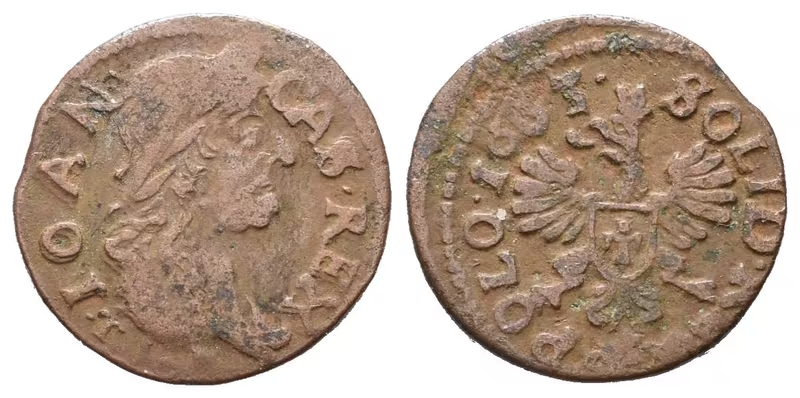
- Code: SPOL91-B1663
Polsko, Szelag 1663
Polsko, Jan II. Kazimír, 1648 - 1668 Boratynka koronna 1663, Ujazdów, Kop.1550, patina
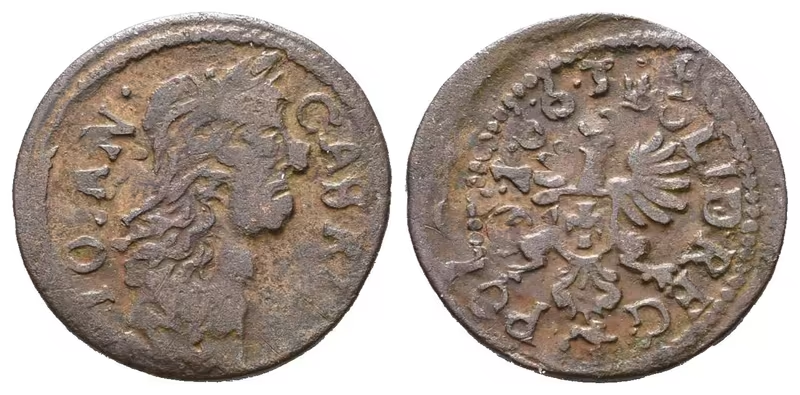
Skladem 1 ks - Code: SPOL91-B1663.1
Polsko, Szelag 1663
Polsko, Jan II. Kazimír, 1648 - 1668 Boratynka koronna 1663, Ujazdów, Kop.1550, var. letopočtu, patina
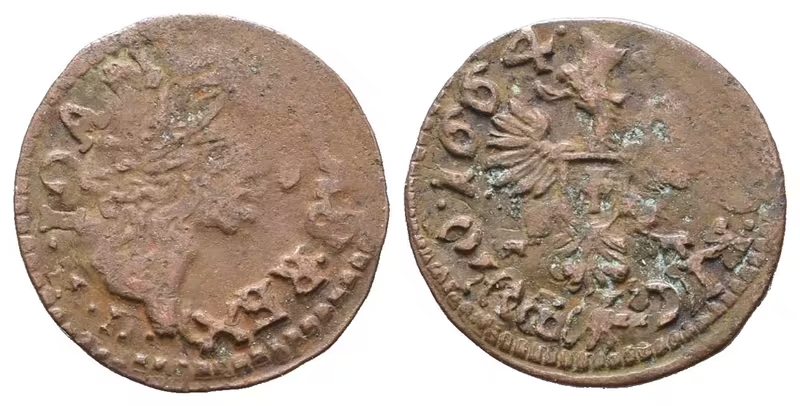
Skladem 1 ks - Code: SPOL91-B1664
Polsko, Szelag 1664
Polsko, Jan II. Kazimír, 1648 - 1668 Boratynka koronna 1664, Ujazdów, Kop.1552, patina
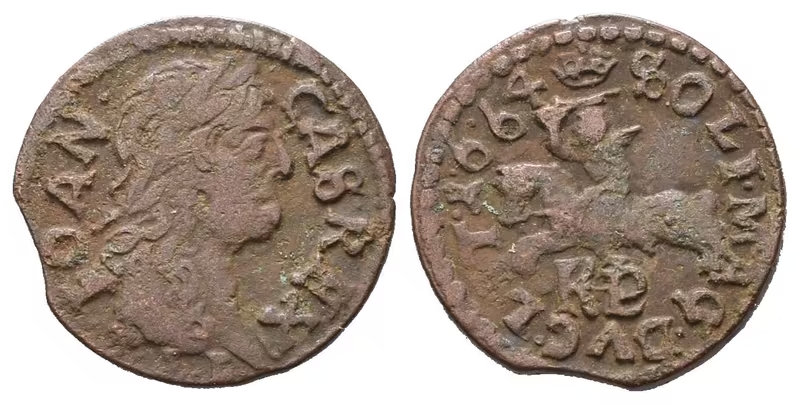
Skladem 1 ks - Code: SPOL91-B1664.1
Polsko, Szelag 1664
Polsko, Jan II. Kazimír, 1648 - 1668 Boratynka koronna 1664 HKPL, Vilnius, Kop.3594, patina
Skladem 1 ks