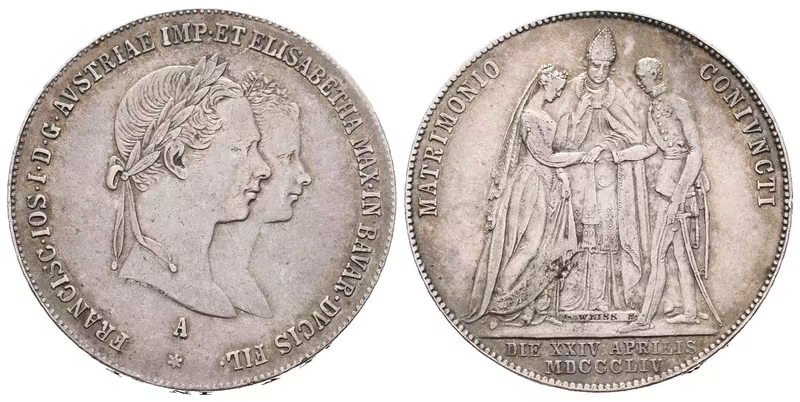
Wedding coinage
Wedding strikes are coins and medals issued on the occasion of the wedding (or its anniversary) of a ruler or another important personage. These are commemorative issues that recall a dynastic union and often bear a double portrait of the couple or symbolism of the marriage.
Wedding strikes grow out of the tradition that coinage and medal-making were not only a practical instrument of circulation but also a means of public representation. Dynastic marriages had an exceptional weight in European history: they united families, consolidated claims to territory, sealed alliances and often changed the balance of power between states. For this very reason, a ruler's wedding became an event that was commemorated not only by celebrations but also by a "lasting" material record. Coins or medals were ideally suited to this purpose: they were metallic, durable, easy to disseminate, and at the same time carried a clear message in both image and text.
In the early modern period, a culture of commemorative issues developed which built on older mediaeval customs but employed ever more advanced engraving and symbolism. Wedding strikes appear more often in sources and collections from the 17th century onwards, when, alongside ordinary circulating coins, medals and commemorative pieces designed to recall important events came strongly to the fore. In some cases these were real coins with a nominal value, in others medals without a circulation function. The distinction between the two categories is important: a coin could theoretically be used for payment, whereas a medal was from the outset a memento and a gift.
Wedding strikes also often had a concrete social role. They could be distributed at celebrations, given as gifts to loyal officials, soldiers or towns, or sold as souvenirs. At rulers' courts they also functioned as an instrument of propaganda in the good sense of the word: they publicly demonstrated the legitimate continuation of the dynasty, emphasised the prestige of the family, and reminded people that the ruler's power had firm family backing. At a time when part of political stability was derived from inheritance claims, a marriage and the subsequent birth of offspring were events with direct political consequences.
History
In the 18th and 19th centuries, when the mass production of coins expanded and at the same time the importance of public state symbolism grew, wedding strikes became part of the broader world of commemorative issues. Typical are pieces commemorating anniversaries, silver or golden weddings, because precisely round jubilees offered an opportunity for the public celebration of the "stability" of the ruling couple. In the Habsburg environment, for example, one encounters wedding issues commemorating the marriage of Francis Joseph I and Elisabeth of Bavaria, as well as later anniversary pieces. These issues show how the motif of marriage was transformed into a symbol of dynastic continuity and the loyalty of subjects.
In the modern era, the tradition is continued mainly by commemorative medals and collectors' strikes that recall weddings in ruling houses or significant social personages. A similar principle, however, can also appear outside the monarchy, as a commemoration of state, ecclesiastical or social unions, although the most typical and historically most prominent are precisely the royal and aristocratic contexts in which marriage had political weight.
Wedding strikes are characterised by relatively stable iconography. Common is a double portrait of the bride and groom, either facing forward or in profile, often in ceremonial stylisation. Sometimes, instead of a portrait, there appears a scene of the ceremony, a heraldic combination of the two family coats of arms, wedding symbols (wreaths, joined hands, allegories of fidelity), or inscriptions emphasising the date and event. The texts tend to be formulated ceremoniously and may commemorate not only the marriage itself but also anniversaries, such as a "silver" or "golden" wedding.
Motifs, execution and collecting significance
From a technical point of view, these strikes were often produced to a higher quality, because they were meant to be representative. With coins, this meant more careful work on the dies, with medals also a greater freedom in composition and modelling. Wedding strikes are therefore sought after by collectors who appreciate the combination of a historical event and quality artistic execution. With some issues several variants exist according to the metal (silver, gold, bronze), diameter or method of surface finishing, because producers responded to different target groups, from courtly gifts to more accessible souvenir pieces.
In collecting assessment, what matters above all is the preservation of detail in the portraits and inscriptions, a natural surface without harsh cleaning, and with more modern pieces also the completeness of the original packaging or case. At the same time, it is important to distinguish whether the item is an actual coin with a nominal value or a medal: both categories may look similar, but their purpose, mintage and method of distribution may have differed significantly. Wedding strikes thus form an attractive chapter of numismatics and phaleristics, because they show how a ruler's personal event was transformed into a public symbol intended in metal to outlast its own time.
In our auction and shop
- Code: MA007-1854A.1
1/2 Tolar 1854 A
František Josef I. (1848 - 1916) 1/2 Tolar 1854 A - svatební, Ves. 5, pěkná zachovalost
Skladem 1 ks - Code: RX-FRA3000SV
Francie - Svatební medaile
Francie AR Medaile b.l. (po roce 1800) (F. Andrieu) - Svatební medaile, Jacob a Rachel, bez vyrytého nápisu na Rv., pěkná zachovalost, duhová patina, lesk, rysky a drobné hranky Ag 0,800?, 36 mm (21,71 g), puncováno
- Code: RG-2017SVAT
AR svatební tolar 2017
AR Medaile b.l. (2017) - Svatební tolar Ag 0,999, 40 mm (29 g), kapsle, vlasové rysky v ploše ilustrační foto, komisní prodej - obaly mohou být opotřebené
- Code: RAKART-2005Photo coming soon

Kartákova Daniela - Svatební tolar
Kartákova Daniela (1965 - ) AR Medaile 2005 - Svatební tolar Ag 0,999, 40 mm (29 g), kapsle, etue, certifikát, PROOF, vyraženo 1000 ks