John Ernest of Saxony
John Ernest of Saxe-Eisenach (1566–1638) was an Ernestine duke of the House of Wettin who ruled in Saxe-Eisenach and toward the end of his life also inherited Saxe-Coburg. In a time of religious and political tensions in the Empire he relied on court administration and left behind coins and medallic strikes prized for their clear titulature and dating.
John Ernest of Saxe-Eisenach was born on 9 July 1566 at Grimmenstein Castle in Gotha as the youngest son of John Frederick II the Middle and Elisabeth of the Palatinate. He belonged to the Ernestine branch of the Wettins, which after the loss of the Saxon electoral dignity in the 16th century administered a series of smaller duchies. He spent his childhood and youth in an environment where dynastic politics, religious division and the practical questions of administering fragmented lands intersected. He received his education partly at universities, and he soon found himself in the shadow of older relatives, against whom the family estates had repeatedly to be defined and divided.
Inheritance and territorial agreements within the family played a fundamental role in his life. With his brother John Casimir of Saxe-Coburg he was long associated with the administration of the Saxe-Coburg portion, their position shifting from guardianship rule toward a more independent regency. In 1590 an agreement on the division of rule was reached, which opened the way for John Ernest to his own residence. His political centre gradually shifted to Eisenach, which became the capital of his land and the place from which he directed the court administration. In 1598 he established independent organs of administration for his duchy — a territorial government and a consistory — which shows the effort to give a relatively small state a stable institutional framework. Such steps were important in the Protestant lands of the Empire not only for ecclesiastical and educational matters, but also for the daily running of justice and financial administration.
History
Family life was marked by tragedies and childlessness. His first marriage to Elisabeth of Mansfeld-Hinterort (1591) ended with her death in childbirth in 1596; his only son died shortly after birth. In 1598 he married for the second time Christina of Hesse-Kassel, daughter of William IV the Wise, but this union too remained without offspring. The question of succession therefore hung over his rule for a long time, which in the Ernestine environment often led to further divisions of lands. When his brother John Casimir died without heirs in 1633, John Ernest inherited Saxe-Coburg and until his death ruled both lands in personal union. He died on 23 October 1638 in Eisenach. Because he left no descendants, his line died out and the territories were divided among the related Ernestine branches, which once again confirmed the typical mutability of the map of the Thuringian-Saxon duchies in the early modern period.
Under John Ernest of Saxe-Eisenach, coinage followed on from the tradition of the Ernestine lands, where coins became not only currency but also an instrument of sovereign representation. Silver denominations of various values were in circulation — from smaller pieces for everyday payments to thaler strikes intended for larger transactions. Higher silver coins tend to be the most rewarding for collectors: they usually have more legible titulature, a more distinct heraldic composition and often precise years by which strikes can be reliably classified. In his case it is also interesting that part of the issues commemorates joint rule or family ties, which may be reflected in the composition of the arms and in the way the duke's title and affiliation with the Ernestine branch is expressed in the legend.
Coins, titulature and collector context
The connection with both lands that he administered at the end of his life is also attractive for collecting. The transition of Saxe-Coburg into his hands in 1633 creates a clear historical boundary that can be "read" well in a collection by the years and changes in titulature. In practice it is worth observing above all the inscriptions (abbreviations of titles), the form and division of the shield, possible years and also artistic details that differ according to the mint and period. With circulating pieces wear is common, so preservation and the legibility of legends are decisive; with better-preserved examples, the quality of the strike and the aesthetics of the arms or portrait stand out. For the numismatist these coins also represent a source for the history of the small German states, where politics often took place "in the detail" — in institutions, administration and financial stability — and where coins belong among the most tangible evidence of sovereign power.
In our auction and shop
- Code: ZD-2019VIT
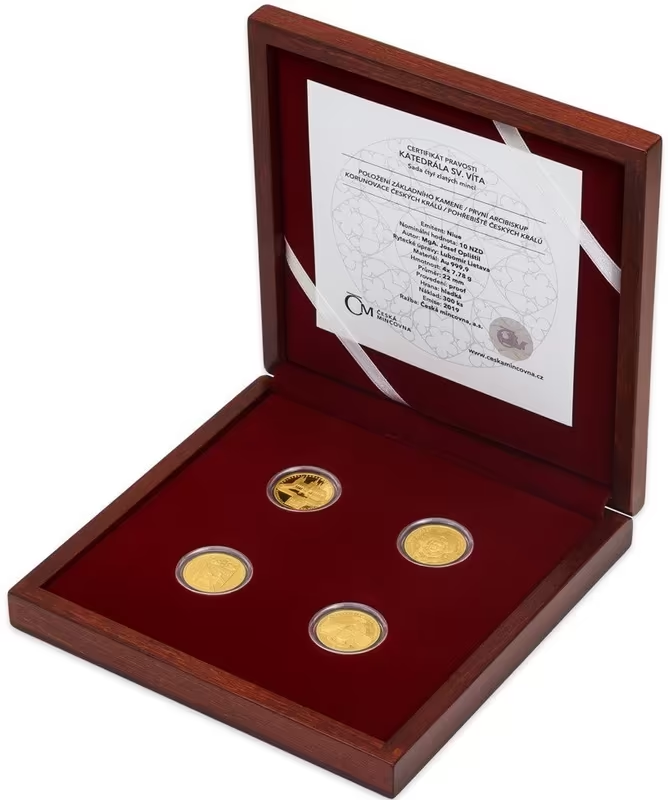
Sada mincí 2019 - Katedrála sv. Víta
Česká republika (1993 - ) Sada čtyř mincí 2019 (Josef Oplištil) - Katedrála sv. Víta 4x Au 0,9999, 22 mm (7,78 g), náklad 300 ks, certifikát, etue, papírový přebal, PROOF Bez ohledu na vyznání je katedrála svatého Víta duchovním symbolem, který je drahý…
Skladem 1 ks