Julia Maesa
Julia Maesa (c. 165–224) was a powerful Roman matron, grandmother of the emperors Elagabalus and Severus Alexander. Sister of the empress Julia Domna and a key figure of the Severan dynasty.
Julia Maesa came from a priestly family from Emesa (Homs) in Syria, where her family administered the cult of the sun god Elagabal. Her sister Julia Domna married Septimius Severus, which opened up to the family the path to power. After the death of Caracalla in 217 and the suicide of Julia Domna, Maesa was banished to Emesa. Augusta Julia Maesa began here to plan a return to power through her grandsons.
In 218 she organised a military uprising which placed her grandson Elagabalus on the throne. The fourteen-year-old emperor was only a puppet in the hands of Maesa and her daughter Julia Soaemias. Maesa effectively ruled the empire and took part in sessions of the Senate — the first woman with this privilege. When Elagabalus became unsustainable because of scandals, Maesa organised his murder and replaced him with her second grandson Severus Alexander in 222.
Life and Political Role of Julia Maesa
She spent her last years as the "Great Grandmother" (Avia Augusta) influencing the rule of Severus Alexander together with her daughter Julia Mamaea. She died a natural death in 224 at the age of about 60. The Senate deified her. Julia Maesa was the most powerful woman of Roman history, the effective ruler of the empire for a period of 6 years.
Julia Maesa is depicted on thousands of coins from throughout the empire. Denarii and antoniniani with the legend IVLIA MAESA AVG are common. The portraits depict a dignified older woman with a characteristic hairstyle. The reverses emphasise Pietas, Felicitas, Saeculi Felicitas. The mints in Rome, Antioch and Alexandria massively produced her strikes.
Numismatic Significance
Unique is the quantity and quality of her coins — surpassing many emperors. Joint issues with Elagabalus and Severus Alexander legitimised the young emperors. Provincial coins from Syria emphasise her Emesa origin. Posthumous consecratio coins with DIVA MAESA. Julia Maesa represents the peak of female power in Roman numismatics.
In our auction and shop
- Code: BE050-0385
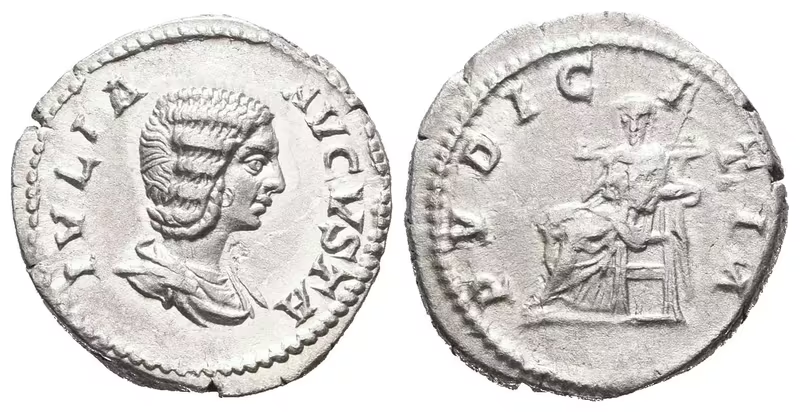
Julia Domna, denár, Řím, RIC IV 385
Julia Domna (211 - 217) mincovna Řím, raženo za Caracally 211 - 215, sedící Pudicitia, RIC IV 385
Skladem 1 ks - Code: BE050-0388Recommended
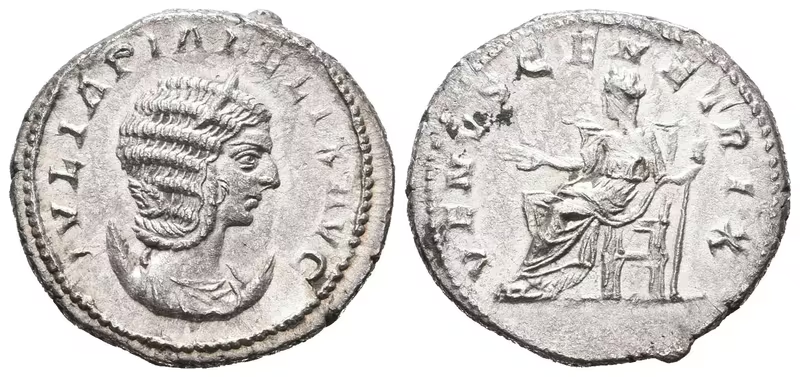
Julia Domna, antoninián, Řím, RIC IV 388a
Julia Domna (211 - 217) mincovna Řím, raženo 215 - 217, sedící Venus Genetrix, RIC IV 388a
Skladem 1 ks - Code: BE050-Z373
Julia Domna, Nicaea, Bithynia, AE
Septimius Severus (193 - 211) Nicaea, Bithynia, AE 15, Rv: Ověnčený hořící oltář, opis. Rec Gen 392, pěkná zachovalost a patina, exc._R!
Skladem 1 ks - Code: BE050-0390
Julia Domna, Denár, RIC.390
Julia Domna, manželka Septimia Severa (193 - 211) Denarius, Roma, 213, Rv: VESTA , stojící Vesta doleva drží palladium a žezlo, RIC.390 (Caracalla), RSC.230 Patina, vady střížku a rysky (2,69 g)
Skladem 1 ks