Julia Mamaea
Julia Mamaea (180–235) was a Roman empress, mother of Emperor Severus Alexander and sister of Elagabalus's mother Julia Soaemias, who became renowned as the effective ruler of the Roman Empire during her son's minority and the last powerful woman of the Severan dynasty before its fall. Julia Mamaea is significant in numismatics for the extensive productio…
Julia Mamaea was born around 180 in Emesa in Syria as the daughter of Julius Avitus and the cousin of Empress Julia Domna. She came from the same influential Syro-Arabian family as Julia Domna and Julia Soaemias, which controlled the temple of the sun god Elagabal. Her family maintained a high standing in the Roman province thanks to a combination of religious influence, commercial wealth and political contacts.
Marriage to Gessius Marcianus brought Julia entry into the Roman senatorial aristocracy, but her greatest power came from family ties to the Severan dynasty. After the deaths of Julia Domna and Caracalla, the Syrian women of her family — grandmother Julia Maesa, sister Julia Soaemias and she herself — became the key figures in maintaining the power of the Severan line.
The reign of Elagabalus (218–222) brought Julia Mamaea a gradually growing influence at the imperial court. While her sister Julia Soaemias supported the controversial policies of her son Elagabalus, Julia Mamaea represented the more moderate wing of the family. When Elagabalus's extravagance and religious excesses became unsustainable, Julia Maesa decided to replace him with Julia's son Alexander.
The conspiracy against Elagabalus in 222 was organised by Julia Maesa with the support of Julia Mamaea and the Praetorian Guard. When Elagabalus was murdered together with his mother Julia Soaemias, the thirteen-year-old Severus Alexander ascended the throne with his mother as effective regent. Julia Mamaea thus became the most powerful woman of the empire.
The regency (222–231) characterised Julia's actual rule over the empire during Alexander's minority. She surrounded herself with experienced advisers including the jurist Ulpian and pursued a moderate policy in contrast to Elagabalus's excesses. She sought to restore the authority of the Senate, to stabilise finances and to calm the army after years of scandals.
History
Conflict with the Praetorian Guard arose because of Julia's efforts to limit military spending and improve discipline. The Praetorians murdered Ulpian in 228, which weakened Julia's position. Cassius Dio criticised her dominant role and accused her of weakening imperial authority through "gynaecocracy" — the rule of women.
The eastern campaign (231–233) against Sasanian Persia was to restore imperial prestige and the military reputation of Severus Alexander. Julia Mamaea accompanied her son to the east, but the campaign ended inconclusively despite enormous costs. The army was dissatisfied with the results and accused the empress of excessive influence on military decision-making.
The German campaign (234–235) became the final ruin of Julia Mamaea and her son. When the Germanic Alamanni broke through across the Rhine, Alexander had to break off the Persian operations and hasten westward. The Rhenish legions were disgusted with Alexander's inability to achieve a decisive victory and with Julia's dominance in decision-making.
The military mutiny at Mainz in March 235 ended tragically for both. The Rhenish legions rebelled under the leadership of Maximinus Thrax and murdered the twenty-year-old Alexander together with his mother. Julia Mamaea died at the age of about 55 as the last powerful representative of the Severan dynasty, ending the era of Syrian dominance in Roman politics.
The legacy of Julia Mamaea is ambivalent — her regency saved the empire from the excesses of Elagabalus, but her dominance over a weak son prepared the ground for the military anarchy of the third century. She represented the last attempt at restoring civil control over the army before the rise of the soldier emperors.
Julia Mamaea in Numismatics
The coins of Julia Mamaea document her rise to power during the regency for Severus Alexander and represent one of the most extensive issues devoted to a Roman empress in the 3rd century. The portraits depict Julia with characteristic Severan hair arrangements — complex chignons and Oriental ornaments reflecting the Syrian origin and Eastern cultural influences at the imperial court.
The most frequent motifs are maternal and regental virtues — MATER AVGVSTI (mother of the Augustus), MATER CASTRORUM (mother of the camps), FELICITAS PVBLICA (public good fortune) and PIETAS AVG (imperial piety). These inscriptions emphasise Julia's legitimate role as mother of the emperor and protector of the empire during the dangerous transitional period after the tyranny of Elagabalus.
Oriental motifs reflect the continuing Syrian influence on the Severan court even after the death of Julia Domna. Some coins contain references to the sun god or Eastern deities, but in a more moderate form than the controversial Elagabalus issues. The design often includes symbols of prosperity, peace and maternal care symbolising Julia's efforts to stabilise the empire.
Regional variants from the eastern provinces often display Greek inscriptions and local cultural motifs reflecting Julia's popularity in the Syro-Arabian areas. Alexandrian coins contain Egyptian symbols, while Asia Minor issues combine Roman and Hellenistic traditions. These coins document the geographical range of Julia's support.
In our auction and shop
- Code: BE064-0331
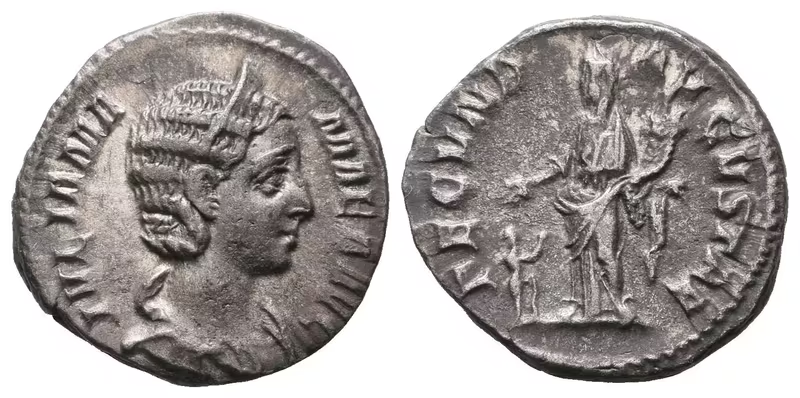
Julia Mamaea, Denár, RIC. 331
Julia Mamaea, matka Alexandra Severa, Denár, Rv: FECVND AVGVSTAE, stojící Fecunditas zleva drží pateru nad dítětem a roh hojnosti, RIC.331
- Code: BE064-0341
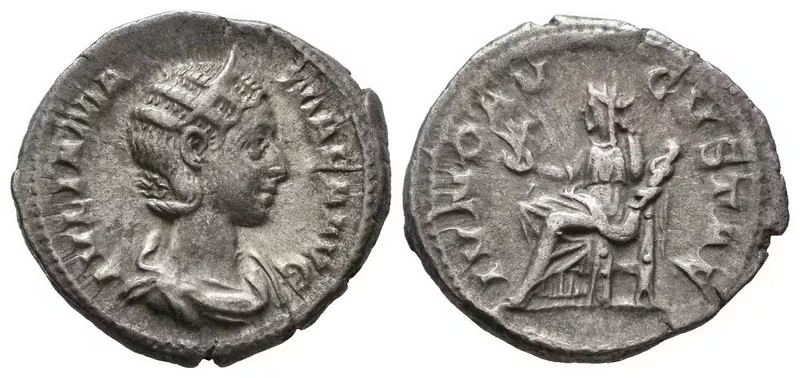
Julia Mamaea, Denár, RIC. 341
Julia Mamaea, matka Alexandra Severa, Denár, Rv: IVNO AVGVSTAE S C, sedící Juno zleva drží květinu a dítě, RIC.341 (Alex. Severus)