Elagabalus
Elagabalus (also Heliogabalus) was a Roman emperor of AD 218–222, known for his rapid rise and violent fall. As a young sovereign he promoted in Rome the cult of the Syrian sun god Elagabal, and his short reign left a marked imprint on coinage.
Elagabalus was born around AD 204 (the place of birth is uncertain) as Varius Avitus Bassianus and came from the milieu of Syrian Emesa (today's Homs), where the local solar cult of Elagabal held an important position. Even before his accession to the throne he had served as priest of this deity, which later became one of the central motifs of his reign. After the murder of Emperor Caracalla and the short reign of Macrinus, his family circle — particularly the women of the Severan dynastic background — exploited the army's discontent and pushed the youth forward as the "true Antoninus", that is, a successor to take up the popular line of the previous emperors.
He was proclaimed emperor in AD 218 and as sovereign used the name Marcus Aurelius Antoninus to bolster his dynastic legitimacy. His reign, however, was not solely a matter of politics and the army but also of religious self-representation. Elagabalus sought to transfer the central weight of the cult of Elagabal to Rome and to advance it at the expense of the traditional Roman cults, provoking the opposition of part of the Senate and of conservative circles. A striking symbol of this programme was the sacred "stone" venerated in Emesa, which was to be moved to the centre of Roman power, together with court rites that Romans found alien.
Ancient sources (often written at a distance and with moralising intent) portray Elagabalus's reign as a period of extravagance, provocations and court instability. What is certain is that he ruled for a very short time, in an environment of tense relations between the imperial court, the Senate and the army. The army was crucial for the retention of power, especially the Praetorians, and it was in their camp that the decisive turn finally came. In AD 222 Elagabalus and his mother Julia Soaemias were murdered, and after his death his body was desecrated and thrown into the Tiber. He was succeeded by Alexander Severus, whose regime sought to distance itself from some of his predecessor's measures and to restore a "more acceptable" image of imperial power.
History
Elagabalus thus entered history as a sovereign whose short reign concentrated a number of the conflicts of the late Severan era: the contest for legitimacy, dependence on military support and at the same time the search for a new ideological foundation for imperial authority. It is precisely this combination of rapid rise and abrupt fall that explains why historians and numismatists return to him again and again.
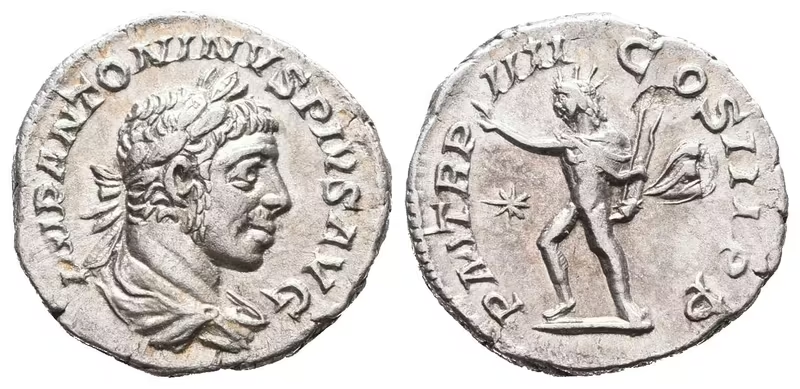
In numismatics Elagabalus is very well documented thanks to extensive issues of imperial coins. Both standard silver and bronze denominations were struck, as well as gold issues, with the iconography and inscriptions serving to promote the legitimacy of the young emperor. The obverses generally bear his portrait with a wreath and a titulature emphasising his role as imperator and as "pious" ruler (the legend IMP ANTONINVS PIVS AVG is common). The reverses make use of traditional Roman motifs — for example, the goddess Victoria, personifications of loyalty or military allegiance — meant to remind the public of the stability and support of the army.
An interesting group is formed by types in which the emperor presents himself in a religious role — for instance, sacrificing at an altar. These motifs may be understood as a numismatic reflection of his emphasis on cult and ritual. Overall, Elagabalus's coins rank among important sources for the study of propaganda: the portrait, the titulature, the deities and the personifications on the reverse together create the "official narrative" of the reign, which could be very different from how it was later portrayed by the hostile tradition.
The ruler on coins and typical strikes
For collecting practice it is useful to know that Elagabalus appears in the literature under several names (Elagabalus/Heliogabalus, and as emperor Marcus Aurelius Antoninus). When attributing coins, the titulature and portrait style are therefore decisive, along with the specific reverse types and dating formulas (consulships, tribunician power). Thanks to these, many strikes can be quite precisely placed within the short period of AD 218–222.
In our auction and shop
- Code: BE056-1620
Elagabalus, Moesia, Marcianopolis, AE
Elagabalus (218 - 222) Moesia, Marcianopolis, společná ražba s Julií Maesou, AE 30, magistrát Seleukos, Rv: Dikaiosyne stojící zleva drží klasy a dlouhou pochodeň, jako Varbanov 1621-2, pěkná zachovalost, patina, škr.
Skladem 1 ks - Code: BE056-1389
Elagabalus, Moesia, Marcianopolis, AE
Elagabalus (218 - 222) Moesia, Marcianopolis, AE 17 Assarion, Rv: Had vylézající z košíku (cista), jako Varbanov 1389, Moushmov 636, tmavá patina
Skladem 1 ks - Code: BE056-1462
Elagabalus, Moesia, Marcianopolis, AE
Elagabalus (218 - 222) Moesia, Marcianopolis, AE 26 Pentassarion, magistrát Titianus, Rv: Hera stojící zleva drží pateru a dlouhé žezlo, pěkná zachovalost a patina, lehce exc., jako Varbanov 1452, Moushmov 656
Skladem 1 ks - Code: BE056-0028.1
Elagabalus, Denár, RIC. 28
Elagabalus (218 - 222) Denarius, Roma, 220, Rv: P M TR P III COS III P P, kráčející Sol doleva drží bič, pravou ruku má zdviženou, v poli hvězda, RIC.28, RSC.154 Krásná zachovalost, jemná patina, krásně vyražený, zbytky lesku, drobné vady střížku (2,80 g)
Skladem 1 ks