Alexander Severus
Alexander Severus was a Roman emperor of the Severan dynasty who reigned from 222 to 235. His rule is associated with efforts to stabilise the empire after a period of crises, with the growing influence of the court and the army, and also with abundant coin production which today belongs among the most accessible sources for this era.
Alexander Severus (Latin Severus Alexander) ascended the throne as a very young man after the violent fall of the emperor Elagabalus. At the time of his accession the Roman Empire was internally unsteady: uncertainty reigned in the army and in the cities, the prestige of imperial power had suffered and pressure from enemies was growing on the frontiers. A fundamental role in the early years of his rule was played by his mother Julia Mamaea, who acted as the principal support of the imperial court and to a considerable degree determined the direction of policy. For part of the Roman elites Alexander's accession meant a return to "more moderate" conditions; for the army, however, the young emperor was from the outset a challenge: the army expected unambiguous leadership, successes on the frontiers and generous rewards.
Alexander attempted to rely on the tradition of Roman state administration and on the authority of the Senate, which stood in sharp contrast to some of his predecessors. In practice this meant an emphasis on order in administration, an effort to restrain court excesses and a search for compromise with urban elites. At the same time, however, the importance of the imperial officials and of the court circle grew, because the empire was becoming ever more complex and administration required specialist support. Alexander's rule thus carried within it a tension: on the one hand an attempt at a "more normal" running of the state, on the other the pressure of a reality in which the army and the security of the frontiers were what really mattered.
The greatest test came from external conflicts. In the East a new and ambitious adversary appeared — Sasanian Persia, which began to press more strongly on Roman holdings and acted more confidently than the earlier Parthian power. In the north and the north-east, pressure from Germanic groups, which carried out raids into the border areas, increased. In such a situation it was crucial for the emperor to demonstrate military authority. Alexander participated in campaigns, but his reputation with the army was weakened by the impression that he preferred negotiation and caution. What might have been pragmatic from the point of view of reason of state appeared to the army as weakness.
History
The end of Alexander's rule came when discontent in the army turned into open resistance. The commander Maximinus Thrax pushed his way through in the military setting, and Alexander Severus was murdered in 235 together with his mother. His death is often understood as a symbolic dividing line: the period of relatively stable dynasties closes and the empire enters the era in which emperors rise and fall chiefly according to the will of the army. This development in the 3rd century then led to the deeper crisis we know today as the "Crisis of the Third Century".
Alexander Severus is exceptionally interesting for the collector by virtue of how extensive and varied his strikes are. They were minted both in Rome and in a number of provincial mints, and thanks to this many types with differing motifs and titulatures exist today. The emperor's portrait often appears on coins in various forms — from youthful depictions to more mature portraits of his later years. It is precisely changes in portrait and legend that can help to assign coins approximately to particular stages of the reign.
Typical are motifs emphasising stability and "good government": personifications of virtues, the security of the state, prosperity and harmony. The coins thus fulfilled the role of a public message — they were to recall that the emperor secured order and prosperity, even though the reality on the frontiers was ever more strained. With provincial strikes it is moreover valuable that they bear local motifs and the names of cities, so showing how imperial power presented itself in various regions of the empire.
The coins of Alexander Severus and what they reveal
For practical collecting it is good to know that more common silver and bronze denominations frequently appear on the market in various grades. Value is markedly affected by the legibility of the legends, the quality of the portrait and a natural surface free from harsh cleaning. With some pieces the identification of a particular mint or an unusual reverse motif may also be important, since these tend to be more highly valued by collectors than entirely common types.
In our auction and shop
- Code: BE062-0601
Alexander Severus, Dupondius, Ric. 601
Alexander Severus (222 - 235) Dupondius, 222 - 231, Rv: RESTITVTOR MON S C, stojící císař zleva drží žezlo, pozvedá pravou ruku, RIC.601
Skladem 1 ks - Code: BE062-0642
Alexander Severus, Sestercius, RIC.642
Alexander Severus (222 - 235) Sestercius, 231 - 235, Rv: PROVIDENTIA AVG S C, stojící Providentia čelně drží dva klasy nad modiem a roh hojnosti, RIC.642
Skladem 1 ks - Code: BE062-0080
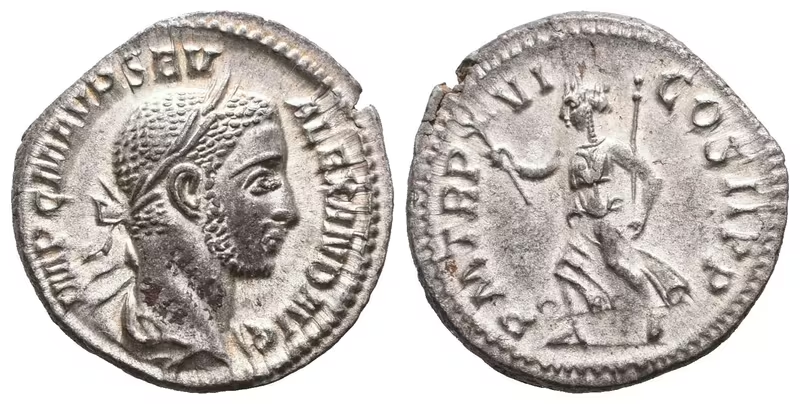
Severus Alexander, denár, Řím, RIC 80
Severus Alexander (222 - 235) mincovna Řím, raženo 228 n.l., křáčející Pax s ratolestí, TRP VI COS II, RIC 80
Skladem 1 ks - Code: BE062-0101
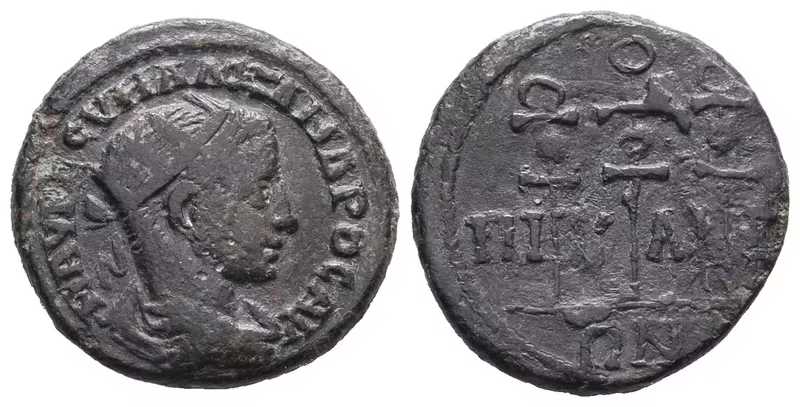
Severus Alexander, provinciální AE, Nikaia, BMC 101
Severus Alexander (222 - 235) mincovna Nicaea, tři vojenské standarty, BMC 101
Skladem 1 ks