Charles Alexander of Brandenburg-Ansbach
Charles Alexander of Brandenburg-Ansbach (German Christian Friedrich Karl Alexander, 1736–1806) was the last Margrave of the Franconian principalities of Brandenburg-Ansbach and Brandenburg-Bayreuth from the House of Hohenzollern. He became famous for having sold his territories in 1791 to Prussia, and in numismatics he is linked with a number of German s…
Charles Alexander of Brandenburg-Ansbach was born on 24 February 1736 in Ansbach as the son of Margrave Charles William Frederick and the Prussian princess Frederica Louisa. After the death of his elder brother he became heir, and in 1757 took over the government of the Margraviate of Brandenburg-Ansbach. As a member of the House of Hohenzollern, he was related to the Prussian royal dynasty, which in the environment of the Holy Roman Empire meant not only prestige but also political ties that could be used to the advantage of a small Franconian state.
His rule fell in a period when the German principalities lived within a dense network of imperial rights, dynastic agreements and financial commitments. The ruler of such a unit had above all to deal with the economy, the administration of the court and the maintenance of fiscal stability. Charles Alexander is mentioned as a ruler who, alongside representation, was also interested in practical projects, in agriculture and in support for various economic undertakings. At the same time this was an age when in many smaller states the ambitions of the court clashed with the means of the country: a costly lifestyle, court buildings and the upkeep of the apparatus could place a long-term burden on finances.
History
In 1769 Charles Alexander also acquired the Margraviate of Brandenburg-Bayreuth, joining together in his hands the two Franconian possessions of the Hohenzollerns. Even so these were still relatively small state units which had to balance their own policy cautiously between stronger neighbours. In the late 18th century, moreover, the old imperial order faced growing pressures, both economic and ideological, and was shortly afterwards shaken to its foundations by the revolutionary and Napoleonic wars.
The most famous act of Charles Alexander was that in 1791 he decided to transfer both margraviate states to Prussia. This was not a "sale" in the modern civil-law sense, but a dynastic and political arrangement that secured for him lifelong financial support and at the same time enabled the territories to come under direct Prussian administration. Charles Alexander then went abroad, lived mainly in England, and appeared more as a private person than as a ruling prince. He died on 5 January 1806 in England, precisely at a time when the old order in central Europe was rapidly collapsing and the map of the German lands was beginning to be rewritten.
The coins of Charles Alexander and typical strikings
Under the rule of Charles Alexander of Brandenburg-Ansbach a varied range of strikings arose, corresponding to the then German coinage environment, in which regional customs intermingled with imperial standards. Alongside small denominations, middle nominals were also struck (for example kreuzers and their multiples), and in ceremonial or representative issues thalers or ducats also appear. On the coins the ruler tends to be designated with a Latin titulature, often with motifs of arms and heraldic emblems, emphasising both his Hohenzollern lineage and the union of the two Franconian margraviates.
For collectors, mint marks and small differences in legends and year dates are also important, because the strikings come from specific mint workshops and may have several variants. With the German states of the 18th century, moreover, it often holds that individual issues reflect not only economic needs (small coinage for the market) but also political representation: a commemoration of an accession, the acquisition of territory or another dynastic event. In the case of Charles Alexander, numismatics also commemorates the fact that his reign closed the era of the independent Franconian margraviates of Ansbach and Bayreuth, and the coins are some of the most tangible evidence of their last ruler.
In our auction and shop
- Code: SFRA-D1990
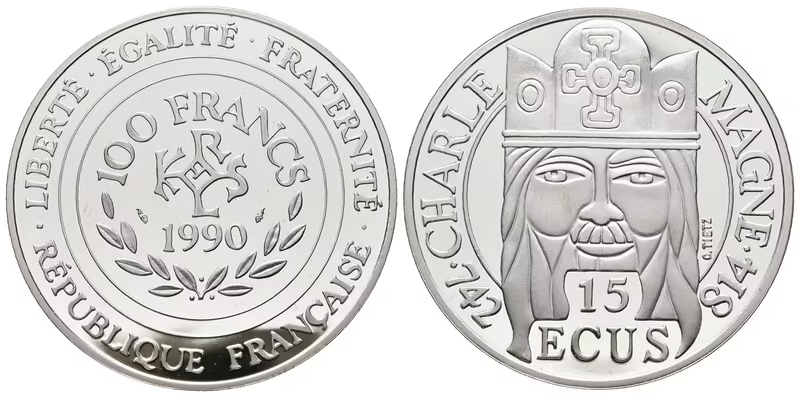
Francie, 100 Francs / 15 Ecus 1990 - Karel Veliký (Charlemagne, 742-814)
Francouzská republika (1958-dosud) 100 Francs / 15 Ecus 1990 - Karel Veliký (Charlemagne, 742-814), KM# 983 Ag (.900), 37 mm (22,2 g), v kapsli. Stav mince odpovídá fotografii.
Skladem 1 ks - Code: M78B-BZ1719
Karel VI., 1/2 Krejcar 1719
Karel VI. (1711 - 1740) 1/2 Krejcar 1719, Kutná Hora-Weyer, oxidace, lehce olámaný_R!
Skladem 1 ks - Code: RASPANEK-1958A
Špánek Karel - Výročí korunovace Jiřího z Poděbrad
Špánek Karel (1883 - 1983) AR Medaile 1958 - 500. výročí korunovace Jiřího z Poděbrad a Kunštátu českým králem Ag 0,900, 29 mm (12,13 g), puncováno luxusní zachovalost, jemná patina, lesk
Skladem 1 ks - Code: RASPANEK-1958A.1
Špánek Karel - Výročí korunovace Jiřího z Poděbrad
Špánek Karel (1883 - 1983) AR Medaile 1958 - 500. výročí korunovace Jiřího z Poděbrad a Kunštátu českým králem Ag 0,900, 29 mm (12,17 g), puncováno luxusní zachovalost, jemná patina, ražební lesk
Skladem 1 ks