Charles Egon I of Fürstenberg
Charles Egon I of Fürstenberg (7 May 1729 Prague – 11 July 1787 Prague) was a Bohemian nobleman originating from the German Fürstenberg family who held the office of Supreme Burgrave of the Kingdom of Bohemia and was famous as an enlightened patron of the sciences and the arts. In numismatic history he holds a particular position thanks to his connection…
Charles Egon I was born in Prague as the second son of Prince Joseph William Ernest of Fürstenberg-Stühlingen, founder of the princely branch of the family, and Countess Maria Anna of Wallenstein, heiress of the extensive Křivoklát estate. His elder brother Joseph Wenceslas inherited the majorat of the princely line based at Donaueschingen in Germany, while Charles Egon obtained the Bohemian possessions through his mother and thus founded the younger Bohemian branch of the Fürstenberg family.
He was educated at prestigious institutions of his day. From 1744 to 1746 he studied at the University of Leipzig, and then continued at the Royal Knight Academy in Turin, Italy. After returning to Bohemia he embarked on a career in the state administration, working from 1751 as a councillor at the provincial government in Prague. In 1766 he was sent as chief imperial commissioner to the Imperial Chamber Court in Wetzlar, where he proved his diplomatic abilities. For his services he received in 1767 the prestigious Order of the Golden Fleece, one of the highest distinctions of the Habsburg Monarchy.
The peak of his career was his appointment as Supreme Burgrave of the Kingdom of Bohemia, that is the de facto administrator of the country on behalf of the sovereign. He held this office from 1771 to 1782, during the reigns of Maria Theresa and her son Joseph II. At first he conducted himself in this office very well and enjoyed the favour of the court. He was, however, a supporter of gradual courtly reforms, which brought him into conflict with the radical reforming course of Emperor Joseph II. For the slow implementation of the Patent of Toleration he was finally dismissed from office.
History
Charles Egon I was distinguished by pronounced humanitarian feeling, which in the noble society of the time was rather exceptional. For his support of the poor and his championing of the subjects he gained the nickname "the beggars' advocate". His social attitudes are best captured by the statement with which he justified the abolition of robot labour on his Podmokly estate in 1779, several decades before the official abolition of serfdom in the entire kingdom: "The whip does not belong on people, and scarcely on cattle." He also founded the first private agricultural school in the Habsburg Monarchy and systematically supported the education of ordinary people.
An important chapter in the life of Charles Egon I was his activity in the field of science and culture. He gathered a remarkable library numbering about 20,000 volumes, for which he personally compiled a five-volume catalogue. This collection still ranks among the largest and most valuable noble libraries in Bohemia, and since 1881 has been kept at Křivoklát Castle. He donated a rich collection of natural and artistic objects to the Royal Bohemian Society of Sciences, of which he became the first honorary president on its foundation in 1784. These collections are today administered by the National Museum in Prague. Charles Egon I died in Prague's Malá Strana and was buried in the Fürstenberg tomb at Nižbor.
For the history of numismatics Charles Egon I of Fürstenberg is of key importance in connection with the Podmokly hoard. On 12 June 1771 on his Křivoklát estate, in the village of Podmokly, the largest deposit of Celtic gold coins in Europe was discovered. A local day-labourer Jan Koch, nicknamed Janota, found after heavy rain in the waterlogged bank of a stream a bronze cauldron containing thousands of gold staters of the "rainbow cup" type. According to surviving records, more than 4,200 coins were recovered; the total number is estimated at 5,000 to 7,000 pieces, weighing 30 to 50 kilograms.
Numismatic significance
News of the find spread quickly among the villagers, who began to divide the coins among themselves. Prince Charles Egon, however, asserted his manorial right and sent his bailiff Růžička with an armed escort to Podmokly. They demanded the coins from the subjects in unscrupulous ways – there are reports of searches of houses, the tearing-up of floors and even physical violence. Most of the hoard was carried off to Prague, where the prince, with the consent of Maria Theresa, had the gold melted down in the Prague mint.
From the melted Celtic gold two types of coin were produced. In July 1771, a total of 7,374 Theresian ducats with the date 1771 were struck. A year later, in 1772, an issue of 5,000 Fürstenberg ducats followed, bearing the bust of Prince Charles Egon I, his arms and the date 1772. These coins are today extraordinarily rare collectors' items. Charles Egon I gave part of the original Celtic coins to numismatic cabinets and museums in Europe and kept about 24 pieces for himself. The surviving specimens of rainbow cups from the Podmokly hoard are now kept in the collections of the National Museum in Prague, together with the remains of the bronze cauldron and its handle.
From a numismatic point of view, the melting of the Podmokly hoard represented an incalculable loss for the study of Celtic coinage. With the destruction of thousands of original coins, the possibility of typological analysis, of studying dies, weight standards and metallurgical composition was irretrievably lost. The surviving specimens indicate that they were staters of the Boii type, probably struck at the oppidum of Stradonice near Beroun.
In our auction and shop
- Code: SFRA-D1990
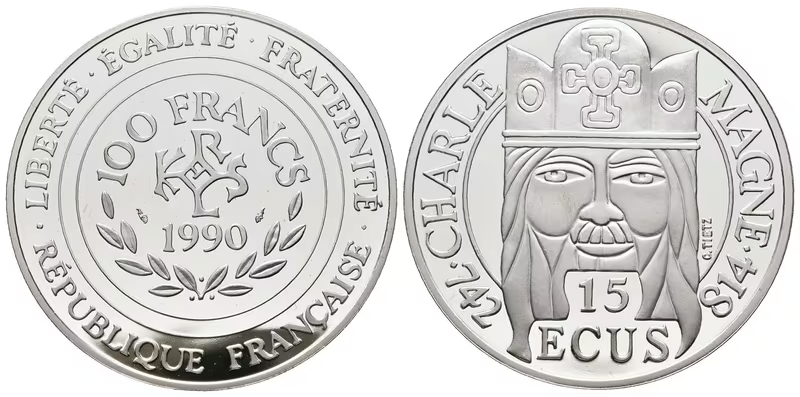
Francie, 100 Francs / 15 Ecus 1990 - Karel Veliký (Charlemagne, 742-814)
Francouzská republika (1958-dosud) 100 Francs / 15 Ecus 1990 - Karel Veliký (Charlemagne, 742-814), KM# 983 Ag (.900), 37 mm (22,2 g), v kapsli. Stav mince odpovídá fotografii.
Skladem 1 ks - Code: M78B-BZ1719
Karel VI., 1/2 Krejcar 1719
Karel VI. (1711 - 1740) 1/2 Krejcar 1719, Kutná Hora-Weyer, oxidace, lehce olámaný_R!
Skladem 1 ks - Code: RASPANEK-1958A
Špánek Karel - Výročí korunovace Jiřího z Poděbrad
Špánek Karel (1883 - 1983) AR Medaile 1958 - 500. výročí korunovace Jiřího z Poděbrad a Kunštátu českým králem Ag 0,900, 29 mm (12,13 g), puncováno luxusní zachovalost, jemná patina, lesk
Skladem 1 ks - Code: RASPANEK-1958A.1
Špánek Karel - Výročí korunovace Jiřího z Poděbrad
Špánek Karel (1883 - 1983) AR Medaile 1958 - 500. výročí korunovace Jiřího z Poděbrad a Kunštátu českým králem Ag 0,900, 29 mm (12,17 g), puncováno luxusní zachovalost, jemná patina, ražební lesk
Skladem 1 ks