Charles II of Spain
Charles II of Spain was the last Spanish king of the Habsburg dynasty, ruling from 1665 to 1700, whose physical and mental degeneration symbolised the decline of what had once been the most powerful European monarchy. In numismatics Charles II represents a tragic figure, while his eight-real thalers, escudos and colonial coins document a paradox – althoug…
Charles II was born on 6 November 1661 in Madrid as the son of Philip IV and his niece Mariana of Austria. The consequences of generations of Habsburg inbreeding were catastrophic for Charles: he suffered from physical deformities, mental retardation, epilepsy and infertility. The Habsburg jaw was so pronounced that he could not chew properly. He acceded to the throne at the age of four in 1665, with regency carried out by his mother Mariana with the help of various favourites, especially the Jesuit Nithard.
Spain under Charles's reign experienced a deep decline. The economy collapsed despite the inflow of American silver, which immediately disappeared in servicing debts and financing wars. Charles II of Spain was a mere puppet in the hands of court factions. The French aggression of Louis XIV deprived Spain of Franche-Comté, parts of the Netherlands and frontier fortresses. The War of Devolution, the Franco-Dutch War and the War of the League of Augsburg systematically eroded Spanish possessions. The king, called "El Hechizado" (The Bewitched), believed that he was possessed by demons and underwent exorcisms.
History
A dynastic crisis dominated the last years of Charles's reign. His two marriages – to Marie Louise of Orléans and Maria Anna of Neuburg – remained childless. The European powers schemed for the Spanish inheritance. Charles first designated as his heir the Bavarian Prince Joseph Ferdinand, and after the latter's death Philip of Anjou, grandson of Louis XIV. This decision unleashed the War of the Spanish Succession, which changed the map of Europe.
Charles II died on 1 November 1700 in Madrid at the age of 38. His death ended the Spanish branch of the Habsburgs after 184 years of rule. An autopsy revealed extreme degeneration: a brain the size of a walnut, rotten intestines, and a single non-functioning testicle. Paradoxically, during his reign the Spanish mints in the Americas produced more silver than at any time before, but this wealth merely financed Spanish decline.
Coinage in an era of decline
Charles's coinage represented a paradox – enormous production against economic collapse. The mints in Seville, Madrid, Mexico, Lima and Potosí struck millions of pieces of eight and doubloons. The design of Spanish coins depicted a simplified royal portrait and the Habsburg arms with the Pillars of Hercules.
Technically there was a decline in quality: coins were often irregular, with illegible inscriptions. The precious-metal content was manipulated for quick profit. Counterfeiting was endemic: up to a quarter of the currency in circulation consisted of forgeries. Colonial "cobs" were rough, hand-struck pieces. Nevertheless Spanish reals remained a world trade currency thanks to their enormous volume, not their quality.
In our auction and shop
- Code: RX-Z-007
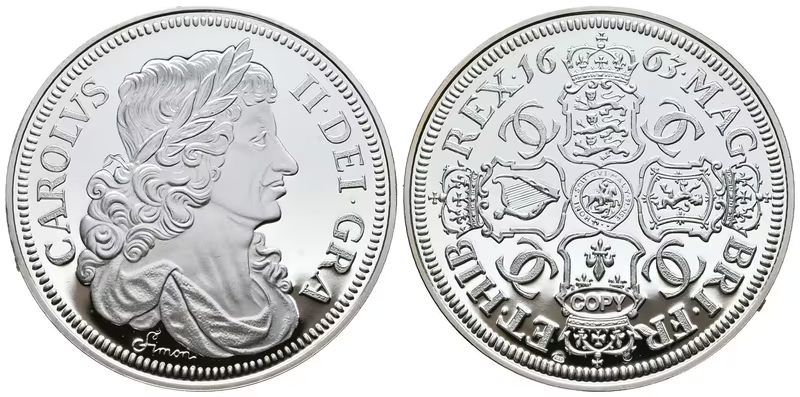
Velká Británie, Crown 1663 - Portrét Karla II., Petition Crown Thomase Simona, replika
Království Anglie - Karel II. (1660-1685) Crown 1663 - Portrét Karla II., Petition Crown Thomase Simona Ag (.925), 40 mm (20 g), v kapsli. Stav mince odpovídá fotografii.
Skladem 1 ks - Code: FA-235D
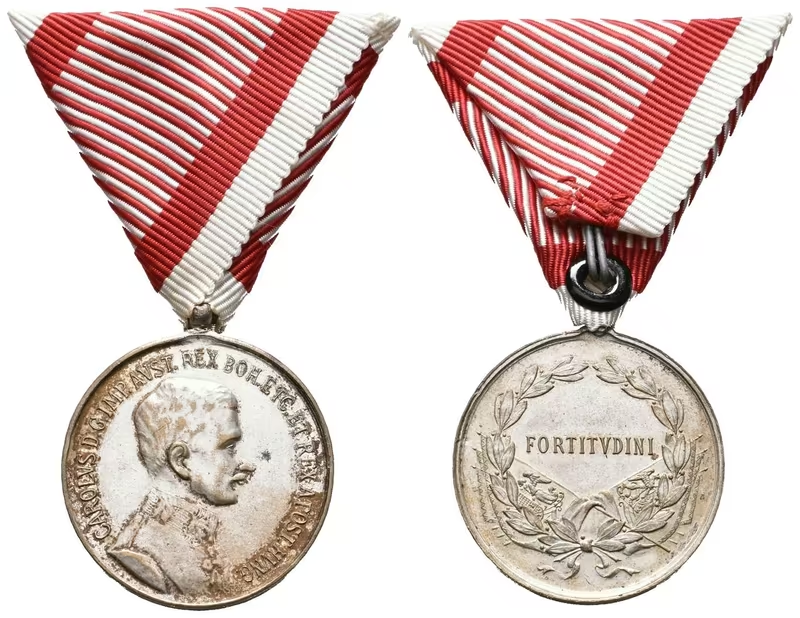
Medaile za statečnost, II. třída, postříbřená
Rakousko - Uhersko / Rakouské císařství Medaile za statečnost, stříbrná medaile, II. třída, IX. vydání 1917 - 1918, Karel, válečný kov stříbřený/pocínovaný, nesignováno, Marko 235d Pěkná zachovalost, patina, zbytky lesku, drobné rysky
Skladem 1 ks - Code: 68092
Rudolf Kremlička
autor Karel Srp Obrazová monografie významného českého malíře (1886–1932), který byl jedním z hlavních představitelů moderního českého umění. V roce 1918 se zúčastnil první výstavy skupiny Tvrdošíjní, byl především vynikajícím portrétistou, ale i…
Skladem 3 ks - Code: RG-ZTOL1
Replika - Historický tolar - Karel II. 1717
Replika - Historický tolar - Karel II. 1717 Ag 999/1000 20 g Replika Tolar