Philip V of Spain
Philip V of Spain was the first Spanish king of the House of Bourbon (1700-1746), whose accession to the throne triggered the War of the Spanish Succession. During his reign Spain lost part of its European possessions, but at the same time gradually sought to modernise the administration and finances.
Philip V of Spain came to the throne after the death of the childless Charles II, the last Spanish Habsburg. In his will Charles named Philip, grandson of Louis XIV, as his heir, placing Spain at the heart of European power politics. The other powers feared that the Spanish inheritance might in effect merge with France, and so the succession quickly turned into a wide coalition conflict. The War of the Spanish Succession (1701-1714) was not just a dispute over the crown, but also a struggle for the balance of power in Europe and for control of trade routes and colonial resources.
The peace treaties at the end of the war recognised Philip V as king of Spain, but at the same time stipulated that the Spanish and French crowns must not be joined in a single dynastic union. Spain lost significant possessions in Europe (especially in Italy and the Low Countries), which marked the end of the era in which Madrid administered a far-flung European composite state. The centre of Spanish power consequently focused all the more on the Iberian Peninsula and on the colonies, which remained crucial for state finances and trade.
Philip's reign is often associated with attempts at internal consolidation of the state. After a long period in which the administrative system had functioned in a complex and partly fragmented manner, Spain sought to strengthen centralisation, improve the efficiency of revenue collection, and better manage the administration of individual parts of the kingdom. These steps did not proceed without resistance, and in various regions the impact and pace of the changes differed, but nonetheless they represented an important shift towards a more modern state apparatus.
History
In foreign policy, Philip V and his court sought to restore prestige and influence, especially in the Mediterranean. Spain repeatedly tried to recover parts of its lost positions in Italy, which led to further conflicts and diplomatic shifts. For the ordinary person and for the economy this meant above all the continuing pressure of war expenditure and the need for stable finances. It is precisely in such an environment that the importance of currency is often shown: the state has to pay the army, provisioning, and officialdom while at the same time maintaining confidence in the value of coins.
Philip V ruled for a long time and his era also had personal, "court" dimensions that influenced his style of rule. Even so, his principal historical significance remains the fact that during his reign there was a dynastic change and a recasting of Spain's position in Europe. Spain was no longer the hegemon of the 16th century, but it was still a power with vast overseas resources - and these were reflected both in coin production and in the circulation of silver flowing from America into Europe.
Under Philip V coins were struck in Spain as well as at the overseas mints, which is of exceptional appeal to collectors. In circulation, silver reales and their multiples played a large role, especially the well-known "eight-real" (8 reales), which thanks to trade routes became one of the most famous silver coins of its time. In gold, escudos and their multiples were struck, serving for larger payments and for state finances. With many types it is important that they differ not only by year but also by mint and by the marks of the responsible officials, which significantly affects rarity and price.
Coins of Philip V and collector context
Numismatically, the first half of the 18th century is typical for the transition from the older, irregular "cob" strikings to higher-quality machine-struck coins with more precise specifications. Spanish and colonial strikings of this period offer a broad field: from coins with traditional heraldry to types that look more modern thanks to uniform striking, legible legends, and a controlled edge. With silver coins this is also important in practical terms - better workmanship makes it more difficult to clip metal from the edge and increases confidence in the coin in trade.
In collector assessment a combination of factors is considered: preservation grade (sharpness of the details of the coat of arms and portrait, legibility of the legends, a natural surface without aggressive cleaning), precise attribution of the mint and variants, and historical context as well. Some years are common, others appear on the market only rarely, especially with particular mints or with transitional types. With Spanish and colonial coins it pays to check weight and diameter as well, because these parameters help to detect later alterations or counterfeit pieces.
Philip V is also of interest to numismatics in that his coins stand on the threshold of two worlds: on one side a Baroque monarchy with traditional heraldry, on the other a nascent "more industrial" coinage with an emphasis on a unified standard. For collectors this means that one can build a collection focused either on Spanish strikings of the Iberian Peninsula, or on the overseas mints, or on one specific denomination (for example 8 reales) across mints and years. Each of these approaches offers a strong historical narrative and a great number of variants to discover.
In our auction and shop
- Code: RX-FRAN007
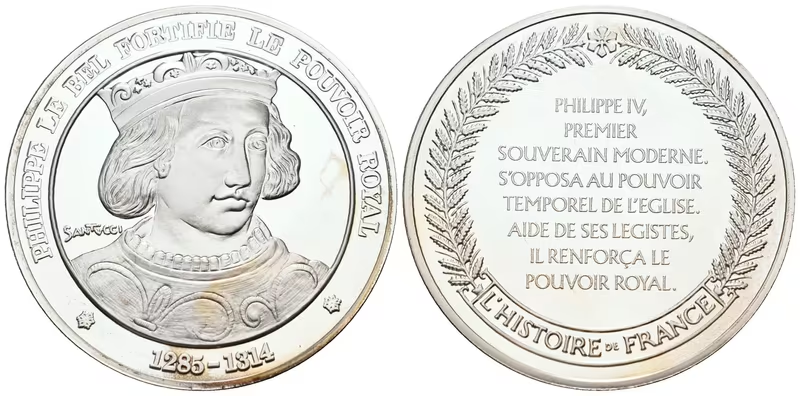
Francie - AR Medaile b.l. - Philippe le Bel
Philippe le Bel - 1285-1314 Ag 0,800, 44 mm (cca. 37 g) Na minci se nachází Francouzský punc ryzosti. V originální kapsli. Medaile je ze série 'Historie Francie v medailích' - Na některých mincích jsou viditelné stopy patiny aj. - Viz. obrázek.…