Charles Theodore
Charles Theodore (1724–1799) was Elector Palatine and from 1777 also Elector of Bavaria from the House of Wittelsbach. He became famous as an Enlightenment patron of the arts and sciences, founder of institutions in Mannheim and later as a sovereign whose accession in Bavaria triggered the European "War of the Bavarian Succession".
Charles Theodore was born in 1724 into the Palatine branch of the Wittelsbachs. As a young prince he grew up in an environment in which, in the imperial lands, courtly representation was interwoven with the gradually advancing ideas of the Enlightenment. The turning point was 1742, when he succeeded as Elector Palatine (ruler of the Palatinate within the Holy Roman Empire). The Palatine lands were politically significant because the elector had a voice in the election of the emperor, and economically they prospered from their position on the Rhine and from the tradition of urban trade.
His rule in the Palatinate is closely linked with Mannheim, which he transformed into a residential and cultural centre. The court supported architecture, music and the theatre, and Mannheim became a place where institutions typical of an Enlightenment state arose: libraries, scientific societies and more modernly organised administration. In this period Charles Theodore presented himself as a ruler who wished to improve the workings of the country through "reason", although it was still a princely state with a strong courtly hierarchy.
A fundamental European echo, however, came in 1777. With the extinction of the Bavarian line of the Wittelsbachs, the Electorate of Bavaria passed to Charles Theodore, who thus became Elector of Bavaria too and moved his seat to Munich. This dynastic transfer caused tension in the empire: Joseph II sought to acquire part of the Bavarian inheritance for the Habsburgs, which led to the War of the Bavarian Succession (1778–1779). The conflict did not bring great battles, but it showed how sensitive the balance between the great powers was even in an age often associated with the Enlightenment. The result was a confirmation of the Wittelsbach Bavarian continuity and at the same time a limitation of Habsburg gains.
History
Charles Theodore encountered in Bavaria a different political environment from the one he knew from the Palatinate. While in the Palatinate he had built his residential image and institutions "on greener fields", in Bavaria he ran up against a strong tradition of provincial structures and against the expectations of the local elite. His rule was also influenced by dynastic questions: he had no legitimate male heir, which increased the importance of succession plans and strengthened the role of related branches of the family. Towards the end of his life the electorate moved within the environment of the Napoleonic Wars and the transformation of the empire, but Charles Theodore died in 1799 before Bavaria became a kingdom.
In memory he remains a typical sovereign of the late 18th century: a capable patron and organiser of cultural projects, but at the same time a dynastic player in the politics of the great powers. His personality therefore cannot be reduced to that of an "enlightened ruler": equally important were the pressures of diplomacy, of inheritance and of imperial law, which set both his possibilities and his limits.
Charles Theodore was above all a sovereign of representation and institutions. His court supported the arts, sciences and urban culture, which was reflected in investment in buildings, libraries and academic projects. In the economy this took the form of an effort to improve the collection of revenue, the administration and the prestige of lands that were not a great power but could appear "very modern". From the perspective of internal politics, an emphasis on the court apparatus and on a considered image of the sovereign was typical of him, which is also visible in the official symbolism.
Politics, court and numismatic links
For numismatics his era is interesting in that it includes two different coinage traditions: Palatine and Bavarian. On the coins the electoral titulature, country emblems and often portrait types appear, intended to make a dignified and unified impression. In the 18th century, in central Europe, larger silver denominations (thaler types) were commonly struck as well as smaller coins for circulation; for the German lands it is moreover important to follow the specific mint, year and legend variants. The change in the sovereign's position after 1777 is reflected in the strikings not only in the emblem (the combination of Palatine and Bavarian elements) but also in the fact that it makes sense for collectors to distinguish the "Palatine" and "Bavarian" periods of his reign.
In practice, the coins of Charles Theodore are also good evidence of how a sovereign communicated legitimacy: the portrait, title and emblem on the coinage functioned as an everyday confirmation of power, reaching the hands of subjects and merchants far beyond the borders of one country. For this reason his strikings rank among the attractive collecting fields for those interested in the German states of the 18th century.
In our auction and shop
- Code: SFRA-D1990
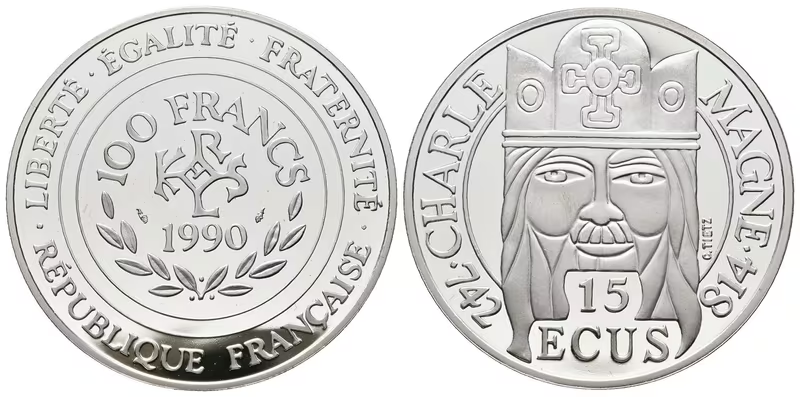
Francie, 100 Francs / 15 Ecus 1990 - Karel Veliký (Charlemagne, 742-814)
Francouzská republika (1958-dosud) 100 Francs / 15 Ecus 1990 - Karel Veliký (Charlemagne, 742-814), KM# 983 Ag (.900), 37 mm (22,2 g), v kapsli. Stav mince odpovídá fotografii.
Skladem 1 ks - Code: M78B-BZ1719
Karel VI., 1/2 Krejcar 1719
Karel VI. (1711 - 1740) 1/2 Krejcar 1719, Kutná Hora-Weyer, oxidace, lehce olámaný_R!
Skladem 1 ks - Code: RASPANEK-1958A
Špánek Karel - Výročí korunovace Jiřího z Poděbrad
Špánek Karel (1883 - 1983) AR Medaile 1958 - 500. výročí korunovace Jiřího z Poděbrad a Kunštátu českým králem Ag 0,900, 29 mm (12,13 g), puncováno luxusní zachovalost, jemná patina, lesk
Skladem 1 ks - Code: RASPANEK-1958A.1
Špánek Karel - Výročí korunovace Jiřího z Poděbrad
Špánek Karel (1883 - 1983) AR Medaile 1958 - 500. výročí korunovace Jiřího z Poděbrad a Kunštátu českým králem Ag 0,900, 29 mm (12,17 g), puncováno luxusní zachovalost, jemná patina, ražební lesk
Skladem 1 ks