Carolingian Type of Bohemian Denarii
The Carolingian type of Bohemian denarii represents a specific issue category of the 10th and 11th centuries, characterised by the motif of the so-called Carolingian chapel – an architectural symbol formed by a shield supported by two stylised columns with a small cross or letter signs. This iconographic element appears on the coins of Boleslav II, Bolesl…
The Carolingian type arose in the period of the peak development of Bohemian denarius coinage, when local issuing centres took inspiration from various European architectural and artistic models. The terminological designation refers to the Carolingian Renaissance of the 8th and 9th centuries, when characteristic architectural forms developed in the Frankish empire, including specific chapels and sacred buildings. The systematic placing of this category within Bohemian numismatic typology was carried out by the scholar V. Katz, who recognised the unifying iconographic principles across the issues of various sovereigns. The chronological span of these coins corresponds to the period of the greatest diversity of Bohemian coinage, when various motifs and stylistic approaches were experimented with. According to more recent research it is a regional variant of the broader group of younger Regensburg types, which suggests a connection with the Bavarian-Austrian coinage tradition. The geographical distribution of finds documents the wide spread of this type across the entire territory of the Bohemian principality and its acceptance in everyday economic exchange.
History
The iconography of the Carolingian chapel on Bohemian denarii documents the sophistication of early mediaeval coinage art and the ability of local craftsmen to adapt complex architectural motifs into the miniature format of coin dies. The technical execution shows considerable variability from carefully worked specimens with sharp details to simplified versions, reflecting the different levels of individual mints and the time of production. The symbolic meaning of the Carolingian chapel exceeds a mere decorative function and probably expresses the ideological links of the Bohemian principality to Christian European civilisation. For numismatic researchers this type represents an important source of information about cultural contacts between the Czech lands and the western European centres of the early Middle Ages. Comparative analysis with similar motifs on the coins of German and French issuers reveals the mechanisms by which artistic and ideological models spread across European court centres. Modern classification as variants of the Regensburg type points to the complex relations between various issue groups and the need to revise traditional typological schemes. The study of the Carolingian type thus contributes to a deeper understanding of the cultural and political identity of the early mediaeval Czech state.
In our auction and shop
- Code: RX-FRAN002
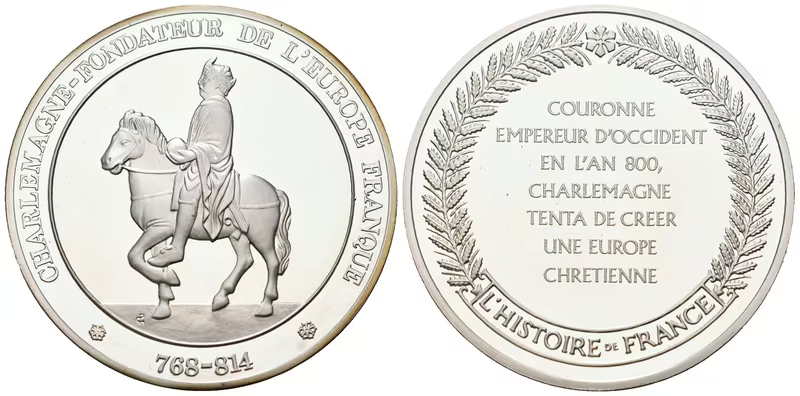
Francie - AR Medaile b.l. - Charlemagne
Charlemagne - 768-814 Ag 0,800, 44 mm (cca. 37 g) Na minci se nachází Francouzský punc ryzosti. V originální kapsli. Medaile je ze série 'Historie Francie v medailích' - Na některých mincích jsou viditelné stopy patiny aj. - Viz. obrázek. L'Histoire de…