Kingdom of Naples
The Kingdom of Naples was a historical state formation in southern Italy that existed from the end of the 13th century to 1816 and included the mainland part of the former "Kingdom of Sicily". It arose after the events known as the Sicilian Vespers and for centuries belonged among the most important centres of power and trade in the Mediterranean.
The Kingdom of Naples took shape at a time when dynastic claims, urban trade and the growing importance of maritime powers clashed in the Mediterranean. Until 1282 Sicily and the mainland southern Italian areas formed a single whole called the Kingdom of Sicily. The uprising on the island — the Sicilian Vespers — however led to a division: the island passed under the influence of the Aragonese crown, while the mainland part remained in the hands of the House of Anjou and in practice gradually began to be called "Naples" after the capital. It is interesting that the official titulature long held to the older name "Kingdom of Sicily", while the common designation Kingdom of Naples became established in order to distinguish the two rival "Sicilies".
In the 14th century the kingdom was burdened with complex succession disputes and internal conflicts, which weakened central power. Nevertheless, Naples retained its importance as a great city with a university, a port and connections to long-distance trade. A turning point came in the 15th century, when the Aragonese dynasty entered Italian politics with full force. Alfonso V of Aragon captured Naples in 1442 and linked it with his other possessions; after his death, however, there followed further dynastic division and a struggle for influence among the European powers.
History
At the turn of the 15th and 16th centuries Naples found itself at the centre of the Italian Wars. In practice this meant that the kingdom often functioned as a strategic base over which France and Spain competed. After the victory of the Spanish side, Naples became a significant part of the Spanish system of power and was for a long time governed by a viceroyalty. This era left a mark on both the economy and the administration: alongside courtly representation, pressure on taxes and supplies grew, since southern Italy was important for the financing and logistics of Mediterranean politics. In the 17th century, social upheavals and dissatisfaction with the tax burden manifested themselves in Naples; this too is among the reasons why the history of the kingdom is not told only as a sequence of dynasties, but also as the history of a great city and its society.
After the War of the Spanish Succession the kingdom passed in 1714 to the Austrian Habsburgs. Already two decades later, however, the situation was changed by the War of the Polish Succession: in 1734 Charles of Bourbon (later Charles III of Spain) obtained Naples, and a Bourbon branch with its own court arose in southern Italy. At the end of the 18th century and the beginning of the 19th, the kingdom was struck by the Napoleonic Wars, a brief republican episode and a period of French-installed rulers. After the restoration of the old order and after the Congress of Vienna, in 1816 the formal union with the island Kingdom of Sicily took place, into the Kingdom of the Two Sicilies, by which the era of the separately understood Kingdom of Naples came to an end.
Currency, coins and minting practice
In numismatics the Kingdom of Naples is known for the varied range of its strikes, which reflect both its long duration and the frequent changes of ruler. The basic role was played by silver and copper denominations for everyday circulation, but also by more valuable coins for trade and state finance. Among typical terms are the piastra as an important silver coin, also the ducato and smaller values such as the carlino, grano, tornese and cavallo. It is precisely with these denominations that one sees how southern Italy was linked to the wider Mediterranean environment: alongside domestic circulation it was important that the coins should hold their own in long-distance trade and in the exchange practice of port cities.
The principal coinage centre was Naples, whose mint produced strikes for various dynasties — from Aragonese and Spanish rulers through the Habsburg and Bourbon periods to Napoleonic issues. On the coins, therefore, portraits, titulature and heraldry often alternate, all of which are key to identification. With older strikes the "fabric" (style and technology) is also important, while with modern coins the date and the mint marks help. Neapolitan coins are thus not only a means of payment but also a clear "record" of political changes in southern Italy.
In our auction and shop
- Code: SITANEA-A1309
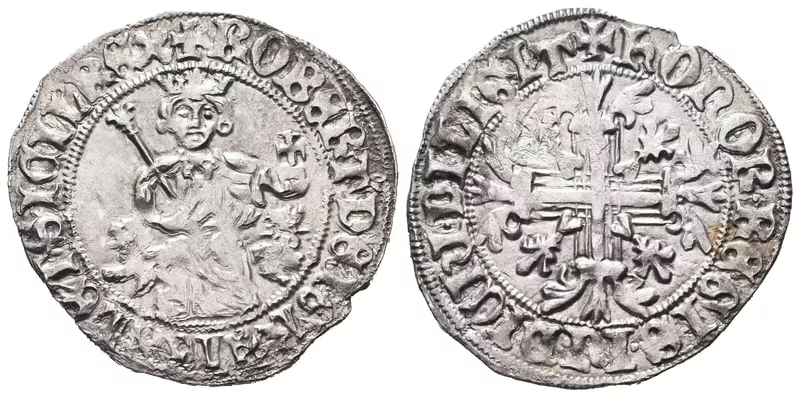
Itálie - Neapol, AR Gigliato b.l.
Itálie - království Neapole a Sicílie, Robert z Anjou (1309 - 1343) AR Gigliato b.l., minc. Neapol. Sedící panovník na trůně čelně, opis ROBERT DIE GRA IERL ET SICIL REX / Liliový kříž, opis HONOR REGIS IUDICIU DILIGIT. (3,95 g) Velmi pěkná zachovalost,…
Skladem 1 ks - Code: SITANEA-B1813
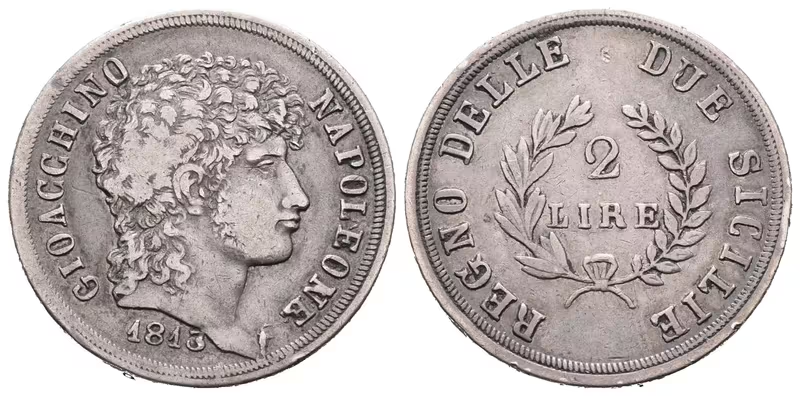
Itálie - Neapol, 2 Lira 1813
Itálie - království Neapolské, Joachim Murat (1808 - 1815) 2 Lire 1813, minc. Neapol, KM.258, vyraženo 220 294 ks, pěkná zachovalost, patina, nep. zbytky lesku, rysky a drobné hranky_R!
Skladem 1 ks - Code: SITANEA-G1792
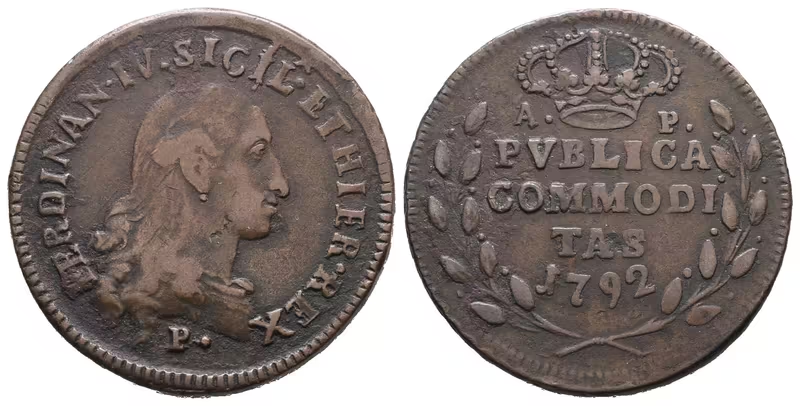
Itálie - Neapol, 3 Tornesi 1792
Itálie - království Neapolské, Ferdinand IV. (1759 - 1825) AE 3 Tornesi 1792 P, KM.206, pěkná zachovalost, patina, oběh_R!
Skladem 1 ks - Code: SITANEA-D1798
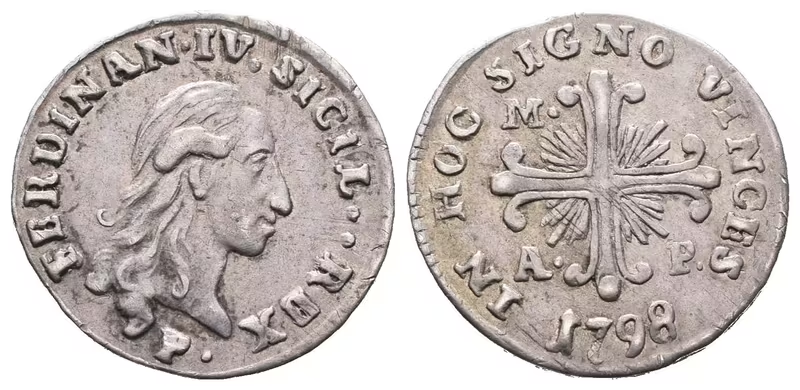
Itálie - Neapol, 10 Grana 1798 PM-AP
Itálie - království Neapolské, Ferdinand IV. (1759 - 1825) AR 10 Grana (Cardino) 1798 P/M-AP, KM.207, velmi pěkná zachovalost, patina, drobné rysky Velmi pěkná zachovalost, pěkně vyražený, patina, rysky