Louis VIII of Hesse-Darmstadt
Louis VIII of Hesse-Darmstadt (1691–1768) was Landgrave of Hesse-Darmstadt, who reigned from 1739 to 1768. He was renowned as a prominent representative of the Baroque court, a lover of hunting and the military, and a sovereign whose era unfolded in a time of frequent European wars and complex imperial politics.
Louis VIII of Hesse-Darmstadt was born in 1691 into a family that belonged to the significant princely dynasties of the Holy Roman Empire. Hesse-Darmstadt was a medium-sized imperial territory whose position was delicate: it had to navigate between the interests of the great powers, maintain its own administration and at the same time hold its own in the competitive environment of neighbouring states. The education of the landgrave was therefore not merely a court matter but preparation for how to advance the family's interests in a diplomatically complex space.
He ascended the throne in 1739 after the death of his father Ernst Ludwig of Hesse-Darmstadt. His reign falls within a period when Europe was repeatedly stricken by major conflicts and smaller states had to choose between neutrality, alliances and the provision of military support to stronger partners. For principalities of this kind it was often a question of survival: the ability to offer troops and to take the politically right side could mean protection and financial revenues, while a wrong choice could mean the risk of occupation or loss of influence. Louis VIII profiled himself in this world as a sovereign with a marked interest in the army, discipline and representation, which in the Baroque was a common way of demonstrating the seriousness and strength of the court.
His era is associated with intensive court life. Baroque sovereigns placed emphasis on celebrations, hunting activities and ostentatious representation, because the court was not merely a place of amusement but also a "political stage". Hunts in particular had practical significance in princely circles: they enabled ties with the nobility to be built, the hierarchy to be displayed and at the same time the image of the ruler as the "lord of the land" to be supported. At the same time, however, court life required considerable expenditure, and so financial administration, the collection of taxes and the ability not to undermine the confidence of creditors were important for the stability of the country.
History
In the second half of the 18th century, moreover, reform tendencies increasingly asserted themselves, aimed at more efficient administration and better control of the economy. Even smaller German states had to respond to the modernisation of armies, to competitive pressure and to changes in trade. Louis VIII ruled until 1768, that is until just before the German space began to be more markedly transformed under the influence of later revolutionary and Napoleonic events. His reign thus closes one of the typical Baroque chapters in which princely prestige rested on court culture, military splendour and careful manoeuvring in imperial politics.
Louis VIII of Hesse-Darmstadt appears in numismatics on coins issued by the landgraviate which bore the ruler's title and the country's heraldry. In the German space of the 18th century several monetary zones operated and the coins of many states circulated side by side, so the recognisability of the origin was essential. For this reason, legends and the coat of arms which confirmed that the coin was "official" and corresponded to the given standard are usually well legible on the strikes.
In circulation, small coins for everyday payments asserted themselves alongside silver denominations of higher values for larger transactions and trade. Particularly with silver coins, the combination of portrait style and a precise coat of arms tends to be attractive for collectors, since on a larger surface the quality of the engraving stands out. By contrast, small denominations often bear the traces of intensive circulation and are valuable testimony to the everyday economy, where coins moved swiftly between the market, the workshop and the authorities.
The landgrave on coins and the monetary environment
The strikes from the time of Louis VIII are also interesting because they show the Baroque conception of sovereign representation. The portrait and titulature were not merely "ornament" but a public communication about power and the legitimate right to issue money. For collectors of German state coins, his strikes therefore represent typical 18th-century material: the combination of a regional state, a marked court style and a monetary world in which the quality of a coin was judged by its metal, weight and the reputation of the issuer.
In our auction and shop
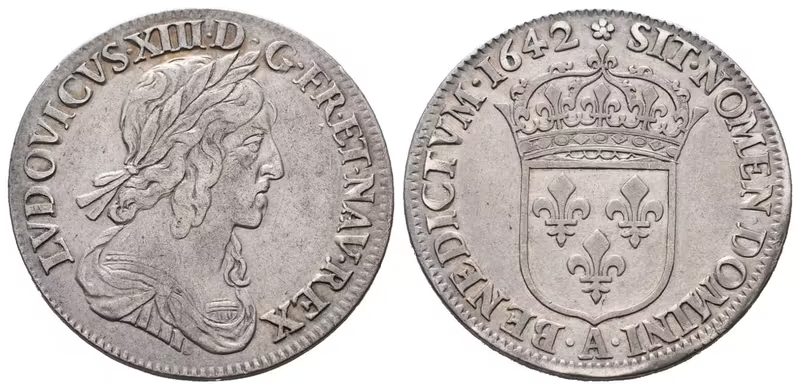
- Code: SFRA88-D1642A
Francie, 1/4 Ecu 1642 A, Paříž
Francie, Ludvík XIII. (1610 - 1643) 1/4 Ecu 1642 A, Paříž, II. typ (růže), Duplessy.1351, krásná zachovalost, lesk, patina
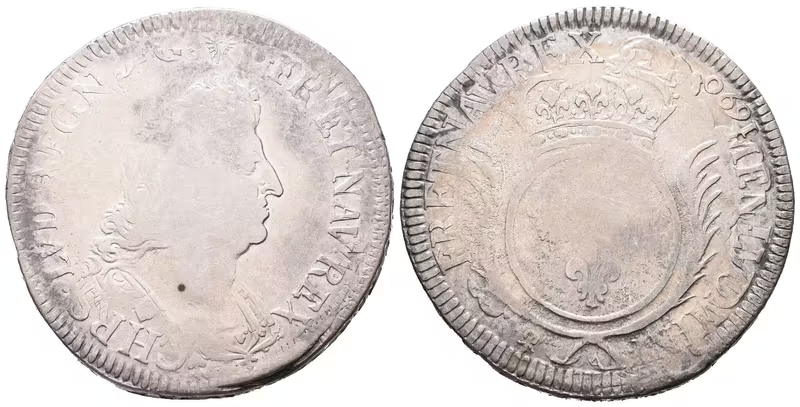
Skladem 1 ks - Code: SFRA89-A1690A
Francie, Ecu 1690
Francie, Ludvík XIV. (1643 - 1715) Ecu aux palmes 1690, Paříž?, přeražba na Ecu s 8 písmeny L, Da.3813, Gad.217, Dup.1520
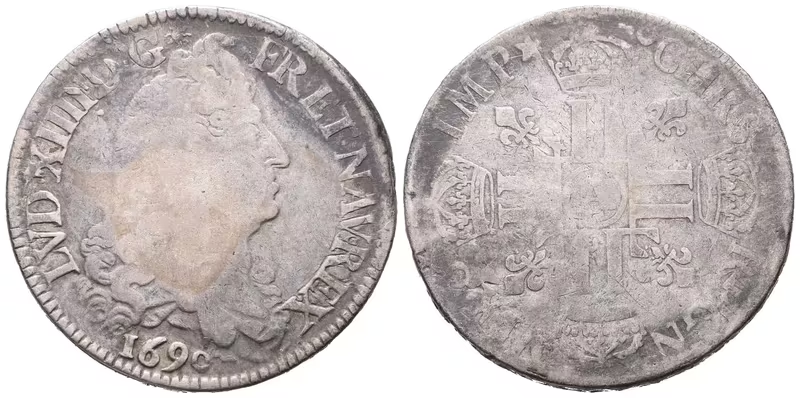
Skladem 1 ks - Code: SFRA89-A1690A.1
Francie, Ecu 1690 A
Francie, Ludvík XIV. (1643 - 1715) Écu aux huit L 1690 A, Paříž, přeražba na jiné mince, Dup.1514, pěkná zachovalost a patina
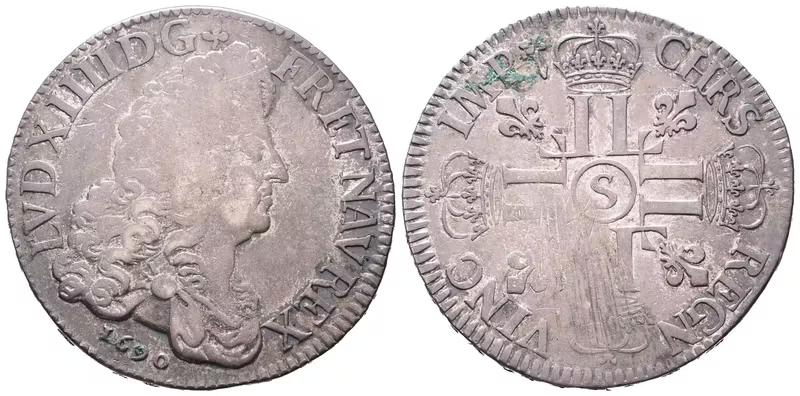
Skladem 1 ks - Code: SFRA89-A1690S
Francie, Ecu 1690 S
Francie, Ludvík XIV. (1643 - 1715) Écu aux huit L 1690 S, Troyes, vzácně bez přeražby!, Da.3813, Gad.217, Dup.1520, pěkná zachovalost a patina, oxidace na Rv., just., starý pod. lístek s cenou 60Kč,-
Skladem 1 ks