Maximilian II of Bavaria
Maximilian II Joseph of Bavaria was King of Bavaria from the House of Wittelsbach, who reigned from 1848 to 1864. He became famous for his support of science and culture in Munich and for his effort to maintain the political independence of Bavaria at a time of growing tension between Prussia and Austria.
Maximilian II of Bavaria was born on 28 November 1811 in Munich as the son of King Ludwig I of Bavaria. He ascended the throne on 20 March 1848 after his father's abdication, which took place in the atmosphere of the revolutionary events of 1848, which affected a large part of Europe. His accession was therefore not just a dynastic change but at the same time a test of whether the monarchy in Bavaria could respond to public pressure, demands for constitutionalism and the modernisation of state administration.
In the German space it was a period when debates about the future arrangement of Germany were accelerating. Bavaria was among the significant states of the German Confederation, but at the same time stood in the shadow of two great powers — Austria and Prussia. Maximilian II sought to pursue a course that was to leave Bavaria with as much room for manoeuvre as possible: instead of unconditional alignment with one of the hegemons, he supported the idea of a "third force", that is, a bloc of medium-sized and smaller German states which would together balance the Prussian-Austrian rivalry. In practice, however, such a concept clashed with the reality of power politics and with the differing interests of the individual lands.
Alongside foreign-policy dilemmas, the king also dealt with the internal transformation of Bavaria. The period of his reign is associated with emphasis on learning, science and cultural prestige. Munich was to become a modern centre that would not be only a representative residence but also a city of universities, academies and scientific work. This ambition built on the earlier efforts of the Wittelsbachs, but Maximilian II shifted it in a distinctly "civic" direction: cultural policy was not to be merely a court ornament, but an instrument of the long-term modernisation of the country.
History
In the dynastic context, it is important that he was the father of the later King Ludwig II of Bavaria, whose reign became famous, among other things, for monumental buildings and romantic projects. Maximilian II died on 10 March 1864 in Munich, thus closing an era that is often assessed as relatively moderate and intellectually oriented — in contrast to the turbulent political ruptures that awaited the German lands in the following years.
Maximilian II is described as a sovereign with a strong interest in learning and scientific life. In Munich he supported cultural institutions and strove to profile the city as a centre of art, education and research. The important Munich avenue Maximilianstrasse also bears his name, and is to this day associated with the representative 19th-century buildings and with the idea of the metropolis as a "showcase" of the Bavarian state.
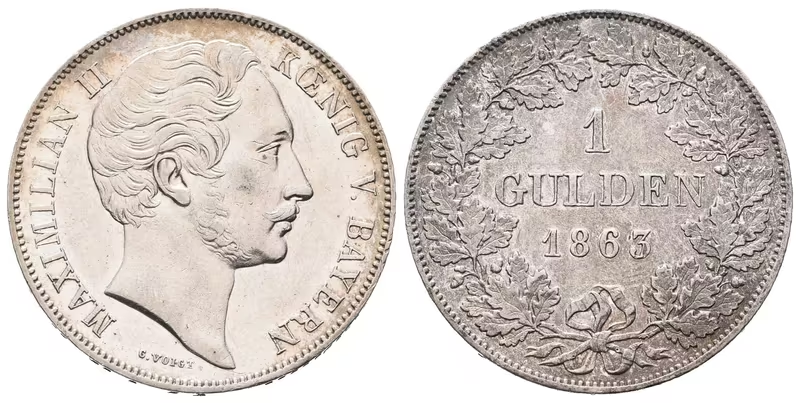
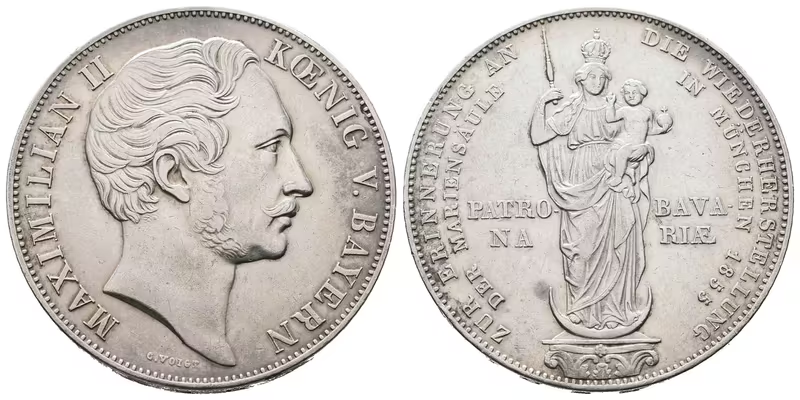
From a practical point of view, it is significant for numismatics that during his reign the regular striking of currency of the Kingdom of Bavaria continued. In the mid-19th century, monetary systems based on gold and silver standards were commonly used in the German states, and alongside small denominations, larger silver coins of higher value also appeared. Typical of Maximilian's era are mintages in the gulden system as well as large silver denominations of the type "2 thalers = 3½ gulden", which were struck in several year issues. These coins are characterised by a high content of silver and a representative conception of the sovereign's portrait, as was usual for the 19th century in the German space.
Sovereign, cultural policy and coins from his period
From the collector's point of view, Maximilian's coins are interesting chiefly because they stand at the boundary of "old" provincial currencies and the later unification of the German space. The iconography is usually dominated by the sovereign's portrait and the state symbolism of Bavaria; technically these are often quality machine strikes of their time. The precise composition of denominations and the parameters of individual types vary by year issue and specific emission, but a common feature remains a clear link to the modernisation of the state and its representation in the period after 1848.
In our auction and shop
- Code: NABAV-F1863
Bavorsko, 1 Gulden 1863
Bavorsko (Bayern), Bavorsko, Maximilian II., 1848 - 1864 1 Gulden 1863, KM.445, krásná zachovalost, patina, lesk, drobné rysky a hranky
Skladem 1 ks - Code: NABAV-G1855
Bavorsko, 2 Gulden 1855 - Pamětní
Bavorsko (Bayern), Bavorsko, Maximilian II., 1848 - 1864 2 Gulden 1855 - Obnovení Mariánského sloupu v Mnichově, Dav.604, KM.465, pěkná zachovalost