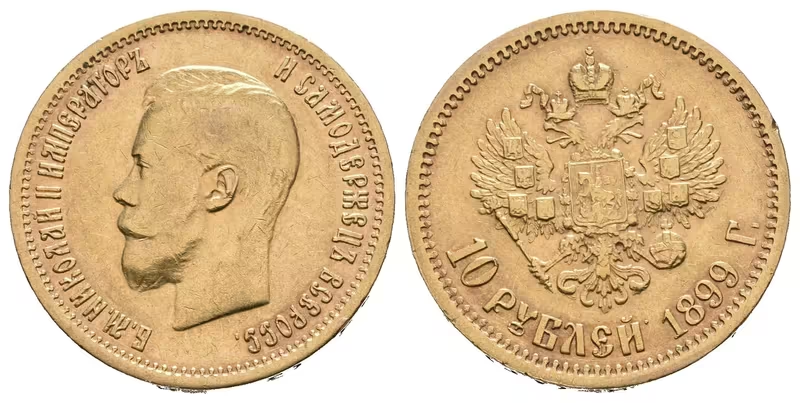
Nicholas II Alexandrovich
Nicholas II Alexandrovich (1868–1918) was the last Russian Tsar of the Romanov dynasty, who reigned from 1894 to 1917. His rule was marked by the upheavals of modernisation, the defeat in the Russo-Japanese War, the Revolution of 1905, the First World War and finally his abdication, which opened the way to the fall of the monarchy.
Nicholas II Alexandrovich came to the throne on the death of his father Alexander III in 1894. He entered upon his reign as a ruler brought up in the tradition of autocracy, which placed the Tsar in the role of the supreme bearer of power and responsibility 'from above'. Russia, however, at the turn of the 19th and 20th centuries, was undergoing rapid changes: industrialisation, the growth of towns, the emergence of a modern working class and the spread of political ideas that called the old order into question. It was precisely the clash between the traditional conception of tsarist power and the new social forces that set the tone of his entire reign.
In foreign policy the first great upheaval was the Russo-Japanese War (1904–1905), in which Russia suffered a humiliating defeat. The setback accelerated the internal crisis and in 1905 culminated in a wave of unrest, strikes and revolutionary events. The regime responded with a combination of repression and concessions: a Duma was established as a representative body and certain civil liberties were proclaimed, but the actual balance of power remained fragile. Nicholas II at the same time sought to maintain the autocratic framework, so the reforms often appeared half-hearted and were not able to ease the tensions in the long term.
Domestic affairs were further complicated by court and family circumstances. The Tsar relied on a narrow circle of advisers, and his decision-making was, in the eyes of the public, weakened by distrust of part of the court. A symbolic phenomenon became the influence of Grigori Rasputin on the imperial family, particularly in connection with the illness of the heir. At a time when the state needed to appear firm and credible, court scandals and intrigues easily turned into a political burden.
History
The decisive turning point was the First World War. Russia entered the conflict with enormous powers of mobilisation, but at the same time with shortcomings in logistics, armament and command. The losses of war, the problems of supply and the economic disruption led to the radicalisation of society. In 1917 a revolution broke out which paralysed the tsarist government. Nicholas II ultimately abdicated, and with that ended more than three centuries of Romanov rule. There followed a period of the Provisional Government and then the Bolshevik takeover, which transformed Russia into a new type of state.
The fate of the imperial family became the tragic symbol of the end of an era. Nicholas II, his wife Alexandra and their children were, after a period of internment, killed in 1918. In historical memory Nicholas II thus remains a figure in whom one can see how difficult it was to preserve a traditional monarchy in the era of mass politics, modern war and a rapidly changing society.
Numismatically, the era of Nicholas II ranks among the much sought-after, since the Russian Empire struck a wide spectrum of coins in copper, silver and gold. On the circulating silver and gold strikes the Tsar's portrait often appears, while the reverse bears the double-headed eagle and state symbols. For collectors, the gold denominations and silver roubles are particularly attractive, representing a combination of a historical narrative with a high-quality strike and clear iconography of late tsarist Russia.
The coins of Nicholas II and their collector significance
When identifying coins it is important to follow the year, denomination and any mint marks, since within a single series there are differences according to the mint and to small die variants. For silver and gold the state of the surface also plays a role: careless cleaning is markedly visible on the coin and reduces collector value. With copper coins a frequent problem is corrosion and an uneven surface, so top-quality preserved pieces can be considerably rarer than at first sight they appear.
Nicholas II is at the same time a typical example of a ruler whose coins today function as 'portable history'. They bear the image of the last tsarist era, which within a few years was transformed by revolution into a new world, and it is precisely this contrast that gives the coins of his time a strong collector appeal.
In our auction and shop
- Code: ZSRUS-90B1899AG
Rusko, 10 Rubl 1899 AG
Rusko, Mikuláš II. (1894 - 1917) 10 Rubl 1899 AG, St. Peterburg, Bitkin 2.4 Au 0,900, 22,5 mm (8,60 g)
Skladem 1 ks - Code: SRUS90-A1896LOT
Rusko, Rubl 1896, 1897, 1898
Rusko, Mikuláš II., 1894 - 1917 Soubor mincí Rubl 1896 AG, 1897 Brusel, 1898 AG, St. Peterburg, Bitkin2.39, Uzd.2066_ celkem 3 ks
Skladem 1 ks - Code: SRUS99-K1898C
Rusko, 1/4 Kopějka 1898 SPB
Rusko, Mikuláš II. (1894 - 1917) 1/4 Kopějka 1898 SPB, Birmingham, Bitkin2.297, Uzd.3881 Etue PCGS, hodnocení MS 64 RB, luxusní zachovalost
Skladem 1 ks - Code: SRUSFIN90-B1917.1
Finsko pod Ruskem, 50 Penniä 1917 - bez koruny
Ražby pro Finsko, Mikuláš II., 1894 - 1917 50 Penniä 1917 S - orel bez koruny, provizorní vláda, KM.20, krásná zachovalost, ražební lesk, drobné rysky, patina
Skladem 1 ks