Tarsos Mint
The Tarsos Mint denotes the coin production of the ancient city of Tarsos in Cilicia (today's Tarsus in Turkey), one of the most important minting centres of the eastern Mediterranean. It became famous for the silver staters of the satraps with the motif of Baaltars and for later civic issues with local deities.
The Tarsos Mint belongs among the most important "signatures" of Cilicia, since the city lay at the strategic crossroads between Anatolia and the Levant and had strong commercial hinterland. It was precisely such a location that created a constant demand for reliable coins - not only for the local market, but also for long-distance trade and for army expenditure at a time when great powers were vying for the area. Tarsos therefore struck coins in several great waves which correspond well with the political history of the region.
In the Classical and Late Classical period Tarsos is known especially for silver staters on the Persian weight standard. The typical motif became "Baal of Tarsus" (often described as Baaltars/Baaltarse), seated on a throne and holding the attributes of power, while on the other side there is often a very dynamic scene of a lion attacking a bull. This iconography is so characteristic of the Cilician satrapal issues that it allows quick identification even without a deeper knowledge of the inscriptions. On the coins, Aramaic legends and marks also appear, which reflect the administrative environment of the Achaemenid Empire. Among the best-known issuers belongs the satrap Mazaios, whose name appears in inscriptions on these coins and who is closely associated with Tarsos.
After the Macedonian conquest the mint did not begin to "write itself from scratch"; on the contrary, it continued producing coins which visually carry on the older tradition, but their political framework gradually changes. In the Tarsenian production the continuation of satrapal types (already under new administrators) meets with the issues associated with Alexander the Great and his successors. Tarsos thus belongs among those places where the transition from Persian administration to the Hellenistic world is well observed: older symbols and local deities remain comprehensible to the population, but new schemes of power and titulature enter the system.
History
In the Hellenistic and later Roman period, the mint significantly relied on civic (municipal) issues, often of bronze, intended for ordinary circulation in the region. Here Tarsos already appears as a self-confident metropolis with its own identity, which is reflected in the iconography. Frequent motifs are the city goddess Tyche, the personification of fortune and protection of the city, and also local cultic themes - typically the deity Sandan, who is long associated with Tarsos. The Roman era adds the portraits of emperors, while the reverses continue to tell the "local story": deities, temples, symbols of prosperity and titular inscriptions which emphasise the status of Tarsos as an important centre of the province.
The long continuity of the mint at Tarsos is important also from a historical point of view: it shows that the coin was not merely an economic instrument but also a medium of identity. The city maintained its traditional motifs on the coins even at a time when rulers and state entities were changing. It is precisely in this that the charm of Tarsenian issues lies - on a small format the Persian, Hellenistic and Roman worlds meet, and yet it is still clear "where the given coin's home is".
The Tarsos Mint is in practice identified by a combination of iconography, inscriptions and weight standard. For satrapal silver staters the most typical is the seated Baaltars (often with an eagle or sceptre and accompanying symbols, such as an ear of grain or grapes), and on the other side a lion attacking a bull. Important is also the presence of Aramaic legends, which may bear the name of an administrator (for example Mazaios) and help to place the coin more precisely. Since these are coins intended also for wider circulation, the quality of the engraving is often very high and the scene of the lion and the bull appears exceptionally "alive".
Types of issues and distinguishing features
For Hellenistic and Roman civic bronzes the frequent guide is the name of the city in Greek and the recurring local motifs. Tarsos liked to emphasise civic protection and prosperity, hence Tyche with a turreted crown is frequent. The second great identifying feature is Sandan, sometimes depicted in a pronounced cultic composition (for example in a kind of "monument" or shrine), which in the numismatics of Cilicia is considered a typically Tarsenian theme. With Roman provincial issues the imperial portrait and titulature are added, which allow relatively precise dating. Practically, it is good to count on the fact that bronze coins from civic circulation have often been preserved with various degrees of patina and wear - for identification it is therefore essential to consider the legibility of the key letters of the city's name and the recognition of the principal reverse motif.
Overall, Tarsos is an excellent example of a mint where "international" currency of high value (silver staters of the satraps) alternates with "civic" issues for everyday life. For collectors and historians, Tarsenian coins therefore offer two levels at once: the great politics of empires and the local culture of one exceptionally influential city.
In our auction and shop
- Code: XB-1000
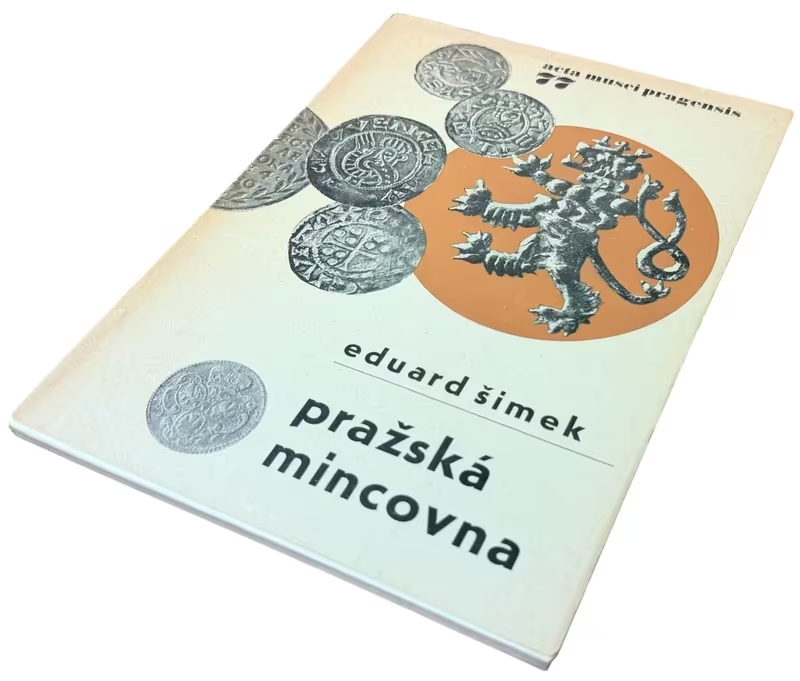
Pražská mincovna
Šimek, Eduard Pražská mincovna devět století české mince - katalog výstavy Praha 1977, 38 stran a 48 stran vyobrazení, brožované, pěkná zachovalost
Skladem 1 ks - Code: MC138-PROOF6
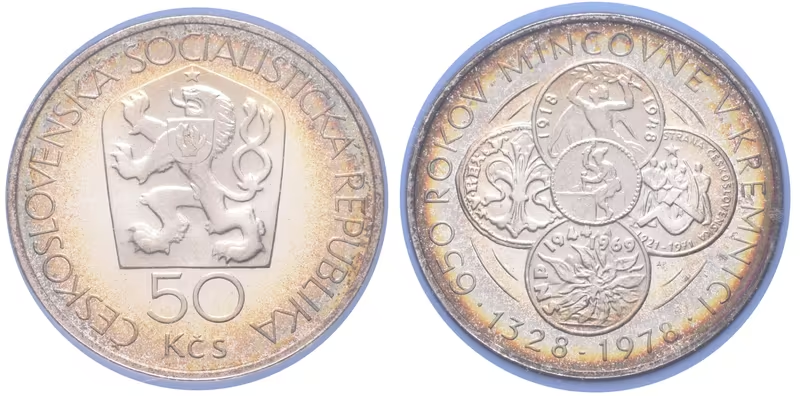
50 Kčs 1978 - Mincovna Kremnica, PROOF
Československo (1953 - 1993) 50 Koruna 1978 - 650. výročí mincovny v Kremnici, autor Andrej Peter, Aurea 138, PROOF Ag 0,700, 31 mm (13 g), raženo 70 076 ks (běžná kvalita), 2 708 ks (proof), původní plastová kapsle, patina v ploše - viz foto
Skladem 1 ks - Code: MC138-PROOF5
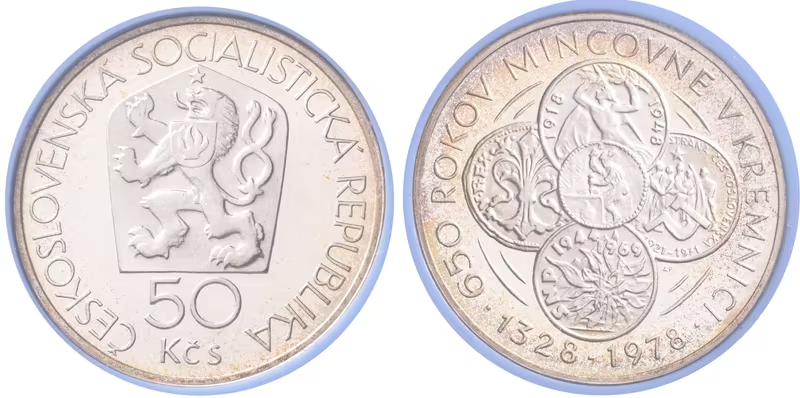
50 Kčs 1978 - Mincovna Kremnica, PROOF
Československo (1953 - 1993) 50 Koruna 1978 - 650. výročí mincovny v Kremnici, autor Andrej Peter, Aurea 138, PROOF Ag 0,700, 31 mm (13 g), raženo 70 076 ks (běžná kvalita), 2 708 ks (proof), původní plastová kapsle, patina v ploše - viz foto
Skladem 1 ks - Code: MC138-PROOF4
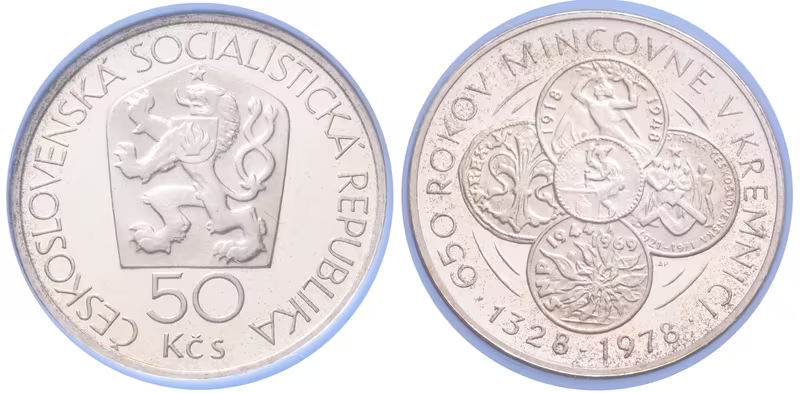
50 Kčs 1978 - Mincovna Kremnica, PROOF
Československo (1953 - 1993) 50 Koruna 1978 - 650. výročí mincovny v Kremnici, autor Andrej Peter, Aurea 138, PROOF Ag 0,700, 31 mm (13 g), raženo 70 076 ks (běžná kvalita), 2 708 ks (proof), původní plastová kapsle, patina v ploše - viz foto
Skladem 1 ks