Toledo Mint
The Toledo Mint denotes coin issues arising in the Spanish city of Toledo, which was for centuries an important administrative and ecclesiastical centre. Coins from Toledo appear in several epochs and are a valuable source for the history of the early Middle Ages and for the Castilian and later Spanish monetary tradition.
The Toledo Mint is closely connected with the exceptional position of the city in the history of the Iberian Peninsula. Toledo (Latin Toletum) was already in late antiquity an important inland centre, but it gained the greatest numismatic importance in the early Middle Ages, when it became the political and ecclesiastical centre of Visigothic Hispania. Precisely where power and administration reside, there is a natural need for a stable circulating tender - for payments, taxes, trade and representation.
The most famous and best recognisable chapter is the Visigothic issues, typically gold thirds of a solidus, which in numismatics are designated as tremissis. These coins usually bear the name of the ruler and at the same time the name of the place of minting, which is essential for identification. With Toledan pieces one often encounters the name of the city in Latinised form (for example "Toleto" within the legend), thanks to which Toledo belongs to the most frequently documented mint places of the Visigothic period. From the point of view of monetary history this is important also because Visigothic gold continued the late Roman tradition, but at the same time bore a clearly regional and dynastic identity.
After the turn of the 8th century the political framework of the peninsula was fundamentally transformed and with it also the monetary environment. Coin production in various periods concentrated in places that had administrative and economic weight in the given system. Toledo retained its importance as a city of great symbolic value, while its minting "imprint" could appear both in the environment of Islamic administration and later in the Christian states which gradually extended their power to the south. In these centuries, the transformation of languages and titulature is typical for numismatics: while the early medieval coins work with Latin legends and royal names, later issues may bear different ways of designating authority and different types of symbolism.
History
From the High Middle Ages, Toledo is associated chiefly with the Castilian and later Spanish monetary tradition. As the economy and state administration changed, so too did the structure of the denominations: alongside more valuable coins, small issues for everyday circulation came into use. For a medieval kingdom the mint was not only a technical operation but also a political instrument - striking confirmed the legitimacy of the ruler, spread his titulature and at the same time enabled state control over the quality of metal and over monetary circulation. In practice, minting activity could be revived, strengthened or, conversely, weakened, depending on the needs of finances, the army and trade.
In the early modern period the mint network in Spain was gradually centralised and the importance of individual urban mints was transformed. Toledo, however, remains a strong concept in numismatics chiefly thanks to the early medieval issues and to the continuity of the city as a cultural and ecclesiastical centre. Toledan coins are thus a good example of how epochs alternate at one place and how changes of power are "translated" into metal: another language, other titles, other motifs, but the same city as the point to which the coin relates.
The Toledo Mint is in practice identified above all according to how the mint place is given on the coin. With Visigothic gold tremisses it is key that the legend often contains the name of the ruler and at the same time the name of the city. It is precisely this combination that enables a relatively precise placement to a period and sometimes also to a particular ruler, although it must be borne in mind that the issues of the early Middle Ages may have stylistically variable script and sometimes also less regular abbreviations. More experienced identification rests on the shape of the letters, the composition of crosses and symbols, and on comparison with catalogue types.
Typical issues and distinguishing features
For later, medieval and early modern issues, recognition often rests on a combination of titulature and local minting features. Depending on the period it may vary whether the mint place is given directly in the legend, or whether the identification is rather indirect (for example through the typical composition of inscriptions and style). In any case it holds that the mint is "read" as a whole: the inscription, the pictorial motif, the metal and the diameter of the coin together form the signature of the period. Toledo is in this sense interesting also for comparison - on one hand the early medieval gold with clear local identification, on the other hand later issues, where monetary customs change and the emphasis shifts to other denominations and forms of state marking.
For numismatics, Toledan coins are valuable also as a source for the history of the city's administration and prestige. The coin namely tells not only about the economy, but also about who had the right to strike, what authority wished publicly to emphasise and how the "official language" of symbols was transformed in various centuries. It is for this reason that Toledo belongs among the cities which appear often in numismatic descriptions - and whose issues stand at the boundary of several great civilisational and political epochs.
In our auction and shop
- Code: XB-1000
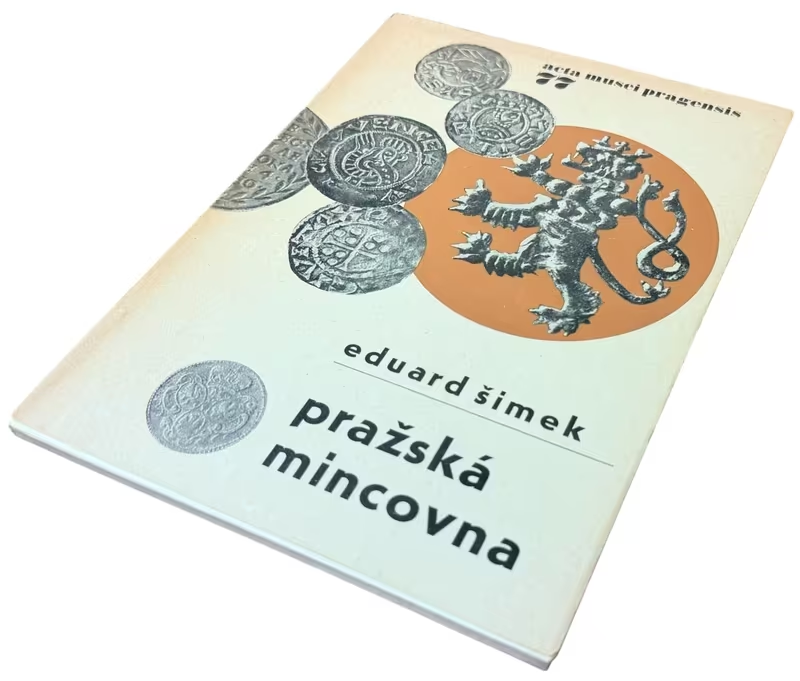
Pražská mincovna
Šimek, Eduard Pražská mincovna devět století české mince - katalog výstavy Praha 1977, 38 stran a 48 stran vyobrazení, brožované, pěkná zachovalost
Skladem 1 ks - Code: MC138-PROOF6
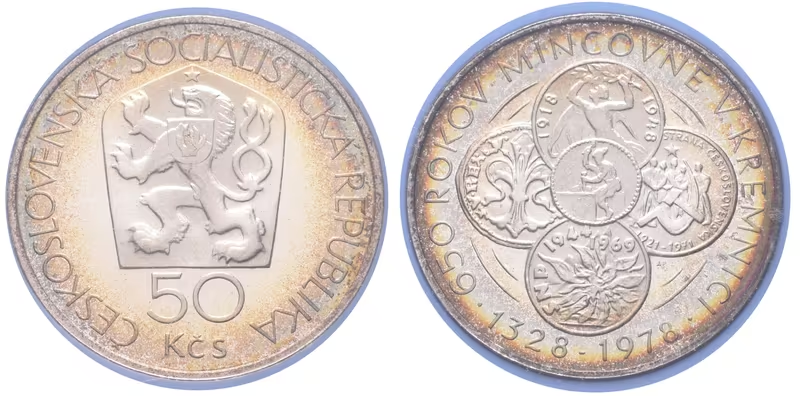
50 Kčs 1978 - Mincovna Kremnica, PROOF
Československo (1953 - 1993) 50 Koruna 1978 - 650. výročí mincovny v Kremnici, autor Andrej Peter, Aurea 138, PROOF Ag 0,700, 31 mm (13 g), raženo 70 076 ks (běžná kvalita), 2 708 ks (proof), původní plastová kapsle, patina v ploše - viz foto
Skladem 1 ks - Code: MC138-PROOF5
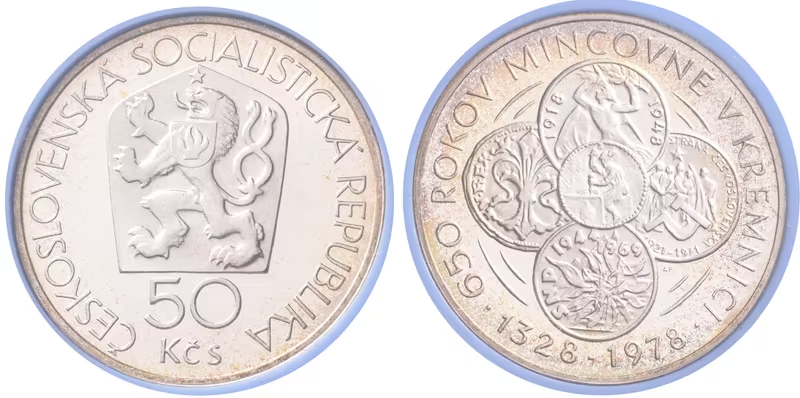
50 Kčs 1978 - Mincovna Kremnica, PROOF
Československo (1953 - 1993) 50 Koruna 1978 - 650. výročí mincovny v Kremnici, autor Andrej Peter, Aurea 138, PROOF Ag 0,700, 31 mm (13 g), raženo 70 076 ks (běžná kvalita), 2 708 ks (proof), původní plastová kapsle, patina v ploše - viz foto
Skladem 1 ks - Code: MC138-PROOF4
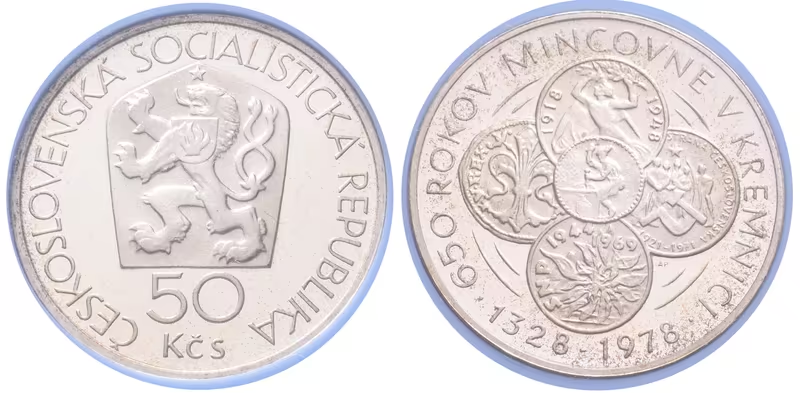
50 Kčs 1978 - Mincovna Kremnica, PROOF
Československo (1953 - 1993) 50 Koruna 1978 - 650. výročí mincovny v Kremnici, autor Andrej Peter, Aurea 138, PROOF Ag 0,700, 31 mm (13 g), raženo 70 076 ks (běžná kvalita), 2 708 ks (proof), původní plastová kapsle, patina v ploše - viz foto
Skladem 1 ks