Wroclaw Mint
The Wroclaw Mint (Polish: Wroclaw, German: Breslau) was an important Silesian mint, which struck coins for various rulers and administrative units from the Middle Ages to the modern period. Its production included civic issues, gold ducats and thaler denominations, and often reflected political changes in Silesia.
The Wroclaw Mint belonged to the most important minting workshops in Silesia, and its importance resulted from the city's position as a commercial and administrative centre. Already from the 11th century, coins were struck at Wroclaw for the Polish rulers, which shows that the city stood at a crossroads of trade and needed stable small currency. A fundamental turning point came in 1290, when the bishops of Wroclaw obtained the right of coinage in connection with the acquisition of the Duchy of Nysa, to which this right was tied. In practice, this meant that coinage at Wroclaw was not merely a "municipal workshop" but a part of a broader framework of power and law, where the interests of the city, the church and the sovereign converged.
At the time when Silesia was part of the Czech lands, civic issues were also applied at Wroclaw. From this stratum, for example, the civic hellers of Charles IV and Wenceslas IV with the motif of the Bohemian lion are known, which clearly show how Bohemian state symbolism was reflected in regional circulation. With the issues of Sigismund of Luxembourg, types occur on which the figure of Saint John the Baptist appears, a motif intended to reinforce religious legitimacy and at the same time to distinguish the coin in circulation. At Wroclaw, civic hellers were also struck by Vladislaus II Jagiellon and Louis Jagiellon; precisely with Louis's civic ducats, the motif of Saint Wenceslas is given, that is, another distinctive element of the Bohemian tradition.
After the death of Louis Jagiellon, the administration of Silesia was transformed and the mint passed into new hands. In 1532 Ferdinand I took over the mint, and in the course of the 16th century Wroclaw became involved in the minting reforms of the Habsburg state. In textual sources, the period is mentioned when pfennigs were also struck at Wroclaw according to the Austrian minting system, designated by the letter S. In the middle of the 16th century, in connection with the reforms, thaler and groschen denominations appeared, and in subsequent decades coinage adapted to changes in the monetary system - including transitions between the thaler and gulden currencies. This is typical of the early modern period: the state sought to unify circulation and at the same time responded to the price of silver and to the need to finance the administration and the army.
History
In the 17th century, the Wroclaw Mint was exceptionally productive, but at the same time sensitive to wartime events. In the period of the Thirty Years' War, issues were interrupted and renewed depending on who had control over the city and what the financial needs were. From the sources it emerges that in some years debased coins were also struck here, which corresponds to a wartime economy, when funds for financing were quickly sought. Nevertheless, "more honest" circulation also long applied at Wroclaw: very common were small kreuzer denominations (especially 3-kreuzers and kreuzers), which were used the most in everyday life.
Under the reigns of Ferdinand III, Leopold I and Joseph I, the mint continued in extensive production, in which, alongside small coins, high denominations and multiples of ducats also appeared. A significant change came under Charles VI, when the mint was technically modernised and adjustments to the marking also occurred; at the same time large gold and silver denominations appeared, and exceptionally civic issues released on the ceremonial occasion of the sovereign's visit. The mint was closed on 30 January 1741, but in the time when Wroclaw was already under Prussian control, coins were still struck here in the years 1743-1826 for Prussian kings. Alongside coins, the Wroclaw Mint also gained a reputation through its medal-making, especially in the 17th-18th centuries, when medals of high artistic level on diverse subjects came into being.
The Wroclaw Mint is interesting to collectors for the wide range of denominations and the long temporal continuity. In the Middle Ages, small civic and royal issues dominate (pfennigs, hellers, groschen-type pieces), which can often be recognised by the motifs of the Bohemian lion or by saintly iconography. In the early modern period, thaler and gulden denominations are added, later also ducats and their multiples. The strong presence of small kreuzer coins is also typical, because precisely these were the most important for everyday circulation, and the mint was able to strike them in large quantities.
Issues, denominations and identification
For identification of Wroclaw issues, a combination of several features is key: (1) the iconography and legend, which will indicate the ruler or the civic character of the issue, (2) the year, if given, (3) the mint mark and possibly also the mintmaster's mark, which was used in some periods in Silesia. For the 16th century, the marking of a certain type of pfennig with the letter S is mentioned, according to the Austrian system, while with later issues the standard Habsburg titulature and typical Baroque compositions are applied. The war years can bring increased variability of types and sometimes worse quality or debased issues, which is manifested in weight, fineness and the overall impression of the coin.
From a numismatic point of view, Wroclaw is important because in one place it shows the alternation of political frameworks: the Polish stage, the Czech lands, the Habsburg Monarchy and finally the Prussian state. Each period left its own "language" of emblems, titles and motifs in the coins, so that Wroclaw issues can be read as an overview of the history of Silesia - from the medieval circulation of small coins up to more modern early-modern denominations and medal-making.
In our auction and shop
- Code: ZD-2020LUD
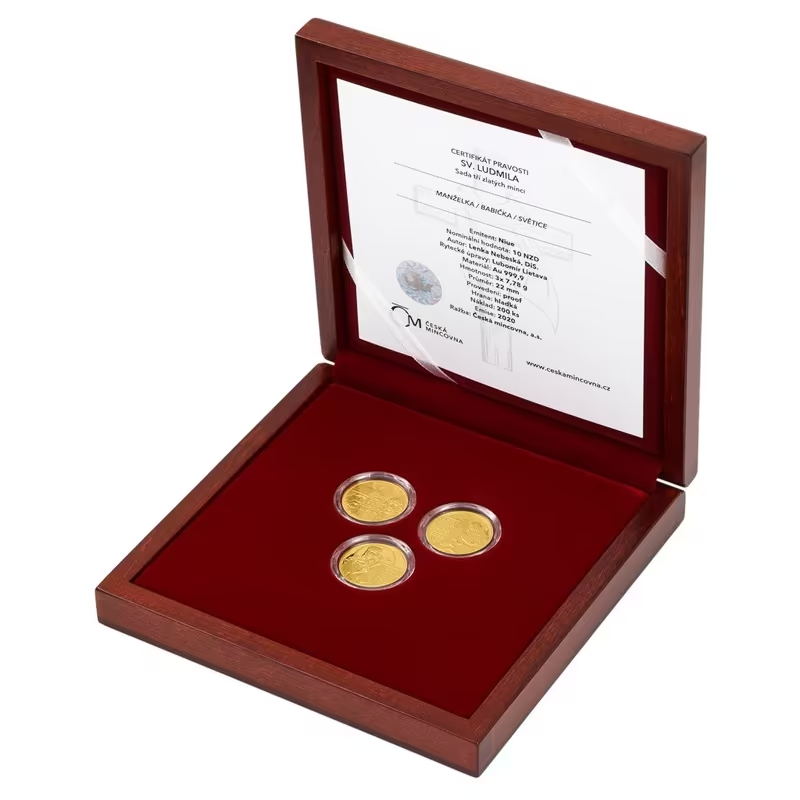
Sada mincí 2020 - Sv. Ludmila
Česká republika (1993 - ) Sada tří mincí 2020 (Lenka Nebeská) - Svatá Ludmila 3x Au 0,9999, 22 mm (7,78 g), náklad 200 ks, certifikát, etue, papírový přebal, PROOF Po svatém Janu Nepomuckém vzdává trojice zlatých mincí České mincovny hold dalšímu…