
German East Africa
German East Africa (Deutsch-Ostafrika) was a German colony from 1885 to 1918 on the territory of present-day Tanzania, Rwanda and Burundi, administered from Dar es Salaam. It was the largest and economically most important German colony.
History
It was founded by Carl Peters' German East Africa Company and administered by the Reich from 1891. In the First World War General Lettow-Vorbeck defended it until November 1918; afterwards Tanganyika passed to Britain and Ruanda-Urundi to Belgium as mandates.
Currency and coins
The currency was the rupie (1 rupie = 64 pesa until 1904, then = 100 heller), tied to the Indian rupee. Silver 1 rupie (11.66 g, .917), ½ and ¼ rupie and 2 rupien (1893–1894 only) bear the portrait of Wilhelm II and were struck in Berlin (A), Hamburg (J) and Munich (D); bronze and copper-nickel heller 1904–1916. Most famous are the emergency issues of Tabora 1916: the gold 15 rupien (7.17 g, .750 from local gold) and copper 5 and 20 heller made from cartridge metal.
In our auction and shop
- Code: BNEVA910G.2
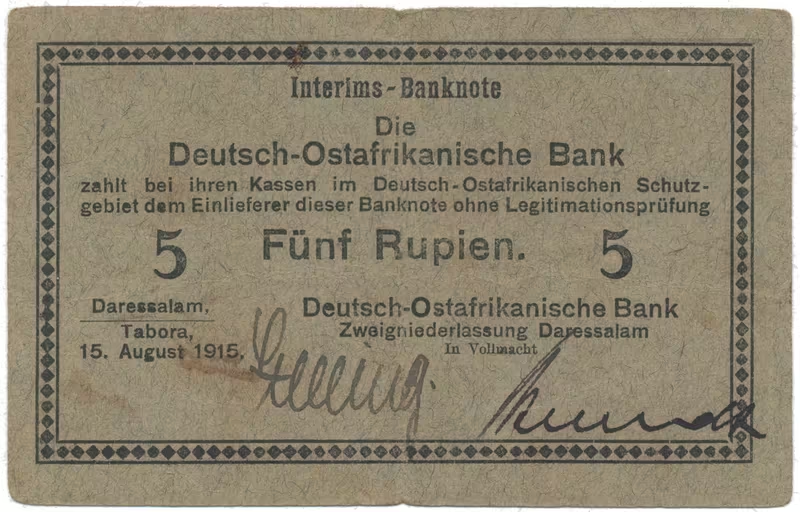
Německá Východní Afrika, 5 Rupien 15. 8. 1915, série B, R.910g
Německá Východní Afrika / German East Africa 5 Rupien 15. 8. 1915, série B, R.910g, v případě konkrétního čísla je foto pouze ilustrační 2-/F
Skladem 1 ks - Code: BNEVA910G.23
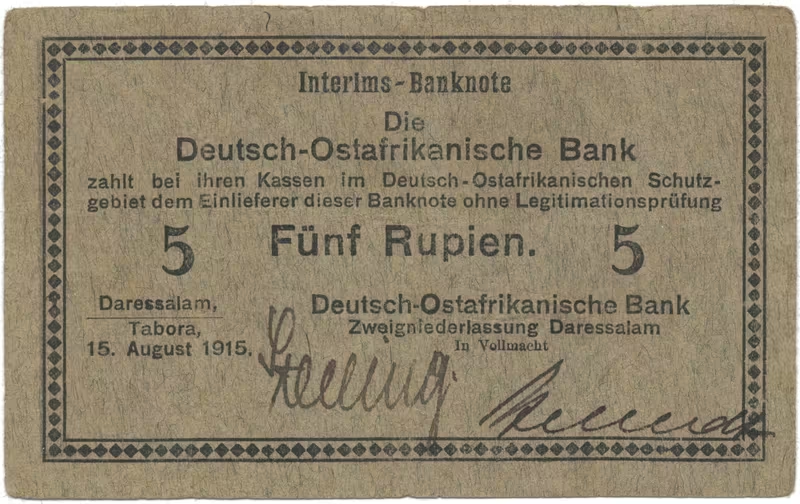
Německá Východní Afrika, 5 Rupien 15. 8. 1915, série B, R.910g
Německá Východní Afrika / German East Africa 5 Rupien 15. 8. 1915, série B, R.910g, v případě konkrétního čísla je foto pouze ilustrační 2-3/F-VG
Skladem 1 ks - Code: BNEVA910H.3
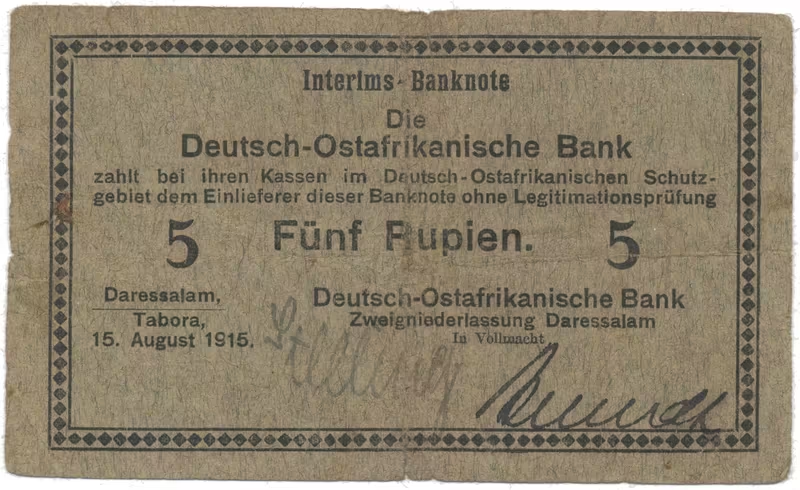
Německá Východní Afrika, 5 Rupien 15. 8. 1915, série B, R.910h
Německá Východní Afrika / German East Africa 5 Rupien 15. 8. 1915, série B, R.910h, v případě konkrétního čísla je foto pouze ilustrační 3/VG
Skladem 1 ks - Code: BNEVA910H.34
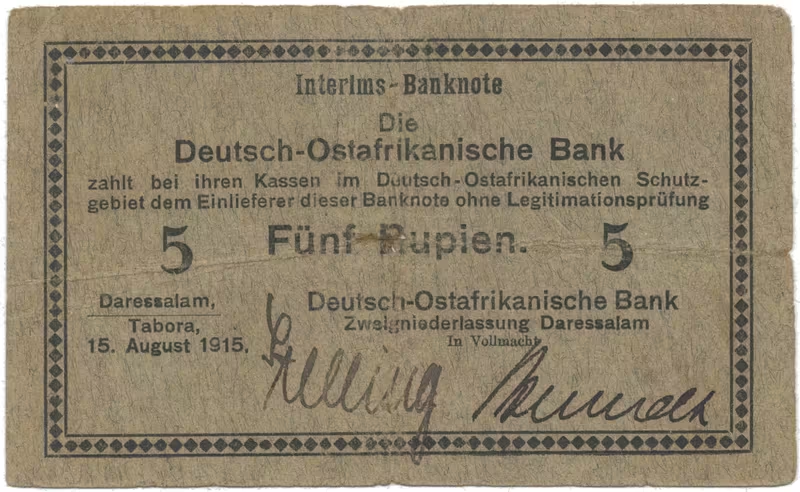
Německá Východní Afrika, 5 Rupien 15. 8. 1915, série B, R.910h
Německá Východní Afrika / German East Africa 5 Rupien 15. 8. 1915, série B, R.910h, v případě konkrétního čísla je foto pouze ilustrační 3-/VG-
Skladem 1 ks
Further in the encyclopaedia
More entries in the category zeme. Continue browsing or return to the full encyclopaedia.