Philip the Younger
Marcus Iulius Severus Philippus II (Philippus / Philip the Younger) (237–249) was a junior Roman emperor ruling together with his father Philip I the Arab in 247–249, who became renowned as the youngest co-emperor in Roman history and tragically perished at the age of just 12 during a military revolt against his father. Philip II is significant in numisma…
Philip was born around the year 237 as the son of Philip I the Arab and Marcia Otacilia Severa in the Arabian region of present-day Jordan. He grew up during his father's rise from an ordinary military officer to praetorian prefect and finally Roman emperor. His origin among the Arab tribes made him the first non-Roman prince in an imperial dynasty.
His elevation to caesar in 244 at the age of only seven followed immediately upon his father's accession to the imperial throne. Philip I sought to secure dynastic continuity and to legitimise his power through the traditional Roman model of adoptive succession. Young Philip received the title "princeps iuventutis" (leader of the youth).
His education proceeded under the supervision of the best teachers and advisers of the imperial court. Although very young, Philip II learnt the basics of statecraft, military affairs and Roman culture. His Arab origin exposed him to criticism from conservative Roman circles, who questioned the legitimacy of the "barbarian" dynasty.
His elevation to augustus in 247 at the age of ten made Philip co-emperor with full imperial powers. This unprecedented decision reflected his father's effort to secure stable succession, but also the growing instability of the empire during the third-century crisis, when dynastic legitimacy was fragile.
The celebrations of the millennium of Rome in 248 represented the peak of the Arab dynasty, and Philip II played a significant ceremonial role at these pompous festivities. The eleven-year-old augustus took part in the games, processions and religious rituals which were meant to demonstrate the strength and continuity of Roman civilisation.
History
Germanic invasions on the Rhine and Danube required military intervention, and Philip I had to leave Rome for campaigns on the frontiers. Young Philip II remained in the capital under the supervision of the senate and the praetorian guard, but his youth made him a symbolic figure without real political power.
The revolt of Decius in 249 represented an existential threat to the Arab dynasty. Gaius Messius Quintus Decius gained the support of the Pannonian legions and marched on Rome with claims to the imperial title. Philip I led the army against the usurper, while his son remained as a hostage of stability in Rome.
The battle of Verona in September 249 ended with the death of Philip I and the collapse of the Arab dynasty. The praetorian guard immediately joined the victorious Decius, and the twelve-year-old Philip II was murdered the same day in the imperial palace. Some sources state that he was killed together with his mother Marcia Otacilia.
Damnatio memoriae followed immediately after Decius's victory. The portraits of the Philips were destroyed, their names erased from inscriptions and their supporters persecuted. The brief reign of the Arab dynasty became merely an episode in the chaotic third century, but Philip II remained in history as a symbol of the tragedy of child emperors.
The coins of Philip II document his brief five-year career from caesar to augustus and represent unique numismatic records of the youngest co-emperor in Roman history. The portraits show his development from a boy to a young adolescent, with an emphasis on imperial dignity despite his youthful age.
Philip II in numismatics
Characteristic motifs of the caesarian period are PRINCIPI IVVENT (to the leader of the youth) and allegories of youthful virtues. Antoniniani and aurei show Philip with the radiate crown typical of the third century and inscriptions M IVL PHILIPPVS CAES emphasising his position as the dynasty's designated heir.
The augustan coins (247–249) bear full imperial titles — IMP M IVL PHILIPPVS AVG — and symbols of joint rule with his father. The design often includes military and peaceful allegories emphasising the stability of the two augusti. Quality remains high despite the general crisis of Roman coinage during the third century.
Rare are the commemorative issues for the millennium of Rome in 248, on which Philip II appears as co-emperor celebrating the eternity of Roman civilisation. These coins often bear the motifs ROMA AETERNA or SAECVLARES AVGG celebrating dynastic continuity. After his death his coins were systematically destroyed during the damnatio memoriae.
In our auction and shop
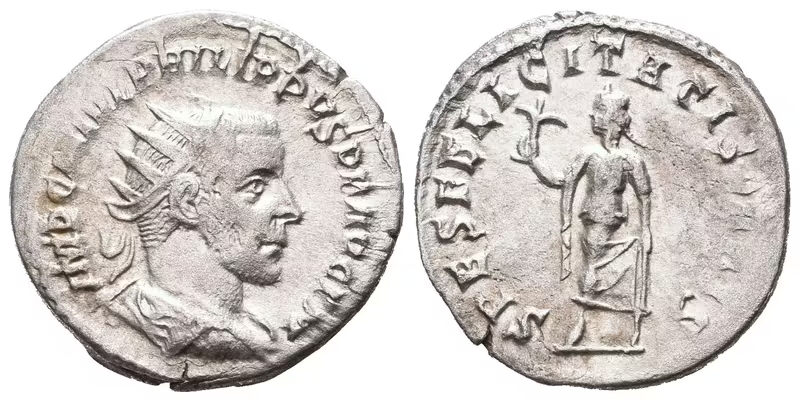
- Code: BE074-0070
Philippus I., Antoninian, RIC.70
Philip I. Arab (244 - 249) Antoninian, 244 - 248, Antiochia, Rv: SPES FELICITATIS ORBIS , Spes kráčející vlevo, drží květinu a přidržuje si šaty, RIC.70, RSC.221 Velmi pěkná zachovalost, patina, zbytky lesku, lehce ned. a vady střížku (3,85 g)
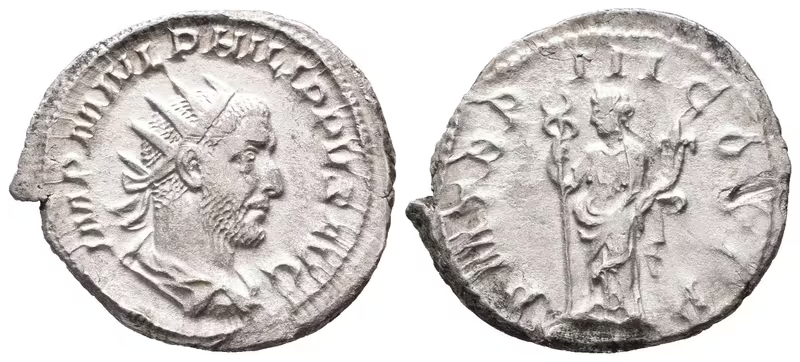
Skladem 1 ks - Code: BE074-0003
Philippus I., Antoninian, RIC.3
Philip I. Arab (244 - 249) Antoninian, 246, Roma, Rv: P M TR P III COS P P , Felicitas stojící zleva drží caduceus a roh hojnosti , RIC.3, RSC.124 pěkný Av. se zbytky lesku, pěkně vyražený portrét, patina, zbytky lesku, ned. Rv., vady střížku (3,78 g)
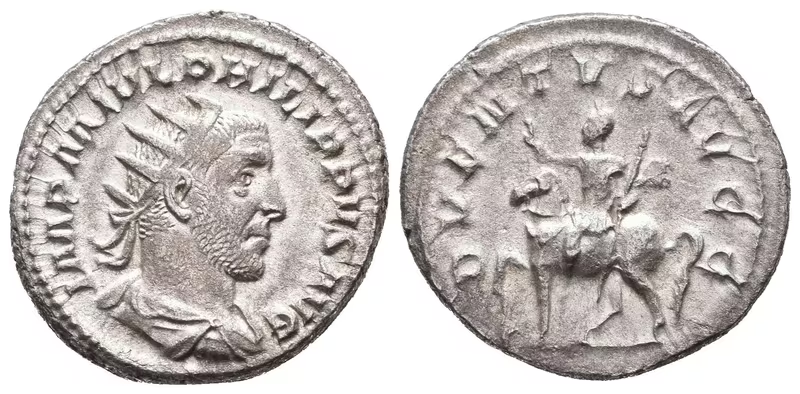
Skladem 1 ks - Code: BE074-0026B
Philippus I., Antoninian, RIC.26b
Philip I. Arab (244 - 249) Antoninian, 244 - 247, Roma, Rv: ADVENTVS AVGG , Philip na klusajícím koni vlevo, drží žezlo a pozvedá pravou ruku, RIC.26b, RSC.3 pěkná zachovalost, krásný Av., pěkně vyražený portrét, patina, zbytky lesku, lehce ned. Rv.…
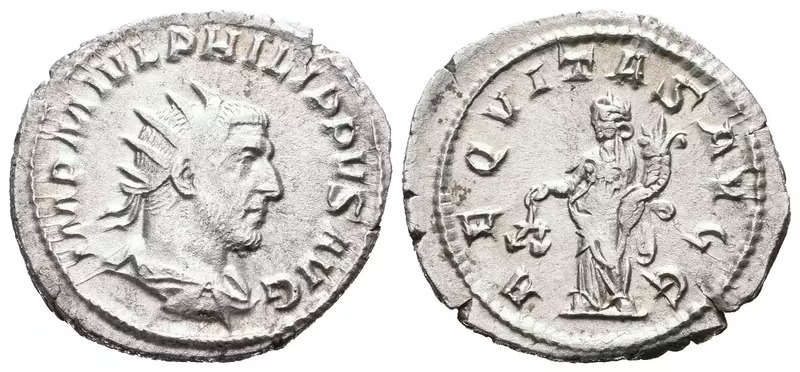
Skladem 1 ks - Code: BE074-0027
Philippus I., Antoninian, RIC. 27
Philip I. Arab (244 - 249) Antoninian, 244 - 247, Roma, Rv: AEQVITAS AVGG, stojící Aequitas zleva drží váhy a roh hojnosti, RIC.27, RSC.9 velmi pěkná zachovalost, pěkně vyražený, vady střížku (3,17 g)
Skladem 1 ks