Philip I the Arab
Philip I the Arab was Roman emperor between 244 and 249, originating from the Roman province of Arabia Petraea. His reign falls within the turbulent 3rd century and is associated above all with the celebrations of the thousandth anniversary of Rome in 248.
Philip I (Marcus Iulius Philippus), nicknamed "the Arab" because of his Syrian-Arab origins, established himself in the army and state administration during a period when the Roman Empire faced frequent coups. He came to the imperial throne in 244 after the death of Emperor Gordian III during the eastern campaign. He subsequently concluded peace with Sasanian Persia in order to consolidate the situation within the empire and stabilise rule at a time when both the frontiers and internal order were under pressure.
In domestic policy, Philip sought to strengthen legitimacy and dynastic continuity. He elevated his son, Philip II, to co-ruling status and presented his family as a guarantee of stability. Even so, his reign played out against a backdrop of mounting problems: rebellions and usurpations broke out in the provinces, security at the frontiers worsened, and the state had to address the financing of the army and provisioning. The 240s of the 3rd century belong to the periods when the Roman system relied ever more on rapid military responses and ever less on a stable long-term political environment.
The most striking event of Philip's reign was the celebration of the thousandth anniversary of the founding of Rome in 248. It was an extraordinary act of propaganda and ritual, intended to reinforce the image of the Eternal City and at the same time to legitimise the emperor as guardian of Roman order. The celebrations included games and festivities at which Roman power and tradition were presented as an unbroken line from the mythical beginnings to the present. Thanks to this event, Philip I is often more prominently remembered in history than the length of his reign would suggest.
History
In 249 Decius rose against Philip; originally dispatched to deal with the situation in the Danube region, he was ultimately proclaimed emperor. The conflict culminated in the battle of Verona, where Philip I fell. Shortly afterwards his son Philip II also died, ending the dynasty. Philip's reign thus fits the typical picture of the 3rd century: rapid succession of emperors, military coups, and attempts to maintain legitimacy through propaganda, dynasty, and public festivities.
Philip I belongs to the emperors from whom a great quantity of coins survives, reflecting both the need to finance the state and intensive propaganda. Silver antoniniani (often with a silvery surface), bronze denominations, and gold coins were struck. Typical of his time is that "silver" coins contained a lower precious-metal content than in earlier centuries, because the monetary system of the 3rd century was undergoing debasement and the state was seeking ways to keep coinage in circulation.
Numismatically the most interesting are the commemorative issues for the year 248. The reverses bear inscriptions and motifs celebrating the anniversary of Rome and its tradition, often with personifications and symbols meant to emphasise the eternity of the city and the prosperity of the empire. Alongside these, the coins of Philip I display the usual propaganda themes: PAX (peace), VICTORIA (victory), FELICITAS (prosperity), or AEQVITAS (just scales and order). These motifs reflect the effort to convince the public that stability and legitimate rule existed even in turbulent times.
Coins of Philip I the Arab and their numismatic significance
In identifying the coins of Philip I it is important to study the titulature, portrait, and mintmarks, since issues were produced at various mints across the empire and many reverse-type variants exist. With antoniniani, moreover, it is common for differences in style and quality of strike to be considerable. Philip I the Arab thus represents an emperor whose coins are a rich source for studying the propaganda of the late Principate and at the same time show the transformations of the Roman monetary system in the period before the stricter reforms of late antiquity took hold.
In our auction and shop
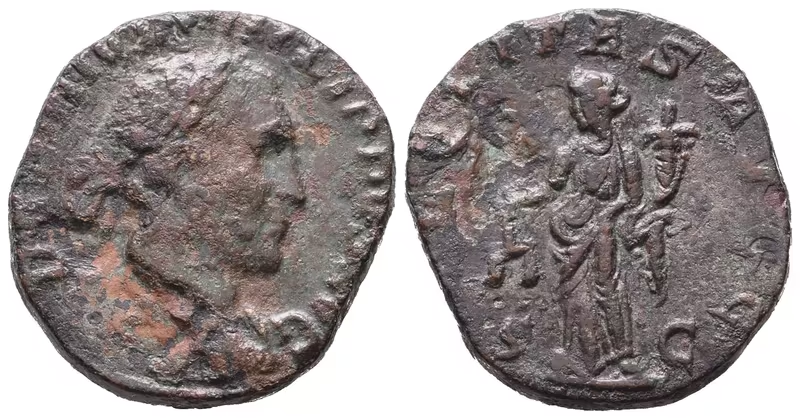
- Code: BE074-0166.2
Filip I. Arab, sestercius, Řím, RIC 166a
Filip I. Arab (244 - 249) mincovna Řím, stojící Aquitas s váhami a rohem hojnosti, RIC 166a
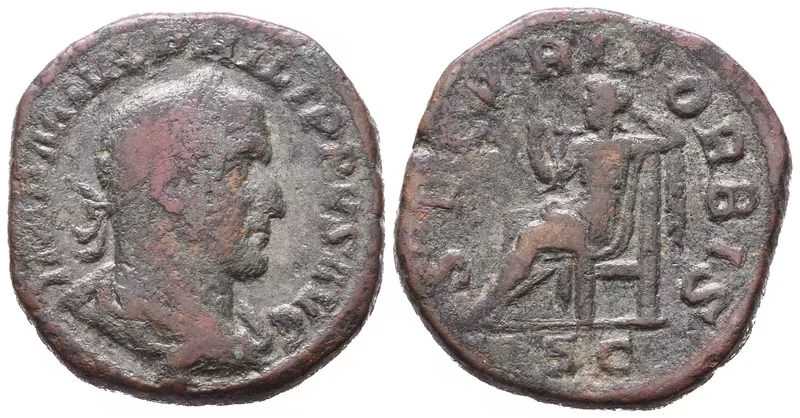
Skladem 1 ks - Code: BE074-0190
Filip I. Arab, sestercius, Řím, RIC 190
Filip I. Arab (244 - 249) mincovna Řím, sedící Securitas držící obřadní hůl, SECVRIT ORBIS, RIC 190
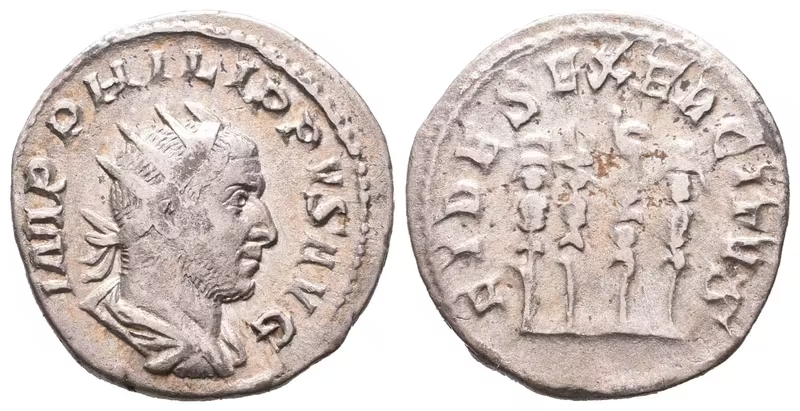
Skladem 1 ks - Code: BE074-0062
Filip I. Arab, antoninián, Řím, RIC IV 62
Filip I. Arab (244 - 249) mincovna Řím, čtyři vojenské standarty, FIDES EXERCITVS, RIC IV 62
Skladem 1 ks - Code: BE074-0070
Philippus I., Antoninian, RIC.70
Philip I. Arab (244 - 249) Antoninian, 244 - 248, Antiochia, Rv: SPES FELICITATIS ORBIS , Spes kráčející vlevo, drží květinu a přidržuje si šaty, RIC.70, RSC.221 Velmi pěkná zachovalost, patina, zbytky lesku, lehce ned. a vady střížku (3,85 g)
Skladem 1 ks