Gordian III
Gordian III (reigned 238–244) was a Roman emperor during the period of the deep crisis of the 3rd century. He came to the throne as an adolescent member of the Gordian family, and his reign is associated above all with the attempt to stabilise the Empire, with the war against the Sasanians, and with an exceptionally rich coin production.
Gordian III (in Latin Marcus Antonius Gordianus) ascended the imperial throne in 238, in a year which history designates as the "Year of the Six Emperors". The Roman Empire at that time experienced a rapid succession of rulers, civil unrest, and pressure on the frontiers. After the fall of the hated emperor Maximinus Thrax, room opened up in the political chaos for a compromise solution. Gordian, grandson of the famous but briefly reigning Gordian I, was acceptable both for the Senate and for part of the army precisely because he was very young and could act as a "unifying symbol", while the actual running of the state was to lie in the hands of experienced administrators.
Because the emperor was a minor, the government rested on the Senate and on a circle of court and military officials. A key role was played by the Praetorian prefect Timesitheus, who became the main organiser of state policy and at the same time the emperor's father-in-law. Under his leadership the Empire sought to return to a certain measure of stability: legitimacy was emphasised, the situation in Rome was calmed, and the defence of the frontiers was strengthened. Even at this time, however, the problem was structural — the Empire faced simultaneously external attacks, economic pressures, and the rapid debasement of the currency, which was typical of the Crisis of the 3rd Century.
The greatest military challenge of Gordian's reign was the war in the East against Sasanian Persia. The Sasanians represented for Rome a new, energetic rival, capable of threatening the key provinces of Mesopotamia and Syria. Gordian III set out for the East at the head of a large expedition; the actual command and logistics, however, were provided by experienced commanders and officials. At first the Roman side had successes, which strengthened the emperor's prestige and were also used in propaganda. The situation changed after the death of Timesitheus, when a new Praetorian prefect, Philip the Arab, asserted himself at court.
History
The end of Gordian's reign is linked precisely with the eastern campaign of 244. The emperor died suddenly during the campaign, and the circumstances are not entirely clear: the sources diverge on whether it was a matter of death in battle, an accident, or an internal coup in the army. What is certain is that after his death power was taken over by Philip the Arab, which in itself indicates sharp power tensions in the imperial camp. Gordian III thus remains one of the typical figures of the crisis epoch: a young emperor with the potential of a "new beginning", whose reign was determined by strong courtiers, war on the frontiers, and an uncertainty which was able, within a short time, to break even a relatively stable-seeming regime.
Gordian III belongs among the emperors whose coins have been preserved in very large numbers. The reason is practical: the Empire needed money for pay, supplies, and administration, and so during his years there was intensive minting, especially in silver and bronze denominations. A typical means of payment is the antoninianus, which in the 3rd century was the main "working" denomination of circulation; alongside it denarii and bronze strikes (for example sestertii or asses) also occur, depending on the place and period of issue. In the provincial environment local bronze coins with Greek legends also arose.
The iconography on the coins uses the emperor's youth as an asset: the portraits often emphasise youthful features and the gradual transformation of the "boy" into a ruler. On the reverses appear motifs of security and prosperity (SECVRITAS, FELICITAS), religious and moral legitimacy (PIETAS), as well as military strength and victory (VIRTVS, VICTORIA). For collectors the variety of types is also attractive: the same legends may have several variants according to mint, dies, and small details in the image.
Coins, iconography, and collectors' significance
Numismatically Gordian's coinage is also valuable as a "mirror of the crisis": high production, variable quality of flans, and the gradual debasement of the currency belong among the marks of the time. At the same time, even ordinary coins can have high evidential value — for example, in the study of mint marks, the development of the portrait, or propaganda themes connected with the eastern war. For this reason Gordian III is a frequent choice for collections of 3rd-century emperors: his coins are relatively accessible, but they offer a broad field for specialisation in types, mints, and iconography.
In our auction and shop
- Code: BE072-0119
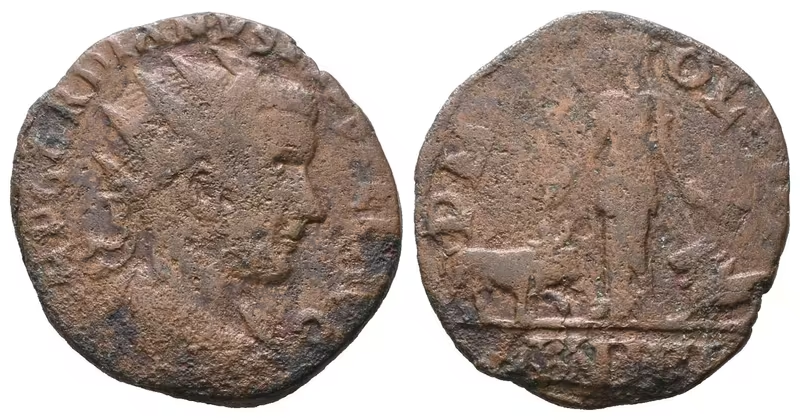
Gordian III., provinciální AE, Viminacum, Varbanov 119
Gordian III. (238 - 244) mincovna Viminacum, Moesia Superior, raženo 242 - 243, stojící Moesia se lvem a býkem, Varbanov 119
Skladem 1 ks - Code: BE072-0271.1
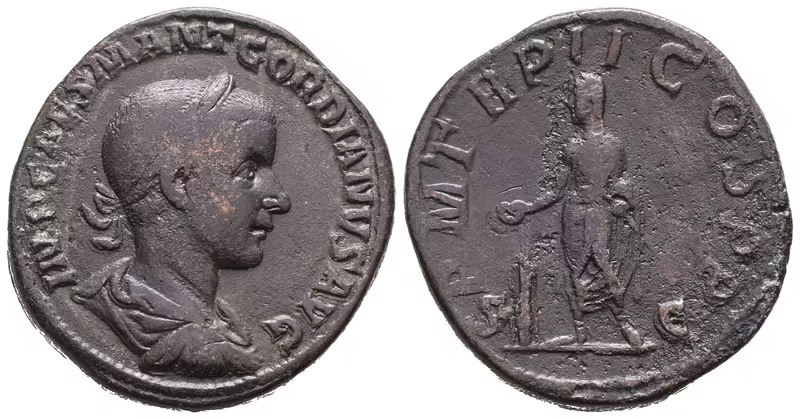
Gordian III., sestercius, Řím, RIC 271
Gordian III. (238 - 244) mincovna Řím, stojící císař obětuje u oltáře, RIC 271
Skladem 1 ks - Code: BE072-1130
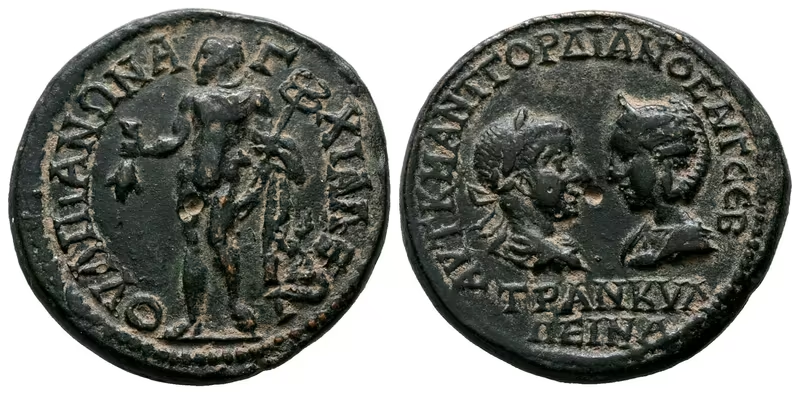
Gordian III. a Tranquillina, provinciální AE, RPC 1130
Gordian III. a Tranquillina (238 - 244) Thrákie, raženo 241 - 244, stojící Apollón, RPC 1130
Skladem 1 ks - Code: BE072-3402
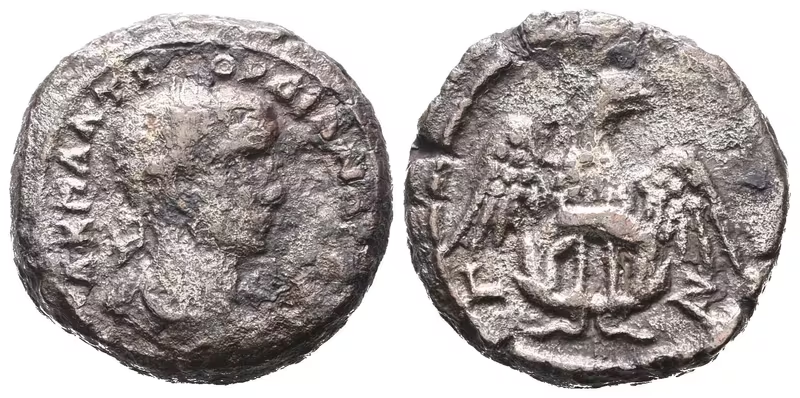
Gordian III., tetradrachma, Alexandrie, Emmett 3402.7
Gordian III. (238 - 244) mincovna Alexandria, Egypt, orel s roztaženými křídly, Emmett 3402.7
Skladem 1 ks