Politics
In numismatics, politics represents a key factor influencing the form of coins, banknotes and medals, which have always reflected the balance of power, state ideology and historical events. Coins and banknotes served as instruments of political propaganda and the legitimisation of power.
The relationship between politics and the striking of coins has existed since the very origin of coinage in the 7th century BC in Lydia. Even the first coins bore symbols of the ruling power and became an instrument for the demonstration of sovereignty. In ancient Greece the city-states depicted on their coins protective deities and symbols which expressed their political independence. The Athenian tetradrachm with Athena and the owl symbolised the power and prosperity of Athenian democracy, while the Macedonian coins of Alexander the Great spread his political influence across the conquered territory.
Roman coinage brought political propaganda to perfection. Emperors used coins to spread political messages to the most distant corners of the empire. On the reverses appeared inscriptions such as Pax Romana or Victoria Augusta, which proclaimed political successes. The portrait of the ruler on the obverse legitimised his rule and ensured that every inhabitant of the empire knew the face of his sovereign. A change of government meant the immediate change of coin images, as the cases of damnatio memoriae document, when the coins of unpopular emperors were overstruck.
In the Middle Ages the political function of coins deepened still further. The Czech denarii of Boleslav I or Wenceslas II bore Christian symbols as an expression of the political orientation of the Czech state. The Prague groschen of Wenceslas II from 1300 represented not only a monetary reform but above all a political act of unification of the Czech kingdom under strong royal power. The inscription Wenceslaus Secundus Dei Gratia Rex Boemie emphasised the divine consecration of royal power.
History
The modern period brought the use of coins and medals as chronicles of political events. The Peace of Westphalia of 1648 was celebrated by dozens of commemorative strikes; the Battle of White Mountain had its propaganda coins from both sides of the conflict. Maria Theresa struck thalers with the inscription Iustitia et Clementia as an expression of her political philosophy. Revolutionary France replaced the royal lilies with the symbolism of the republic; the American states created the dollar as a symbol of political independence from Britain.
The twentieth century showed the extreme politicisation of numismatics. Totalitarian regimes used coins and banknotes for mass propaganda. Nazi Germany, the Soviet Union and communist Czechoslovakia all changed coin images according to the current political line. After 1989 the political changes in Central Europe meant a complete replacement of monetary systems as a symbol of separation from the communist past.
The political message on numismatic material manifests itself in several ways. Portraits of rulers legitimise their power and ensure widespread familiarity with their likeness. State coats of arms and symbols express sovereignty and territorial claims. Allegorical figures such as Liberty, Justice or Victory represent political ideals. Inscriptions and mottoes spread political propaganda, whether it be E Pluribus Unum on American coins or Workers of all countries, unite on Soviet roubles.
Political symbolism on coins and medals
The choice of metals for striking also has a political dimension. Gold and silver coins demonstrated the economic strength of the state, while the transition to less valuable metals often signalled a political or economic crisis. The devaluation of the currency was a frequent instrument for financing wars and the political ambitions of rulers. The coinage prerogative represented an important political instrument of control over the economy and a source of revenue for the state treasury.
Commemorative coins and medals serve as commemorative instruments of the politics of memory. Anniversaries of battles, the birth of rulers, state holidays or political agreements are common subjects of these strikes. Their issue is often strictly regulated by the state and subject to political approval.
In our auction and shop
- Code: ZD-2016ZERO
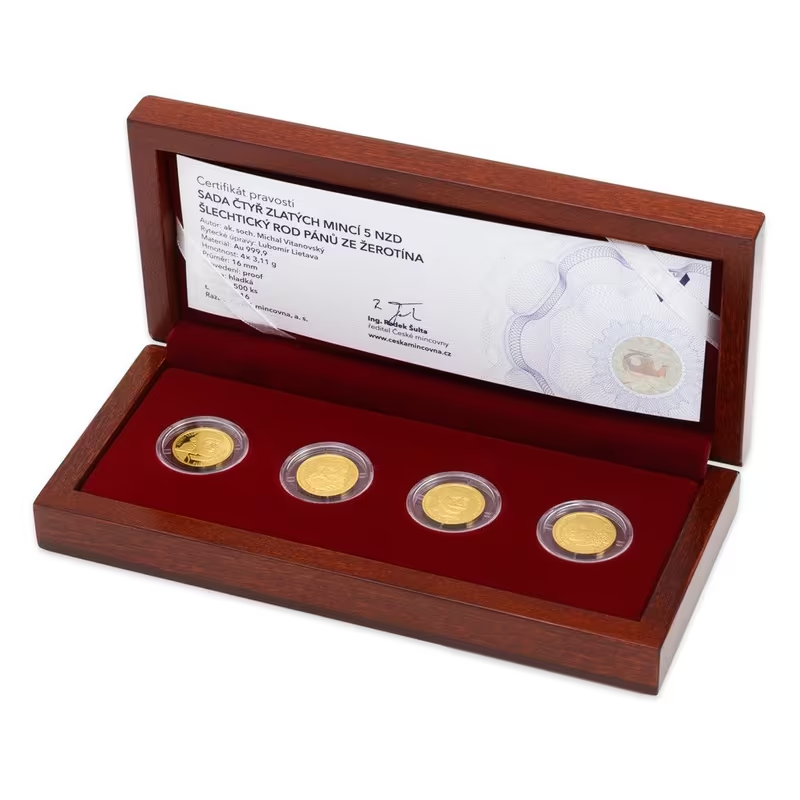
Sada mincí 2016 - Šlechtický rod pánů ze Žerotína
Česká republika (1993 - ) Sada čtyř mincí 2016 (Michal Vitanovský) - Šlechtický rod pánů ze Žerotína 4x Au 0,9999, 16 mm (3,11 g), náklad 500 ks, certifikát, etue, papírový přebal, PROOF Vyhledávanou sběratelskou sérii Šlechtické rody od České mincovny…
Skladem 1 ks - Code: BCSR010A.233
Československo, 20 Koruna 1919, série P 082, tisk Národní Politika Praha, Hej.10a
Československo, 1919 - 1938 20 Koruna 1919, série P 082, tisk Národní Politika Praha, Hej.10a, nevýrazné graffiti na Rv. 2-3/F-VG
- Code: RX-ITA2001EV
Itálie - Ennio Visconti
Itálie, republika (1946 - ) AR Medaile 2001 (Rallo) - K 350. výročí narození politika Ennia Quirono Visconti, krásná zachovalost, patinováno Ag 0,986, 50 mm (52,38 g), puncováno a značeno
- Code: RAOPP-MSRO