Franco-Prussian War
The Franco-Prussian War was a conflict between France and Prussia and its allies in 1870-1871, which ended in a crushing defeat of France. The war led to the creation of the German Empire, the loss of Alsace and Lorraine and significantly altered the political balance in Europe.
The Franco-Prussian War broke out in the summer of 1870 against a backdrop of long-standing tension between France and Prussia, which under the leadership of Otto von Bismarck had become the main driver of German unification. The French emperor Napoleon III perceived the growing Prussian influence as a threat and feared that a united Germany would fundamentally weaken France's position in Europe. The immediate pretext was the diplomatic crisis surrounding the Hohenzollern candidacy for the Spanish throne and the subsequent escalation of communication between the two states, which in Paris created the impression of public humiliation. On 19 July 1870, France finally declared war on Prussia, but other German states gradually joined the conflict, swiftly turning the clash into a war of France against a broader German coalition.
The military course of events was unfavourable for France from the first weeks. Prussia and its allies had the advantage in mobilisation, logistics and command and were able to concentrate forces quickly. The French army, by contrast, suffered from disorder in command and supply problems. A series of defeats culminated on 1 September 1870 in the Battle of Sedan, where Napoleon III was surrounded and capitulated. This event had decisive political consequences: in France the Empire fell and the Republic was proclaimed, while in Germany the willingness to complete unification under the Prussian crown grew. The war did not end immediately, however, the siege of Paris and fighting in other regions continued, while the new French government tried to keep up resistance and at the same time negotiate an acceptable peace.
In January 1871, German unification reached its symbolic climax: in the Hall of Mirrors at Versailles the Prussian king William I was proclaimed German Emperor. For France this was a profound humiliation, since the act took place on its territory and in a space associated with the prestige of the French monarchy. The subsequent armistice and peace negotiations resulted in conditions that hit France hard. The peace settlement included the cession of Alsace and part of Lorraine, as well as a high war indemnity. It was precisely the combination of territorial loss and financial burden that left in France a long-lasting sense of grievance and gave rise to a strong revanchism that influenced European relations for several further generations.
History
The internal impacts of the war on France were dramatic. In the period immediately after defeat, amid an atmosphere of exhaustion, economic difficulties and political uncertainty, a revolutionary episode known as the Paris Commune broke out in the capital. Although this was an event with its own social and political background, the war and the siege of the city were among its main catalysts. In Germany, by contrast, victory strengthened the authority of the Prussian state and gave unification a firm framework, which soon manifested itself in the economy, infrastructure and administration.
The Franco-Prussian War thus belongs among the most important turning points of the 19th century. It redrew the map of Europe, created a new power pole in the form of a united Germany and at the same time sowed the seeds of future rivalry between France and Germany. Its legacy was reflected in diplomacy, military reforms and the public memory of both societies, including symbols, memorials and everyday objects, among which coins and medals also have their place.
The relationship of the Franco-Prussian War to numismatics is most evident through money and state finances. The war indemnity that France paid the victor represented a massive transfer of capital and precious metals and bolstered the German economy in the period after unification. It is precisely this financial injection that is often associated with the faster building of the new German state and with its monetary consolidation. In Germany, following unification, a more unified monetary system was established and strikes appeared that already belong to the framework of the German Empire, for collectors these are attractive above all because they show the transition from regional types (for example thaler types) to a new, all-German symbolism and titulature.
War finances, coins and collector context
In France, the period of the war and immediately after it left its mark on circulation coins rather indirectly, but tangibly: the state was addressing financing and public confidence, while everyday circulation required stable small denominations. Collectors often seek out years and types associated with the fall of the Empire and the advent of the Republic, since a change of regime is usually reflected in inscriptions, state symbols and sometimes also in the speed with which older types are withdrawn or replaced. With some issues it can also be interesting to consider where they were struck and in what volume, since wartime often heightens the differences between mints and years.
Alongside coins, commemorative medals and decorations play a major role. In both Germany and France, medals were produced commemorating campaigns, specific battles, sieges or the return of units, often featuring portraits of ruling figures, allegories of victory and pronounced symbolism. For collectors it is important to distinguish official state decorations from private commemorative medals, which could have been produced in large editions and exist in various metal variants. Value is then determined by the combination of preservation, material, maker and also whether the piece can be traced in period catalogues or in auction practice.
When collecting material on the Franco-Prussian War, it is worth thinking thematically: "pre-war" coins of both states, transitional years around 1870-1871, early issues of the newly united Germany, and finally commemorative medals. Such a collection has a strong narrative, since it links a great political event with specific objects of circulation, propaganda and personal memory. At the same time, the usual rule of numismatics applies: with ordinary pieces, preservation and natural surface are decisive; with rarer years and medals, precise attribution, provenance and an expertly documented description.
In our auction and shop
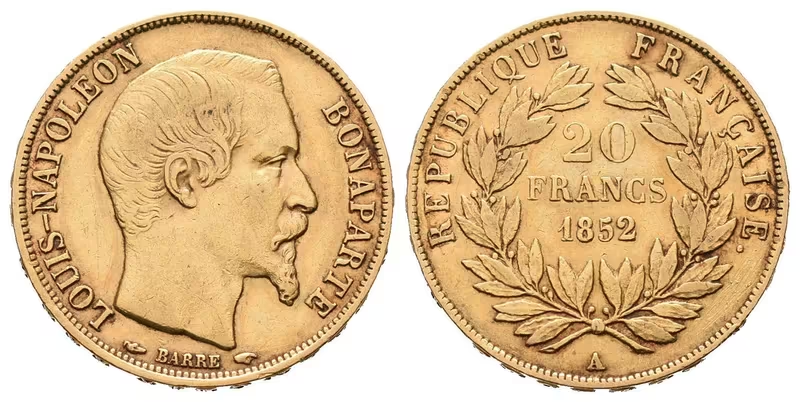
- Code: ZSFRA-89F1852
Francie, 20 Frank 1852 A
Francie, Napoleon III. ( 1852 - 1870) 20 Frank 1852 A - jako president II. republiky, mincovna Paříž Au 0,900, 21 mm (6,4516 g), KM. 774 Charles Louis Napoleon Bonaparte jinak též Napoleon III. (20. dubna 1808 – 9. ledna 1873) byl syn krále Ludvíka…
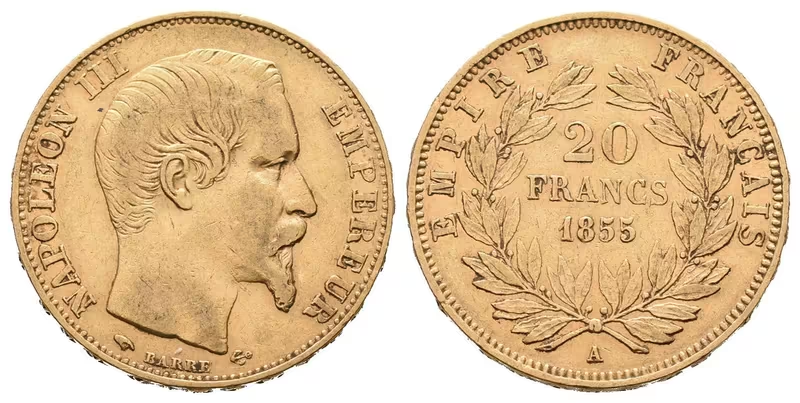
- Code: ZSFRA-89F1855.1
Francie, 20 Frank 1855 A
Francie, Napoleon III. ( 1852 - 1870) 20 Frank 1855 A, mincovna Paříž Au 0,900, 21 mm (6,4516 g), KM. 781.1 Charles Louis Napoleon Bonaparte jinak též Napoleon III. (20. dubna 1808 – 9. ledna 1873) byl syn krále Ludvíka Bonaparta a královny Hortensie de…
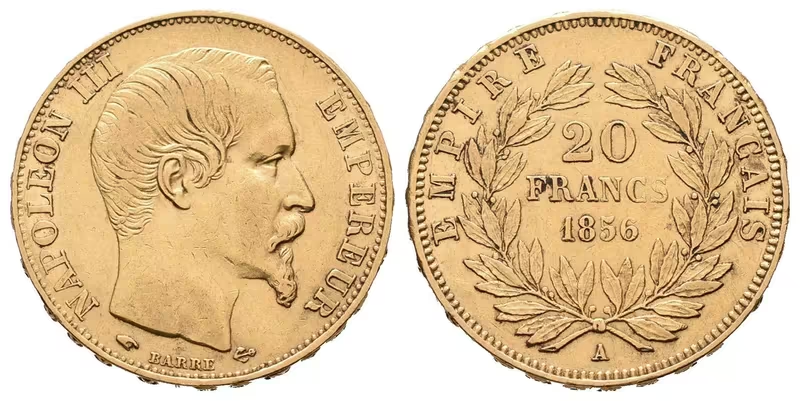
- Code: ZSFRA-89F1856
Francie, 20 Frank 1856 A
Francie, Napoleon III. ( 1852 - 1870) 20 Frank 1856 A, mincovna Paříž Au 0,900, 21 mm (6,4516 g), KM. 781.1 Charles Louis Napoleon Bonaparte jinak též Napoleon III. (20. dubna 1808 – 9. ledna 1873) byl syn krále Ludvíka Bonaparta a královny Hortensie de…
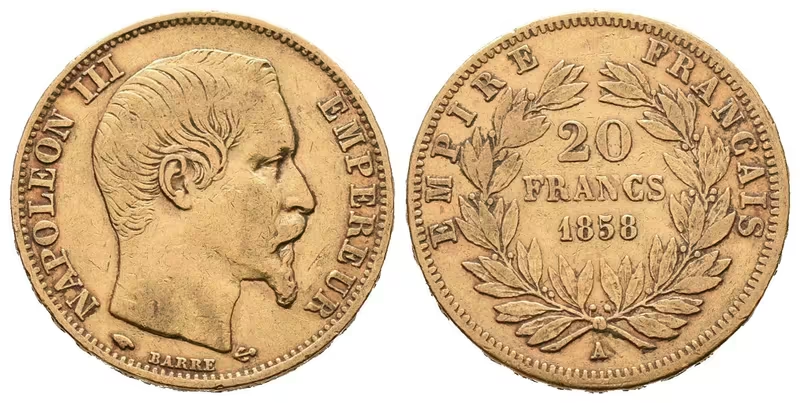
- Code: ZSFRA-89F1858
Francie, 20 Frank 1858 A
Francie, Napoleon III. ( 1852 - 1870) 20 Frank 1858 A, mincovna Paříž Au 0,900, 21 mm (6,4516 g), KM. 781.1 Charles Louis Napoleon Bonaparte jinak též Napoleon III. (20. dubna 1808 – 9. ledna 1873) byl syn krále Ludvíka Bonaparta a královny Hortensie de…