Soles
The soles (Bolivian sol) was the monetary system of independent Bolivia used from 1827 to 1864, when it was replaced by the boliviano. It was a coin-based currency tied to silver and gold, intended for internal circulation and for trade in the Andean region.
The sol appeared shortly after the founding of independent Bolivia (1825), when it was necessary to replace the colonial monetary order and create a separate, state-controlled currency. The new currency was introduced in 1827 and continued the earlier Spanish system in the region, so that the transition would not be too chaotic for trade and tax collection. In practice the sol replaced the older real on a "one for one" basis, which made conversions in everyday payments easier. It is important to note that during this period it was not yet a decimal system: alongside the sol a higher unit of account, the escudo, was also used, one escudo corresponding to sixteen soles.
Bolivia inherited from the colonial era a strong tradition of mining and processing silver, especially in the Potosí region, and the availability of metal had a fundamental influence on the monetary system. Silver coins formed the basis of currency and constituted "hard money", relied upon in state finances and in long-distance trade. At the same time there was a need for higher denominations in gold – not only as a store of value but also as a means for larger transactions and international trade, where gold more easily bridged differences in local monetary customs. The sol thus functioned in an environment where the value of money was perceived above all through the metal, its purity and weight, and where confidence in a coin often depended on the mint's reputation and the steadiness of the standard.
Over the decades, however, it became apparent that a simpler and more comparable monetary system was more advantageous for the modern administration of the state. Moreover, in 19th-century Latin America frequent changes of monetary standards and reforms took place, responding to the development of metal prices, fiscal needs of states and the pressure of trade. In the Bolivian case these efforts culminated in the introduction of the boliviano currency in 1864. The transition was set up so that it could be clearly converted: the new boliviano replaced the sol at a fixed rate of eight soles per one boliviano, which simplified some older accounting relationships and brought the system closer to a more modern conception of currency.
History
The soles is today interesting for numismatics as the "first fully national" currency of Bolivia after independence. The coins often reflect the new state's effort at the symbolism of sovereignty – state arms, inscriptions emphasising the republic and also clearly marked denominations intended to strengthen confidence in the currency. Alongside this, however, the sol also recalls the practical side of the 19th century: the state sought to maintain monetary stability in conditions of a changing economy and in a region where money and metallic values commonly moved across borders.
The soles system rested above all on coins. For circulation, silver denominations in units of soles (typically 1, 2, 4 and 8 soles) were struck, covering ordinary market needs as well as larger payments. Alongside these, gold coins expressed in escudos were also struck, that is in a higher unit corresponding to sixteen soles. Such an arrangement was typical for the period: silver dominated everyday circulation, while gold served rather for larger transactions and for storing value.
In practice a great role was played not only by face value but also by the quality of striking and the uniformity of the standard. With 19th-century metallic currencies, people commonly assessed coins by appearance, wear and sometimes by "experience" of how a given strike was accepted in trade. For collectors today it is important to distinguish years, mints and types (especially by emblems and legends), because even within a single currency, variants may exist that arose through changes of dies, alterations of state symbols or different technical levels of striking.
Coins, values and use in practice
As a historical term, the sol also appears in period accounts and texts in Spanish, where the plural is written soles. In the Czech context the designation "Bolivian sol" is usually used, to distinguish it from other currencies of the same name in Latin America. In a numismatic description it is therefore useful always to state the country, the period and the link with the subsequent reform, since it is precisely these data that precisely determine which "sol" is meant.
In our auction and shop
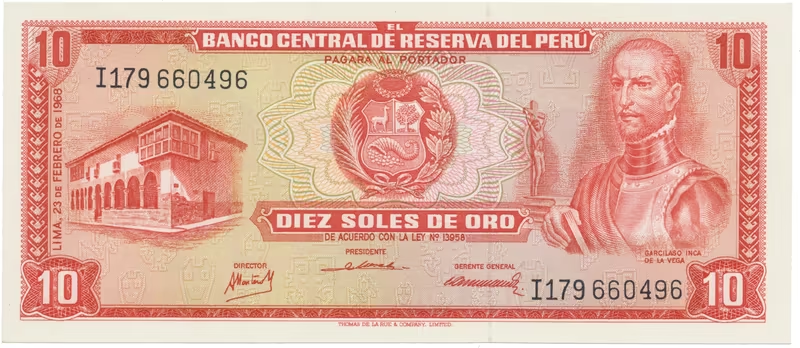
- Code: BPERU093
- Code: BPERU099C
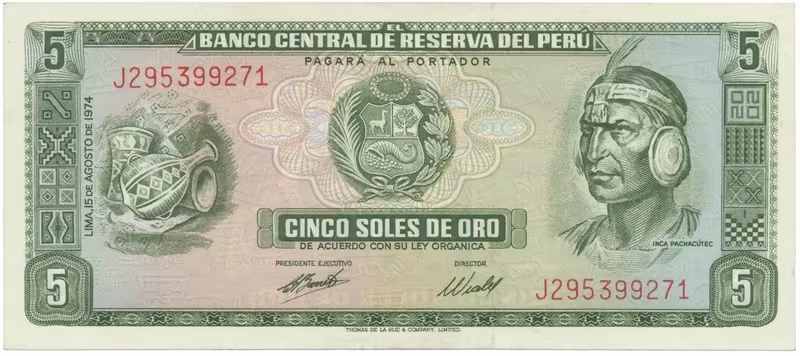
Peru, 5 Soles de Oro 1973~1974, P.99c
Peru / Peru 5 Soles de Oro 1973~1974, P.99c, v případě konkrétního roku vydání je foto pouze ilustrační N/UNC
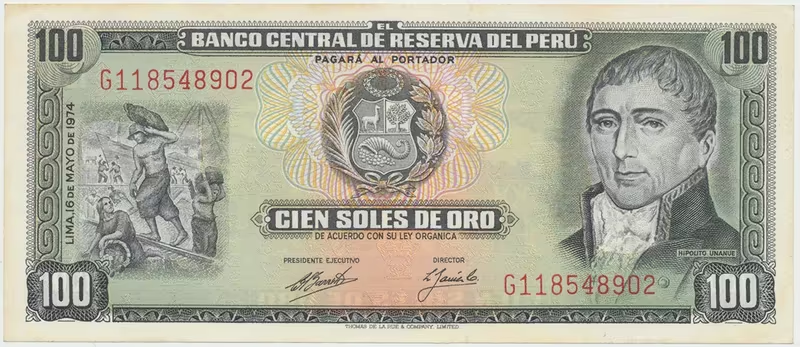
Skladem 3 ks - Code: BPERU102C.0
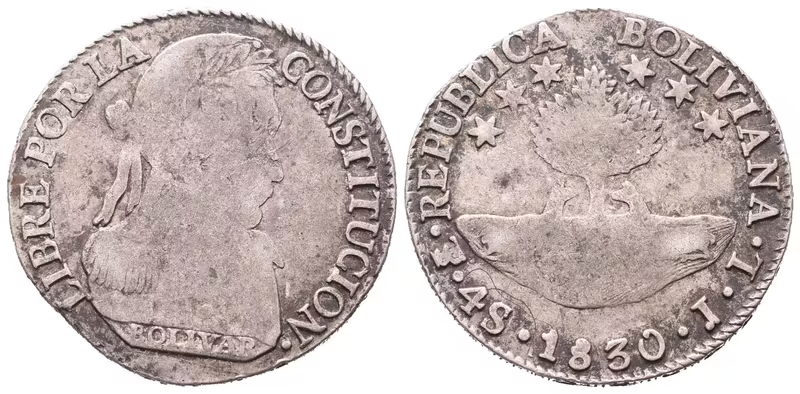
- Code: SBOLI-B1830.1
Bolívie, 4 Sol 1830 JL
Republika, 1825 - 2009 4 Soles 1830 PTS-JL, KM.96a.1, oběhový stav, patina, rysky
Skladem 1 ks